
On this page
Introduction
Bathroom installation cost in the UK has shifted dramatically over the past 18 months, with material prices stabilising after pandemic-era volatility but labour costs continuing their upward march. We're seeing homeowners make smarter, more considered choices about where to spend their renovation budgets—and the trends reflect a fascinating split between high-tech luxury at one end and cost-conscious simplicity at the other. The middle ground? That's shrinking fast.
Key Takeaways
- Budget bathroom installations now start from £3,500–£5,000, mid-range projects cost £7,000–£12,000, whilst luxury renovations easily exceed £15,000–£25,000 in London and the Southeast
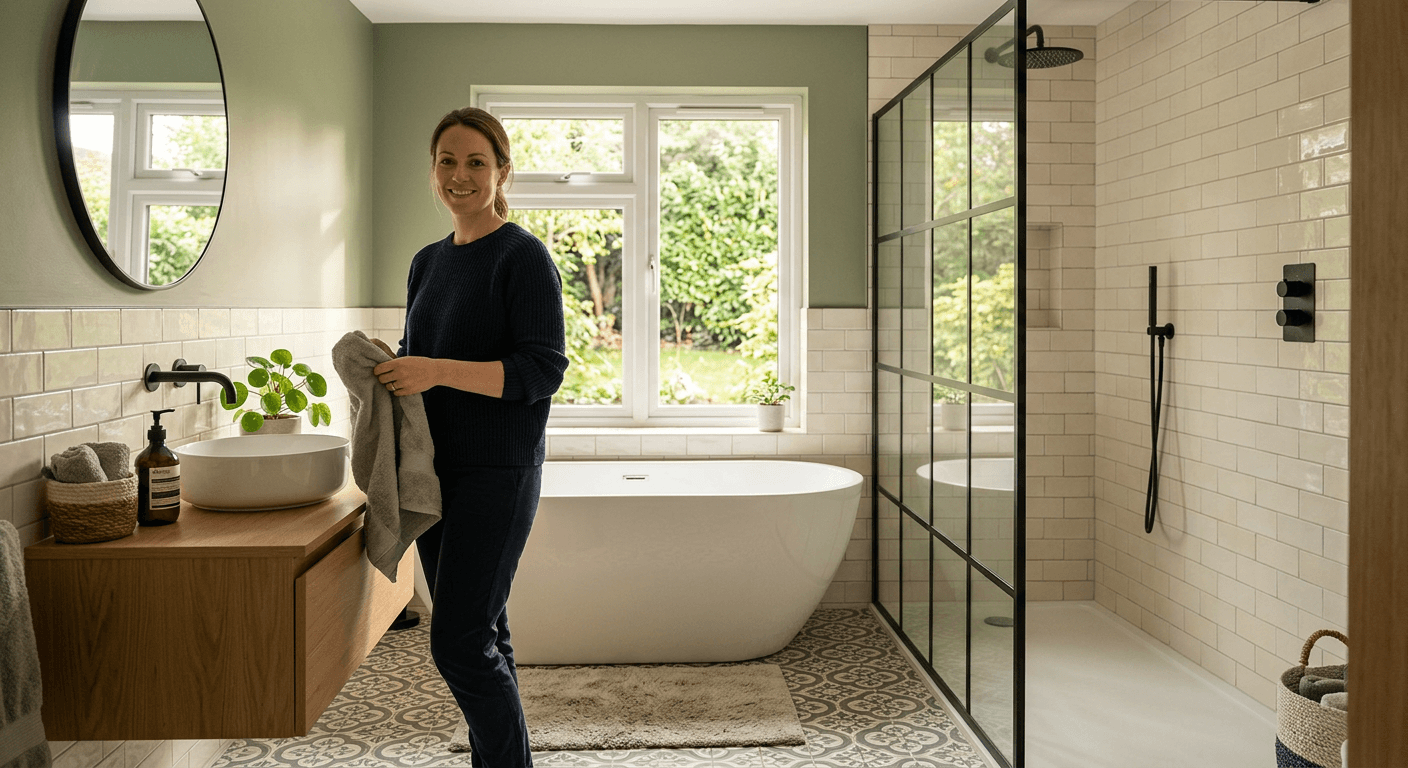
- Wet rooms and walk-in showers dominate new installations, with traditional bath-and-separate-shower layouts declining except in family homes
- Small-format tiles (metro, zellige, terrazzo) remain popular, but larger 600×1200mm porcelain slabs are emerging as the premium choice for seamless looks
- Underfloor heating is now expected rather than optional in mid-to-high-end renovations, with costs starting from £800–£1,500 for an average bathroom
- Timeline expectations have changed: 2–3 weeks is standard for straightforward refits, but complex projects with structural work can stretch to 4–6 weeks
How Much Does a Bathroom Renovation Cost in the UK?
The question of how much does a new bathroom cost UK has no single answer, but we can break down the bands based on our conversations with bathroom specialists across the country.
Budget renovations (£3,500–£6,000): Basic suite replacement with standard white sanitaryware from Wickes or B&Q, ceramic wall tiles, vinyl flooring, and minimal changes to plumbing layout. Labour typically accounts for 50–60% of this total. Popular in rental properties and quick-flip scenarios.
Mid-range projects (£7,000–£12,000): Quality branded sanitaryware (Roca, Ideal Standard, Crosswater), porcelain tiles throughout, shower enclosure or walk-in screen, basic underfloor heating, and moderate layout changes. This bracket represents the sweet spot for most UK homeowners who plan to stay in their property medium-term.
Premium installations (£15,000–£25,000+): Designer brands (Duravit, Vitra, Laufen), bespoke joinery, wet room tanking, high-end fixtures, smart technology, and significant structural alterations. London and the Southeast frequently see projects at the upper end or beyond, particularly in period properties requiring specialist heritage considerations.
Regional variations remain stark. A bathroom that costs £8,000 in Manchester might run to £11,000–£13,000 in London for identical materials and specifications. Labour rates in the capital can hit £250–£350 per day for skilled bathroom fitters, compared to £180–£220 in much of the North and Midlands.
According to the Federation of Master Builders' 2023 pricing survey, bathroom renovations ranked as the third most expensive home improvement project after kitchen refits and extensions. Their data shows average spend has increased 18% since 2021, driven primarily by labour shortages and energy-intensive material costs.
Read our complete guide to complete bathroom renovation guide UK for detailed breakdowns of every cost component, from initial design through to final tiling.
Emerging Trends: What's Gaining Ground
Wet rooms are no longer niche. Once considered a luxury or accessibility feature, wet rooms now account for roughly 30% of bathroom renovations in our directory data. The appeal? They maximise perceived space in small bathrooms, eliminate cleaning-intensive shower trays, and deliver that hotel-spa aesthetic homeowners crave after pandemic travel restrictions.
But here's the thing about wet room vs walk-in shower pros cons: wet rooms require more extensive (and expensive) preparation. Tanking the entire floor and lower walls to British Standard BS 8102:2009 adds £800–£1,500 to installation costs compared to a standard shower tray installation. The gradient flooring—essential for proper drainage—can also create challenges in timber-floor properties where structural reinforcement may be needed.
Walk-in showers with low-profile trays offer a middle ground: easier installation, lower cost (typically £400–£800 less than full wet rooms), and they still deliver much of that open, frameless aesthetic. We're seeing bathroom specialists recommend walk-ins for most standard bathrooms, reserving true wet rooms for larger spaces or where level-access is a genuine requirement.
Japandi minimalism dominates the aesthetic conversation. That Scandinavian-Japanese hybrid—natural materials, neutral palettes, clean lines, hidden storage—has moved from Instagram aspiration to mainstream expectation. Homebase reported a 67% increase in sales of natural stone-effect tiles and wood-look porcelain in 2023, whilst Wickes noted similar trends in their bathroom department.
Concrete-effect tiles, terrazzo (both real and porcelain imitations), and micro-cement wall finishes are everywhere. The challenge? These sophisticated finishes demand skilled installation. Rushed tiling jobs on large-format slabs show every imperfection, so budgeting for experienced professionals becomes non-negotiable.
Smart technology is filtering downwards. Digital shower controls with temperature memory and water-saving features, which were £800+ just three years ago, now start around £400–£500 for decent quality models. Illuminated mirror cabinets with demister pads, USB charging, and integrated Bluetooth speakers have become standard in mid-range renovations.
Motion-sensor taps and touchless flush plates—initially pandemic purchases—are sticking around, particularly in family bathrooms and ensuites. Prices have dropped significantly as production volumes increased, making them accessible in projects beyond the luxury tier.
Small Bathroom Design Ideas with Shower: What Actually Works
Small bathroom design ideas with shower dominate our enquiry data, reflecting UK housing reality: most bathrooms measure between 2×2 metres and 2.5×2 metres. The trends here are ruthlessly practical.
Corner entry shower enclosures are declining. Those quadrant trays that maximised floor space? They're being replaced by walk-in screens or three-sided enclosures that feel less claustrophobic, even if they technically occupy more floor area. Perception beats geometry in small spaces.
Wall-hung everything. Wall-hung toilets, floating vanities, and wall-mounted taps create visual space by exposing floor area. They're pricier to install—expect to add £300–£600 for proper wall reinforcement and concealed cisterns—but the spatial impact justifies the premium in tight quarters.
Large tiles in small rooms. This seems counterintuitive, but best bathroom tiles for small spaces are increasingly large-format options: 300×900mm or even 600×1200mm porcelain planks. Fewer grout lines mean less visual clutter and easier cleaning. The trend toward full-height tiling rather than half-height with painted walls also makes rooms feel more cohesive and larger.
Topps Tiles and Tile Giant both report that neutral large-format porcelain now outsells small ceramic tiles by roughly 3:1 in new bathroom installations. The subway tile moment hasn't ended—it's just moved into heritage and period-property renovations where it suits the architecture.
Recessed storage is essential. Shampoo niches, recessed mirror cabinets, and in-wall toilet roll holders prevent that cluttered countertop look that kills small-space design. These need planning at first-fix stage, so they're non-negotiable items in your initial specification.
Underfloor Heating: From Luxury to Standard
Underfloor heating bathroom cost UK has dropped to the point where it's now specified in roughly 60% of mid-range renovations according to businesses in our directory. Electric mat systems suitable for bathroom installation typically cost £600–£900 for materials in a 4–5 square metre bathroom, with installation adding another £200–£400.
The running costs are modest—Energy Saving Trust data suggests approximately £1–£2 per week during winter months for an average bathroom with good insulation and a programmable thermostat. That's comparable to running a traditional heated towel rail whilst providing superior comfort.
Wet underfloor heating systems (connected to your central heating) cost more upfront (£1,200–£2,000 installed) but integrate with your existing heating system. They make sense in new-build scenarios or whole-house renovations where you're already modifying heating infrastructure.
The installation sequence matters: underfloor heating must go down before final floor screeding or tile adhesive, which means committing to your floor layout early. Changes after this point become expensive.
What's Fading: Trends on the Way Out
Fully tiled bathrooms with busy patterns are retreating. That geometric encaustic tile moment of 2018–2020? Mostly gone, replaced by calmer, larger-format tiles with subtle variation. Homeowners report tile fatigue—too much pattern in too small a space.
Chrome is losing ground to matt black, brushed brass, and gunmetal finishes. John Lewis reported that matt black taps and showers outsold chrome equivalents for the first time in 2023. The shift reflects broader interior trends toward warmer, less clinical bathroom aesthetics.
Bath-and-separate-shower combinations are declining except in family homes with multiple children. For couples and smaller households, the oversized shower or wet room makes more sense than a bath that gets used quarterly. We're seeing baths removed in roughly 40% of bathroom renovations according to installers listed on HouseJester.
Bathroom furniture in wood-effect finishes is losing share to handle-free lacquered units in greys, greens, and muted blues. The oak-effect vanity unit—ubiquitous five years ago—now feels dated to many homeowners.
How Long Does It Take to Fit a New Bathroom?
Timeline expectations have lengthened post-pandemic, partly due to more complex installations and partly due to labour availability constraints.
Straightforward refits: 10–14 working days for a standard bathroom where you're replacing like-for-like without moving plumbing. That includes removal, first fix plumbing and electrics, boarding and tanking, tiling, second fix, and final fitting.
Mid-complexity projects: 15–21 working days when you're reconfiguring layouts, moving soil pipes, installing underfloor heating, or creating a wet room. The tanking alone requires multiple applications with drying time between coats.
Complex renovations: 4–6 weeks (or longer) for projects involving structural changes, moving doorways, creating ensuites from bedrooms, or dealing with period property complications like lime plaster walls and cast iron pipework.
These timelines assume your materials arrive on schedule—a genuine concern in 2024. Lead times for mid-to-high-end sanitaryware can stretch to 3–4 weeks, whilst custom shower screens might take 2–3 weeks from template to installation. Smart project planning means ordering long-lead items before work begins.
You'll also need to factor in Building Regulations notification and inspection visits. Most bathroom work requires notification to Building Control (particularly anything affecting drainage, ventilation, or electrical zones). Inspection scheduling can add a few days to your timeline, though most councils now offer same-week visits for routine bathroom work.
Do I Need a Wet Room Specialist?
Short answer: yes, if you're installing a true wet room rather than just a walk-in shower.
Wet room tanking is skilled work that must comply with BS 8102:2009 to prevent catastrophic water damage. A standard bathroom fitter might have tanking experience, but specialist wet room installers bring dedicated expertise in gradient screeds, linear drains, and waterproof membrane systems.
The consequences of poor tanking? Water penetration into floor structures, which can mean £5,000–£15,000 in remedial work if joists or subfloors need replacing. That's many times the £200–£400 premium you'd pay for a specialist installer.
Check credentials carefully. Many bathroom specialists in cities like Birmingham and across the UK will claim wet room capability, but ask specifically about their tanking system (AquaDec, Wedi, Schluter, or similar), how many wet rooms they've completed in the past year, and whether they provide insurance-backed guarantees on waterproofing.
For walk-in showers with low-profile trays, standard bathroom fitters are usually fine—the waterproofing demands are less extreme, and the installation is more straightforward.
Making Your Decision: Where to Spend, Where to Save
Our experience working with UK tradespeople suggests these priority areas:
Spend on these:
- Quality installation and waterproofing (this is not the place to cut corners)
- Shower valve and thermostatic controls (cheap ones fail frequently and replacement is disruptive)
- Proper ventilation (mechanical extract to Building Regulations Part F standards prevents mould)
- Subfloor preparation and waterproof tanking materials
- Skilled tiling for large-format materials
Save on these:
- Sanitaryware brand names (own-brand ranges from B&Q, Wickes, and Screwfix offer remarkable quality at half the price of showroom equivalents)
- Decorative tile choices (use expensive tiles as accents rather than everywhere)
- Bathroom furniture (flat-pack options from Ikea, B&Q, and Homebase have improved dramatically)
- Accessories and finishing touches (these are easy DIY upgrades later)
The biggest cost variable remains layout changes. Every relocated soil pipe, moved doorway, or replumbed waste run adds hundreds to thousands to your bill. If your existing layout works reasonably well, optimise it rather than reconfiguring it.
Finding the Right Professionals
Bathroom installation sits at the intersection of plumbing, electrical work, tiling, and carpentry. Some bathroom fitters handle everything in-house; others subcontract specialists. Both models work—what matters is clear communication about who's responsible for what.
Check multiple quotes (we recommend at least three) and verify that each includes:
- Removal and disposal of existing bathroom
- All labour for first and second fix plumbing and electrics
- Materials specification (not just "tiles" but which tiles, what quality)
- Waterproofing method and tanking materials
- Building Regulations compliance and notification
- Timeline with specific start date
- Payment schedule (never more than 10–15% upfront, balance on completion)
Insurance-backed guarantees through schemes like TrustMark or Checkatrade provide additional protection for projects over £5,000. We've seen these prove invaluable when businesses cease trading before snagging issues are resolved.
Browse bathroom businesses on HouseJester to compare verified installers across the UK. Our directory includes 661 businesses across 21 categories, making it straightforward to find professionals with relevant experience in your area.
Looking Ahead: What's Coming in 2024–2025
Sustainability is finally moving beyond greenwashing into practical application. Water-saving toilets (4/2.6 litre dual flush rather than older 6/4 litre models), aerated shower heads that reduce flow without compromising pressure, and greywater-ready plumbing are increasingly common specifications.
Vinyl and LVT flooring is gaining ground in bathrooms despite tile traditions. Modern luxury vinyl with rigid core construction offers warmth underfoot, easy installation, and surprising durability. Expect to see this trend accelerate in mid-range renovations where budget matters.
Colour is returning cautiously. Deep greens, terracottas, and warm greys are replacing the all-white aesthetic of the 2010s. But it's sophisticated colour—muted, nature-inspired tones rather than the bright primary colours of 1990s bathrooms.
Prefabricated bathroom pods—common in hotels and new-build apartments—will likely remain niche in domestic renovations. The cost savings don't materialise in one-off installations, and customisation options remain limited compared to traditional builds.
Taking Action
Bathroom renovation represents substantial investment—typically £7,000–£12,000 for most UK homeowners pursuing mid-range quality. The projects that succeed share common characteristics: realistic budgets with 10–15% contingency, careful planning before work begins, and skilled professionals who understand current Building Regulations.
Start by clarifying your priorities: is this about adding value for imminent sale, creating your dream space for long-term enjoyment, or fixing failing infrastructure? That answer shapes every subsequent decision about specification and budget.
Get multiple quotes, verify credentials, and don't make decisions based solely on price. The cheapest quote frequently becomes the most expensive bathroom when remedial work is needed.
Browse bathroom businesses on HouseJester to find verified installers in your area, compare services, and read reviews from other UK homeowners. Whether you're in London, Manchester, or anywhere across the UK, our directory connects you with professionals who can turn your bathroom vision into reality.
For businesses offering bathroom installation, design, or specialist services, list your business on HouseJester to reach homeowners actively searching for expertise in this high-value home improvement category.
Sources & Further Reading
- Federation of Master Builders: 2023 Bathroom Renovation Pricing Survey and Trade Statistics - Industry data on costs, trends, and member business insights
- Building Regulations Approved Documents: Part G (Sanitation), Part F (Ventilation), and Part L (Conservation of Fuel and Power) - Essential compliance requirements for bathroom work
- Which? Home & Garden: Bathroom Planning and Installation Guides - Independent consumer advice on products, costs, and avoiding common pitfalls
This article was created with AI assistance and reviewed by the HouseJester editorial team for accuracy and relevance.
Written by
Emma Richardson
Kitchen & Bathroom Specialist
Emma has reviewed hundreds of kitchen and bathroom installations across the UK. She combines product knowledge with real-world testing to help homeowners choose the right fitters and materials for their projects.
- Fitted Kitchens
- Bathrooms
- Tiles
- Heating & Plumbing