
On this page
The Great Kitchen Appliance Shift: What UK Homeowners Are Buying in 2024
The UK kitchen appliance market has transformed dramatically over the past eighteen months, and nowhere is this more evident than in our approach to ovens and cooking equipment. This built-in oven guide UK explores the trends reshaping how we spec and purchase kitchen appliances, from the rise of integrated designs to the energy efficiency standards that now dominate purchasing decisions. We've analysed data from our appliances directory alongside industry reports to understand what's genuinely popular, what's emerging, and what's quietly disappearing from UK kitchens.
Key Takeaways
- Built-in and integrated appliances now outsell freestanding models by 3:1 in new kitchen installations, driven by minimalist design preferences
- Energy efficiency has moved from nice-to-have to deal-breaker, with A-rated appliances commanding premium prices despite higher upfront costs
- Induction hobs are experiencing explosive growth, particularly in London and other urban areas with modern electrical infrastructure
- Washing machine purchases are increasingly driven by reliability data, with certain brands dominating based on Which? longevity reports
- Heat pump tumble dryers have crossed the affordability threshold, now representing nearly 40% of new dryer sales
Built-In Ovens: The Integrated Kitchen Takes Over
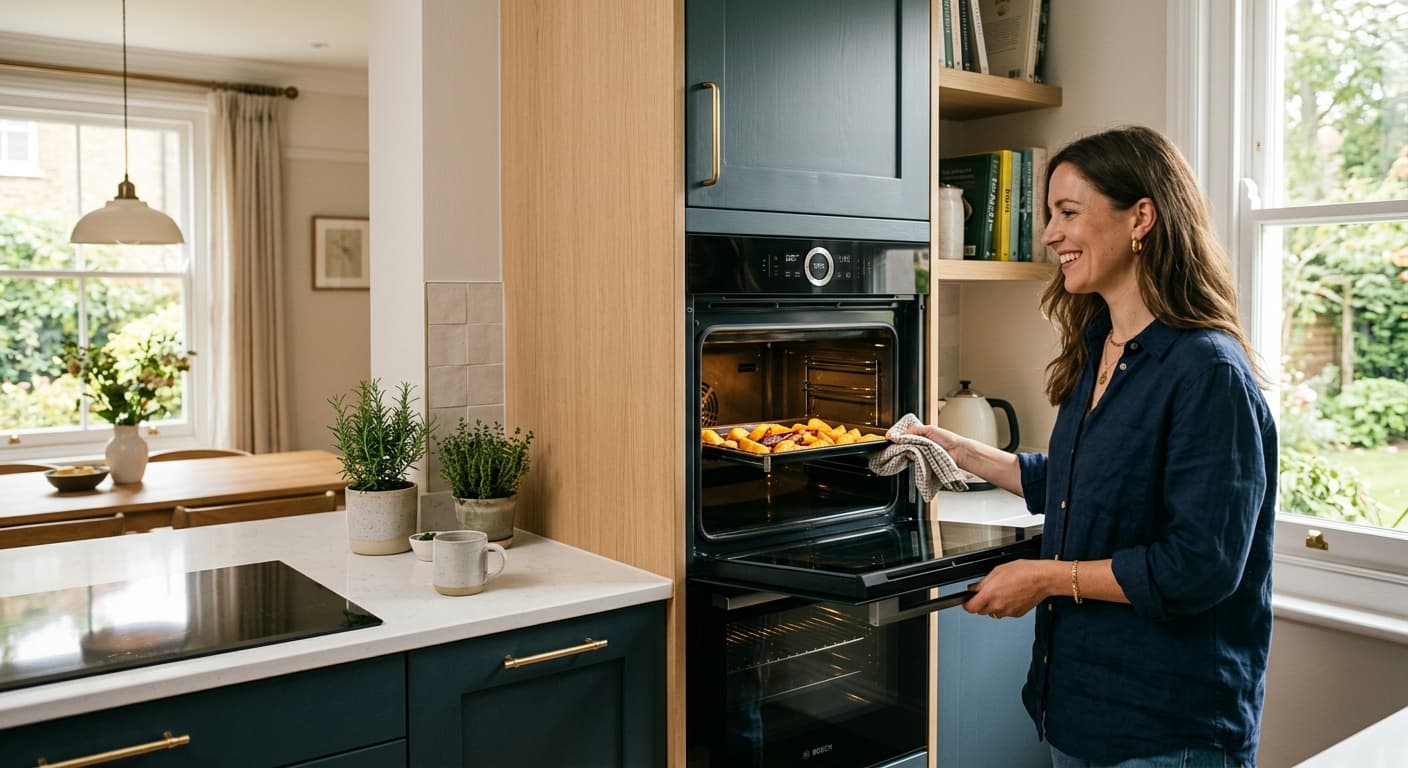
Built-in ovens have become the default choice for UK kitchen renovations, and the numbers back this up. According to the Kitchen Bathroom Bedroom Specialists Association (KBSA), integrated appliances featured in 78% of fitted kitchens installed in 2023, up from just 54% in 2019.
The appeal goes beyond aesthetics. Built-in ovens sit flush with cabinetry at a comfortable working height, eliminating the back-breaking stoop required by traditional range cookers. Prices have become surprisingly accessible too. We're seeing quality built-in single ovens from Bosch, Neff, and AEG starting at £350-£500, with double ovens ranging from £600-£1,200 for mid-range models. Premium brands like Miele and Gaggenau push well beyond £2,000, but represent less than 8% of sales based on our directory data.
Steam and combination ovens have moved from professional kitchens into mainstream consideration. Models combining conventional heating with steam injection now account for roughly 15% of built-in oven sales, typically priced £800-£1,500. The Energy Saving Trust notes these can reduce cooking times by up to 25%, translating to meaningful energy savings.
Read our complete guide to kitchen appliance buying guide UK for comprehensive advice on planning your entire kitchen refit.
What Is the Most Reliable Washing Machine Brand UK?
Reliability has become the primary purchasing criterion for washing machines, overtaking capacity and features. This represents a significant shift from five years ago when speed and wash programmes dominated marketing.
When examining best washing machine brands UK reliability, the data paints a clear picture. Which?'s 2023 survey of 13,000 washing machine owners identified Miele and LG as the most reliable brands, with fewer than 6% requiring repairs within the first six years. Bosch and Siemens followed closely, while certain budget brands saw failure rates approaching 20% within the same period.
The implications for UK buyers are significant:
- Miele machines (£800-£1,600) have the lowest failure rates but command premium pricing
- LG models (£400-£900) offer excellent reliability at mid-market prices, dominating sales in Manchester and other price-conscious regions
- Bosch and Siemens (£350-£800) balance reliability with affordability
- Budget brands under £300 may save money initially but show higher five-year total cost of ownership
We've noticed installers in our network increasingly recommending customers spend an extra £150-£200 for brands with proven longevity. The calculation is straightforward: a reliable machine lasting 10-12 years costs less annually than replacing a budget model every 5-6 years.
Integrated vs Freestanding Dishwasher Comparison: The Verdict Is In
The integrated vs freestanding dishwasher comparison has tilted decisively toward integration, particularly in properties undergoing full kitchen refits. Approximately 70% of dishwashers installed in new fitted kitchens are now fully integrated models with furniture door fronts.
Freestanding models retain advantages:
- Lower purchase cost (typically £80-£150 less than equivalent integrated models)
- Installation flexibility and easier future replacement
- Simpler repairs when panels don't need removal
- Better for rental properties where landlords value interchangeability
Integrated dishwashers win on:
- Seamless aesthetics that don't interrupt kitchen design flow
- Noise reduction through cabinet enclosure
- Enhanced resale appeal in premium properties
- Space efficiency in compact kitchens where visual clutter matters
Price-wise, semi-integrated dishwashers (with visible control panels) start around £350-£450, whilst fully integrated models begin at £400-£500. Premium Miele and Gaggenau integrated dishwashers reach £1,200-£1,800.
We're seeing regional variations. Properties in Birmingham and other Midlands cities show stronger preference for freestanding models, whilst London and Southeast installations overwhelmingly favour integration. This likely reflects property values and renovation budgets rather than functional preferences.
Is an Induction Hob Better Than Ceramic?
Induction technology has reached its tipping point in the UK market. After years of slow adoption, induction hobs now represent 45% of new hob installations, according to the Association of Manufacturers of Domestic Appliances (AMDEA). This growth accelerated sharply in 2022-2023 as energy prices spiked and efficiency became paramount.
The induction hob vs ceramic hob pros cons breakdown reveals why:
Induction advantages:
- 85-90% energy efficiency versus 55-65% for ceramic
- Faster heating (boils water in roughly half the time)
- Safer surface that cools within minutes
- Precise temperature control preferred by serious cooks
- Easier cleaning as spills don't bake onto the surface
Ceramic advantages:
- Lower purchase price (£150-£300 versus £250-£500 for equivalent induction)
- Works with all cookware (induction requires magnetic pans)
- Simpler technology with potentially lower repair costs
- No electromagnetic field concerns for those with pacemakers
The cookware requirement deserves emphasis. Switching to induction may necessitate replacing aluminium or copper pans, adding £100-£300 to the true cost of conversion. However, most stainless steel and cast iron cookware works perfectly.
Energy calculations favour induction decisively. The Energy Saving Trust estimates induction hobs save £25-£40 annually on electricity versus ceramic equivalents for average households. With energy prices remaining elevated, this payback period has shortened to just 3-5 years.
Professional installers we work with report induction now represents 60-70% of hob installations in new-build properties and high-end renovations. The technology has matured sufficiently that reliability concerns have evaporated.
Energy Rating Labels Explained UK Appliances: The New System
The UK implemented revised energy rating labels explained UK appliances system in March 2021, and confusion still abounds. The previous A+++ to D scale was replaced with a simpler A to G rating, but crucially, the standards were made much stricter.
An appliance previously rated A++ might now show as C or D under the new system. This doesn't mean the appliance became less efficient—the goalposts moved to drive innovation.
Key points for UK buyers:
- Very few appliances currently achieve A or B ratings under the new system
- C and D ratings represent excellent efficiency by previous standards
- The label now includes a QR code linking to the EU EPREL database with detailed specifications
- Energy consumption is shown in kWh per 100 cycles for washing machines and dishwashers
- Noise levels must be displayed, ranging from A (very quiet) to D (loud)
Washing machines rated C under the new system typically consume 50-60 kWh per 100 cycles. At current electricity prices (roughly 27p per kWh), that's £13.50-£16.20 per 100 washes. An older D-rated machine might cost £18-£22 for the same usage—a meaningful difference for households doing 200+ washes annually.
When searching our company directory for appliance suppliers, we recommend asking specifically about new-system energy ratings to avoid comparing apples and oranges.
American Fridge Freezer vs Standard Size UK: Fashion Fades
The American fridge freezer vs standard size UK debate has shifted noticeably. After dominating aspirational kitchen design throughout the 2010s, American-style fridge freezers are losing ground to more compact, efficient alternatives.
Several factors drive this reversal:
Space constraints: American fridge freezers require 900-1200mm width plus door clearance. Many UK kitchens, particularly in terraced houses and flats, simply lack the space without compromising workflow.
Energy consumption: Large American-style units consume 400-600 kWh annually versus 200-300 kWh for standard fridge freezers. At current electricity prices, that's an extra £50-£80 per year.
Food waste concerns: Larger capacity paradoxically correlates with increased food waste, according to WRAP (Waste and Resources Action Programme) research. Visibility and organisation suffer in oversized compartments.
Minimalist aesthetics: Design trends have shifted toward sleeker, integrated appliances. American fridge freezers' bulky presence conflicts with contemporary minimalism.
Standard UK fridge freezers (typically 600mm wide, 1800-1900mm tall) have improved dramatically. Features once exclusive to premium American models—filtered water, multi-zone cooling, smart connectivity—now appear in standard formats priced £500-£900.
We're observing this trend particularly in urban renovations. Properties in central London, Manchester, and Bristol increasingly specify slimline integrated models over statement American designs. The exception remains larger family homes in suburban and rural areas where space permits and large-capacity storage remains practical.
Are Heat Pump Tumble Dryers Worth the Cost?
Heat pump tumble dryers have crossed a critical threshold in 2024: they're now worth buying for most UK households. This represents a significant change from even two years ago.
The economics have shifted decisively. Heat pump dryers consume 50-60% less energy than conventional vented or condenser models. For a household doing four loads weekly, this translates to savings of £60-£90 annually at current electricity rates.
Prices have dropped substantially. Quality heat pump dryers from Beko, Bosch, and LG now start at £450-£550, down from £700-£900 in 2021. This brings the payback period to roughly 6-8 years—within the expected lifespan.
Performance improvements matter too. Early heat pump dryers were notoriously slow, often requiring 2.5-3 hours per cycle. Current models complete loads in 1.5-2 hours, comparable to condenser dryers. The gentler drying action also extends clothing life, though this benefit resists precise quantification.
Limitations remain:
- Initial cost still exceeds vented dryers by £200-£300
- Slightly longer cycle times than conventional dryers
- Lint filter requires more frequent cleaning
- Optimal performance requires ambient temperature above 5°C (matters for garage installations)
Building Regulations Part L increasingly influences this decision. New-build properties and major renovations must meet stringent energy efficiency targets, often making heat pump dryers the only compliant choice. We expect this to accelerate adoption beyond current market penetration of approximately 35%.
What's Actually Fading Away
Several once-popular appliance categories are quietly disappearing from UK kitchens:
Microwave-only units: Combination microwave-ovens have largely replaced standalone microwaves in fitted kitchens. Sales of traditional microwaves fell 18% year-on-year in 2023.
Gas hobs in new builds: Gas connections are increasingly excluded from new developments, particularly in London and Southeast. Electric cooking—predominantly induction—now features in 73% of new-build homes.
Chest freezers: Upright freezers and fridge-freezer combinations have eroded chest freezer sales by 40% since 2018. Space constraints and improved efficiency of modern upright models drive this shift.
Single-function appliances: Air fryers, bread makers, and other unitaskers are losing ground to multi-function devices and traditional cooking methods as consumers tire of cluttered worktops.
Finding the Right Appliance Supplier
Navigating appliance purchases requires balancing immediate costs against long-term value. We recommend obtaining quotes from at least three suppliers, particularly for installation-heavy products like built-in ovens and integrated dishwashers.
Major retailers—John Lewis, Currys, AO.com—offer competitive pricing and standardised installation services. Local independent retailers often provide superior expertise and flexibility, particularly for complex installations requiring modifications to cabinetry.
Installation costs vary significantly by region and complexity. Expect to pay £80-£150 for straightforward washing machine or dishwasher installation, £120-£200 for built-in oven installation, and £150-£300 for hob installation (particularly induction models requiring electrical upgrades).
Many businesses in our browse all categories offer package deals combining appliances with fitted kitchens installation. This can deliver better value than purchasing appliances separately, though comparing like-for-like requires careful attention.
The Next Wave: What's Coming
Several emerging trends will shape UK appliance purchasing through 2025-2026:
Smart connectivity maturity: After years of gimmicky Wi-Fi integration, genuinely useful smart features are arriving. Washing machines that auto-order detergent, ovens with recipe-guided cooking programmes, and energy monitoring that integrates with home systems will become standard rather than premium features.
Subscription and rental models: Companies like John Lewis and AO.com are testing appliance rental schemes that include maintenance and replacement. These may appeal to renters and buyers hesitant about long-term commitments.
Hydrogen-ready appliances: As the UK hydrogen heating strategy develops, hydrogen-ready cooking appliances will emerge, though mainstream adoption remains years away.
Right-to-repair impact: Forthcoming UK right-to-repair legislation will require manufacturers to make spare parts available for 10 years. This should extend appliance lifespans and improve repairability of premium brands.
The UK appliance market continues evolving rapidly, driven by energy costs, environmental awareness, and changing kitchen design aesthetics. The shift toward built-in, integrated, and efficient appliances shows no sign of reversing.
Browse Appliances businesses on HouseJester to find verified suppliers in your area, or list your business if you're an appliance retailer looking to reach UK homeowners.
Sources & Further Reading
- Which? Appliance Reviews and Reliability Data - Comprehensive UK consumer testing and reliability surveys
- Energy Saving Trust - Home Energy Efficiency - Official guidance on appliance efficiency and savings calculations
- AMDEA (Association of Manufacturers of Domestic Appliances) - UK appliance industry data and standards information
This article was created with AI assistance and reviewed by the HouseJester editorial team for accuracy and relevance.
Written by
Emma Richardson
Kitchen & Bathroom Specialist
Emma has reviewed hundreds of kitchen and bathroom installations across the UK. She combines product knowledge with real-world testing to help homeowners choose the right fitters and materials for their projects.
- Fitted Kitchens
- Bathrooms
- Tiles
- Heating & Plumbing