
On this page
Introduction
Choosing between a curtain pole vs curtain track is one of the first decisions you'll face when updating your window treatments. This isn't just about aesthetics—your choice affects how smoothly your curtains operate, how much light they block, and even your heating bills. We've worked with dozens of soft furnishings specialists across the UK, and we consistently see homeowners making the same avoidable mistakes. This guide cuts through the marketing fluff to give you practical advice on poles, tracks, fabric choices, and everything else you need to dress your windows properly.
Key Takeaways
- Curtain poles suit lighter fabrics and traditional aesthetics; curtain tracks handle heavier materials and provide better light blocking for bedrooms
- Made to measure curtains typically cost £200-£600 per window versus £30-£150 for ready-made, but the fit and fabric quality justify the investment
- Thermal lining can reduce heat loss by up to 35% according to the Energy Saving Trust—crucial for older UK homes
- Allow 10-20cm clearance above the window frame and ensure curtains touch the floor (or sit 1-2cm above) for the best appearance
- Roman blinds offer a tailored look but cost more than roller blinds; combination treatments work brilliantly in living rooms
Curtain Pole vs Curtain Track: Which Should You Choose?
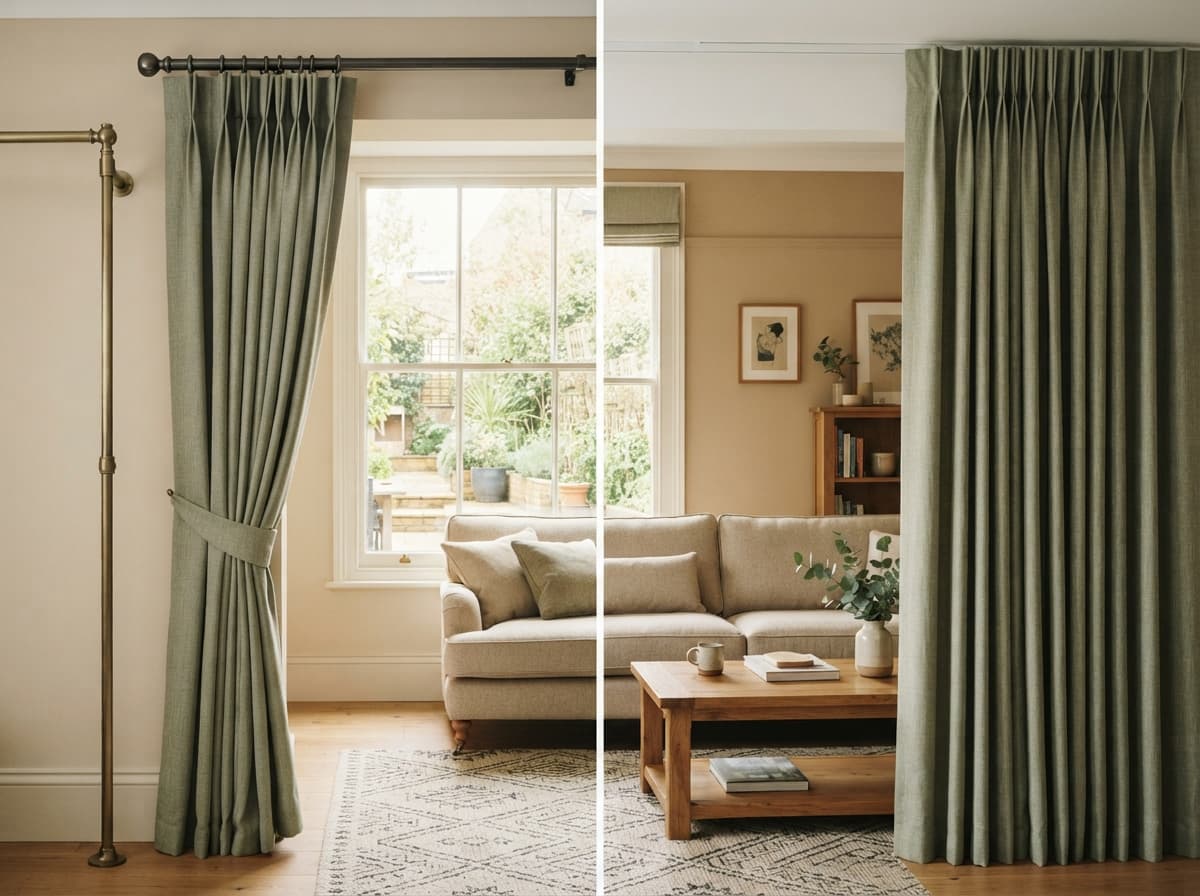
The fundamental difference comes down to visibility and function. Curtain poles sit proudly on display with decorative finials, whilst tracks hide discreetly behind a pelmet or the curtain heading itself.
Choose a curtain pole when:
- You're hanging lightweight to medium-weight curtains (up to about 3kg per metre)
- The window has a traditional style that suits exposed hardware
- You want rings that glide along the pole—the classic swish
- Your curtains won't need to pull back fully to the wall edges
Choose a curtain track when:
- You're hanging heavy interlined curtains or multiple layers
- You need curtains to stack tightly at the edges (bay windows, patio doors)
- You want to fit curtains into a ceiling recess or behind a pelmet
- You're after maximum light blocking in bedrooms
Poles look decorative but have limitations. Most standard wooden or metal poles from B&Q or John Lewis will struggle with curtains heavier than 5-6kg total weight. We've seen too many sagging poles in London townhouses where homeowners chose style over substance.
Tracks, particularly the corded varieties from specialists like Silent Gliss or Swish, can handle substantial weight and bend around corners. They're the professional choice for serious window dressing.
Installation Considerations
Pole installation is straightforward—two or three brackets screwed into the wall above the window. Expect to pay £40-£80 for a tradesperson to fit a standard pole, or DIY it in an hour.
Tracks require more precision, especially corded systems. Professional fitting typically costs £60-£150 depending on complexity. Ceiling-mounted tracks need solid fixing points—plasterboard fixings won't cut it for heavy curtains.
How Much Do Made to Measure Curtains Cost?
This question dominates our conversations with homeowners. The made to measure curtains vs ready made cost debate is simple: ready-made curtains from high street retailers run £30-£150 per pair for standard drops (around 220cm). Made to measure starts at roughly £200 per window for basic fabrics and climbs rapidly.
Here's what you'll actually pay:
| Curtain Type | Fabric Quality | Price Range (per window) | Lead Time |
|---|---|---|---|
| Ready-made (high street) | Budget polyester/cotton mix | £30-£80 | Immediate |
| Ready-made (John Lewis, Next) | Mid-range fabrics | £80-£200 | Immediate |
| Made to measure (basic) | Standard fabric, pencil pleat | £200-£350 | 3-4 weeks |
| Made to measure (mid-range) | Designer fabrics, thermal lining | £350-£600 | 4-6 weeks |
| Made to measure (luxury) | Heavy interlined, hand-finished | £600-£1,500+ | 6-10 weeks |
London prices typically run 15-25% higher than elsewhere in the UK. The specialists we've spoken to in Manchester and Birmingham offer notably better value whilst maintaining quality.
Ready-made curtains come in fixed drops—usually 137cm, 183cm, 229cm, or 274cm. If your window doesn't match these dimensions exactly, you'll compromise on appearance. Made to measure curtains fit perfectly, with hems that graze the floor at precisely the right point.
The fabric quality difference matters more than most people realise. Ready-made curtains use lighter-weight materials that fade faster and hang less elegantly. We recommend made to measure for any prominent room—your sitting room, main bedroom, or dining room. Save the ready-made options for spare bedrooms and utility spaces.
What Curtain Fabric is Best for Insulation?
This question has serious implications for UK homes, particularly older properties with single or early double glazing. The Energy Saving Trust estimates that windows account for 10-20% of heat loss in typical homes. Proper curtains genuinely reduce your heating bills.
Best Curtain Fabrics for Insulation UK
The best curtain fabrics for insulation UK homes need combine three elements: dense face fabric, thermal lining, and proper interlining. Let's break this down.
Face fabrics with natural insulating properties:
- Wool or wool-mix: Excellent natural insulator, inherently flame-retardant to BS 5867 standards
- Heavy cotton or linen: Dense weaves trap air effectively
- Velvet: The pile creates air pockets; traditional choice for period properties
- Chenille: Similar benefits to velvet but typically more affordable
Synthetic fabrics like polyester conduct heat more readily and offer poor insulation regardless of weight.
How to Choose Curtain Lining Types
The how to choose curtain lining types question determines your curtains' thermal performance more than the face fabric. Standard cotton lining adds minimal insulation but protects fabric from sun damage. Thermal lining is where proper insulation begins.
Lining options explained:
- Standard cotton lining: £8-£15 per metre. Protects fabric, adds body, minimal thermal benefit
- Thermal lining (3-pass): £15-£25 per metre. Acrylic foam layer sandwiched between fabric layers. Reduces heat loss by 25-35%
- Blackout thermal lining: £18-£30 per metre. Combines light blocking with thermal properties. Essential for shift workers
- Interlining (bump or domette): £10-£18 per metre. Soft fleece layer between face fabric and lining. Professional curtain makers swear by this for luxury feel and maximum insulation
Fully interlined curtains with thermal lining represent the gold standard for insulation. They're heavy, expensive (add £150-£300 to made-to-measure costs), and absolutely worth it for draughty Victorian or Edwardian homes.
The Building Regulations Part L requires certain thermal performance standards for new builds and extensions, but existing homes aren't covered. Nonetheless, the same principles apply—reducing heat loss through windows pays dividends.
Should Curtains Touch the Floor?
Unequivocally yes, with one exception. Professional interior designers specify curtains that either kiss the floor (sitting 1-2cm above) or puddle slightly (2-5cm of fabric pooling on the floor). Floating curtains that end 10-15cm above the floor look unfinished and cheap.
The exception: kitchens and bathrooms where hygiene and practicality matter more than aesthetics. Here, ending just below the window sill makes sense.
Correct curtain length guidelines:
- Measure from the pole or track to the floor
- Add 1.5-2cm for the "kissing" look (our recommendation for most rooms)
- Add 5-8cm for a slight puddle (works in formal dining rooms and bedrooms with minimal foot traffic)
- Subtract 1cm for high-traffic areas where you want to avoid treading on hems
Ready-made curtains cause problems here. A 229cm drop might be perfect for a floor-to-ceiling height of 240cm, but most UK homes have 230-235cm floor-to-ceiling heights. You'll end up with curtains hovering awkwardly above the floor.
Roman Blind vs Roller Blind Comparison
Blinds offer a streamlined alternative to curtains, particularly popular in contemporary homes and smaller windows. The roman blind vs roller blind comparison highlights different strengths.
| Feature | Roman Blinds | Roller Blinds |
|---|---|---|
| Aesthetic | Tailored, fabric folds create visual interest | Clean, minimal, modern |
| Fabric options | Any curtain-weight fabric | Limited to roller blind fabrics |
| Cost (made to measure) | £180-£450 per blind | £80-£250 per blind |
| Light control | Good (small gaps at sides) | Excellent (can fit within recess) |
| Insulation | Better (more layers of fabric) | Limited |
| Maintenance | Dry clean or professional clean | Wipe clean |
| Lifespan | 10-15 years with care | 5-10 years (mechanism wears) |
| Child safety | Chain operated (safety requirements apply) | Chain or spring operated |
Roman blinds suit traditional and transitional interiors. The horizontal folds add architectural interest to plain windows. They work beautifully in sitting rooms, bedrooms, and dining rooms.
Roller blinds excel in kitchens, bathrooms, and home offices where clean lines and easy maintenance matter. The fabric selection has expanded dramatically—you'll find everything from blackout to sheer voile, with moisture-resistant options for bathrooms.
We've found that combining curtains with roller blinds gives the best of both worlds. Use a blockout roller for light control and privacy, with decorative curtains framing the window for warmth and style. This layered approach works particularly well in browse all categories of period properties where you want modern function with traditional aesthetics.
Understanding Upholstery Fabric Durability Ratings
If you're considering cushions, throws, or reupholstering furniture to complement your new curtains, upholstery fabric durability ratings explained matter enormously. The Martindale test measures abrasion resistance—how many rubs a fabric withstands before showing wear.
Martindale ratings for upholstery:
- 10,000-15,000 rubs: Light domestic use only (decorative cushions, occasional chairs)
- 15,000-25,000 rubs: General domestic use (dining chairs, bedroom furniture)
- 25,000-30,000 rubs: Heavy domestic use (sofas, family room furniture)
- 30,000+ rubs: Contract/commercial use (offices, hotels, commercial settings)
For family homes with children or pets, never specify anything below 25,000 rubs for main seating. We've seen too many beautiful sofas destroyed within two years because someone prioritised pattern over durability.
Natural fabrics like cotton and linen typically score 10,000-20,000 rubs. Wool and wool-mix fabrics reach 25,000-40,000 rubs. Synthetic performance fabrics can exceed 50,000 rubs whilst still looking and feeling good.
Common Soft Furnishing Mistakes to Avoid
Our team has identified these recurring errors when working with UK homeowners:
Skimping on curtain width: Curtains need 2-2.5 times the window width for proper fullness. A 2-metre-wide window requires 4-5 metres of fabric. Flat, skimpy curtains look dreadful regardless of fabric quality.
Ignoring existing architecture: Georgian and Victorian homes need different treatments than 1930s semis or modern new builds. Work with your property's character, not against it.
Choosing fashion over function: That gorgeous sheer linen might look stunning in the showroom, but it'll provide zero privacy in your ground-floor sitting room facing the street.
Forgetting about radiators: Curtains that drape over radiators waste heat and risk scorching. Either choose sill-length curtains or position radiators away from windows if possible.
DIY measuring errors: Measure three times across the width (windows aren't always square) and take the longest measurement. Allow for obstacles like radiators, handles, and wall protrusions.
Neglecting care requirements: Those velvet curtains need professional dry cleaning every 2-3 years at £80-£150 per pair. Factor ongoing costs into your decision.
Finding the Right Soft Furnishings Specialist
The quality of your supplier and fitter matters as much as the products themselves. According to businesses listed on HouseJester, the soft furnishings sector includes everyone from sole traders working from home to established showrooms with decades of experience.
Look for specialists offering:
- Home consultation and measuring services (typically £50-£100, often refunded against orders)
- Physical fabric samples you can assess in your own lighting
- Clear written quotations breaking down fabric, making, and fitting costs
- Evidence of professional memberships (The British Institute of Interior Design, for instance)
- Insurance and guarantees on workmanship
Avoid suppliers who:
- Pressure you to order on the day of consultation
- Can't explain where fabrics are manufactured
- Offer suspiciously cheap prices (you'll get what you pay for)
- Don't provide fabric composition and care information
- Won't give references from recent customers
If you're looking for reputable specialists in your area, search our company directory for verified professionals. We're always adding new verified listings, and if you're a soft furnishing specialist yourself, you can list your business to reach homeowners actively seeking your services.
Seasonal Considerations and Energy Efficiency
Britain's variable climate makes seasonal window dressing worth considering. Heavy thermal curtains that feel cosy in January can make rooms stuffy in July. Some homeowners swap between light summer curtains and heavy winter versions, storing the off-season set.
This approach requires storage space and doubling your curtain investment, but it's genuinely practical for main reception rooms. Alternatively, specify medium-weight curtains with thermal lining as a year-round compromise.
The Energy Saving Trust recommends closing curtains at dusk during winter months to trap heat inside. Thermal curtains closed at night can reduce heat loss through windows by 15-17% compared to leaving windows uncovered. Over a winter, this saves £50-£100 on heating bills for an average three-bedroom house.
Summer presents the opposite challenge—keeping heat out. Reflective or pale-coloured blind linings on south-facing windows reduce solar gain. Combined with curtains, this layered approach can keep rooms 3-4°C cooler without air conditioning.
Final Recommendations
Start your soft furnishing project by deciding whether you need maximum light control (tracks with lined curtains), architectural statement (decorative poles), or a combination approach (blinds plus curtains). Visit physical showrooms to handle fabrics—photographs never convey texture and weight accurately.
Budget realistically. For a standard three-bedroom house with made-to-measure curtains throughout, expect to spend £2,500-£5,000 including poles or tracks and fitting. This seems steep, but quality soft furnishings last 15-20 years with proper care.
Prioritise your main living spaces first. Get those rooms perfect with made-to-measure solutions, then use ready-made curtains or budget blinds for secondary spaces. This staged approach spreads costs whilst ensuring your most-used rooms look their best.
Remember that soft furnishings dramatically affect how a room feels—acoustically, thermally, and aesthetically. They're not just decoration; they're functional elements that contribute to home comfort and running costs. Invest thoughtfully and you'll enjoy the returns for years.
Browse Soft Furnishings businesses on HouseJester to find specialists in your area offering consultation, supply, and fitting services across the UK.
Sources & Further Reading
- Energy Saving Trust: Energy Efficient Windows and Glazing - Comprehensive guidance on reducing heat loss through windows, including the role of curtains and blinds
- Which?: How to Buy the Best Curtains - Independent testing and buying advice for curtain quality and value
- Building Regulations Approved Document L: Conservation of Fuel and Power - Technical standards for thermal performance in UK buildings
This article was created with AI assistance and reviewed by the HouseJester editorial team for accuracy and relevance.
Written by
Sarah Mitchell
Interior Design Editor
Sarah has spent over 12 years covering UK interiors and design trends. She works closely with interior designers and soft furnishings specialists across the country to bring readers expert insights on creating beautiful, functional living spaces.
- Interior Design
- Soft Furnishings
- Paint & Wallpaper
- Lighting