
On this page
The UK home improvement industry is undergoing a digital revolution. From AI-powered design tools to e-commerce platforms that now account for nearly half of all furniture sales, technology is fundamentally changing how consumers plan, shop for, and manage home projects. Here is a data-driven look at where the industry stands in 2026 and what the near future holds.
The Scale of Digital Adoption
The numbers make the scale of the shift unmistakable:
- 40% of UK furniture transactions now happen online — a proportion that has roughly doubled since 2019
- Dunelm generates 41% of its revenue through digital channels, blending online with its 180+ physical stores through a "Total Dunelm" omnichannel strategy
- Screwfix processes 58% of its sales through e-commerce, making it one of the most digitally advanced trade suppliers in Europe
- B&Q's marketplace — which allows third-party sellers to list products alongside B&Q's own range — saw gross merchandise value grow 45.4% to £228 million
- 31% of design firms now use AI tools daily, and 66% expect AI to fundamentally transform the industry within five years
These are not fringe statistics. They represent a mainstream shift in how the entire sector operates, from sole-trader upholsterers to multinational retailers.
AI in Interior Design and Home Improvement
Artificial intelligence is moving rapidly from novelty to necessity in the home sector.
How Design Professionals Are Using AI
The most common applications of AI among UK design firms include:
- Concept generation — AI tools can produce initial design concepts, mood boards, and spatial layouts from text prompts or rough sketches, dramatically accelerating the early stages of a project
- 3D visualisation and rendering — AI-enhanced rendering tools produce photorealistic images of proposed designs in minutes rather than hours, allowing clients to see exactly what a finished room will look like
- Material and product sourcing — AI can scan thousands of suppliers to find products matching specific criteria (colour, size, material, budget), saving designers hours of manual searching
- Automated client communication — Platforms like Houzz Pro's AutoMate use AI to handle initial client enquiries, schedule consultations, and send follow-up messages, freeing designers to focus on creative work
- Specification writing — AI can generate detailed product specifications, cutting schedules, and materials lists from design drawings
AI for Consumers
Homeowners are also benefiting directly from AI:
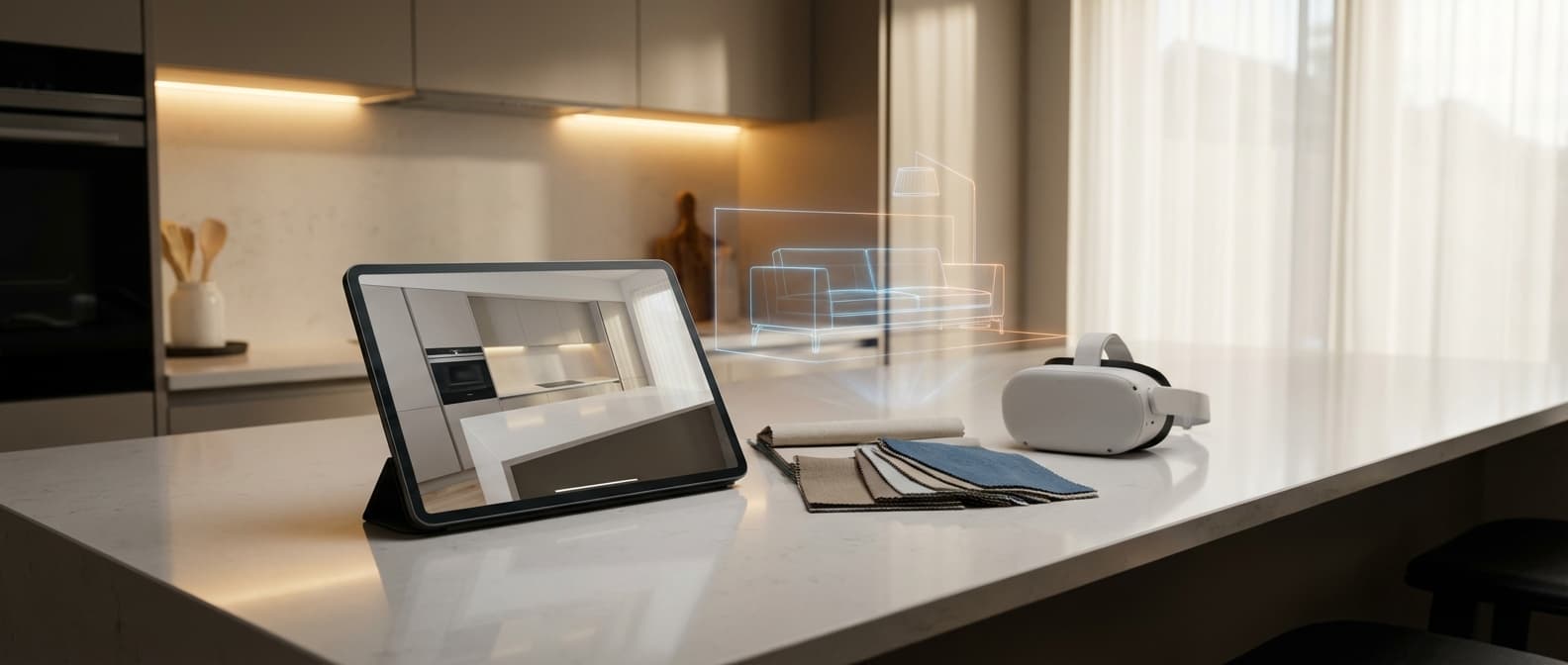
- Virtual room planners — Several retailers and apps now offer AI-powered tools that let you photograph your existing room and see how new furniture, paint colours, or flooring would look in your space
- Style matching — Upload an image of a room you admire, and AI can identify the products, materials, and colours used, then suggest similar items available in the UK
- Budget estimation — AI tools can provide rough cost estimates for renovation projects based on room dimensions, desired specification, and regional pricing data
- Smart home integration — Voice-activated assistants and AI-driven home management systems can control lighting, heating, blinds, and appliances from a single interface
E-Commerce: How Online Is Reshaping Retail
The shift to online purchasing is not simply about convenience. It is restructuring the entire retail model for home improvement.
Marketplace Models
The fastest-growing segment of home improvement e-commerce is the marketplace model, where established retailers open their platforms to third-party sellers. B&Q's marketplace growth of 45.4% to £228 million demonstrates the appetite for this approach.
For consumers, marketplaces offer a vastly expanded product range without leaving a trusted environment. For smaller furniture makers and specialist suppliers, a marketplace listing on a major platform provides access to millions of visitors without the cost of building independent e-commerce infrastructure.
Click-and-Collect and Omnichannel
Pure online and pure physical retail are both giving way to omnichannel — a blended model where customers move seamlessly between digital and in-store experiences. Dunelm's strategy is a textbook example: customers research online, visit stores to see and touch products, and complete the purchase through whichever channel is most convenient.
For furniture and interiors, this matters more than in most sectors. A sofa, a kitchen worktop, or a set of curtains are deeply tactile purchases. Most consumers want to see the colour, feel the fabric, and sit on the cushions before committing. The winning retailers are those that combine digital convenience with physical reassurance.
Delivery and Logistics
Last-mile delivery remains the biggest operational challenge in home improvement e-commerce. Furniture is bulky, fragile, and often requires room-of-choice delivery and assembly. Companies investing in their own delivery fleets and white-glove services — such as DFS and John Lewis — are gaining a competitive advantage over those relying on third-party couriers.
Smart Home Technology
The smart home is no longer a futuristic concept. It is a present reality that is influencing furniture and interior design decisions.
The Matter Protocol
The Matter protocol — backed by Apple, Google, Amazon, and Samsung — is emerging as the universal standard for smart home devices. For the first time, devices from different manufacturers can communicate seamlessly without proprietary hubs or apps. This is particularly significant for the kitchen and living room:
- Smart ovens, fridges, and dishwashers that report their status and energy consumption to a central hub
- Automated lighting scenes that adjust colour temperature and brightness throughout the day
- Motorised blinds and curtains that respond to sunlight, temperature, and time of day
- Heating systems that learn occupancy patterns and optimise energy use
For interior designers, integrating smart technology into projects is becoming a standard expectation rather than a premium add-on. Understanding cable routing, device placement, and system compatibility is now part of the job.
Energy Management
With energy costs a persistent concern, smart energy management is driving adoption. Heat pumps, solar panels, and battery storage systems all benefit from intelligent control systems that optimise when energy is consumed, stored, or exported to the grid. The intersection of smart home technology and the Future Homes Standard is creating demand for professionals who understand both design and technology.
What This Means for Businesses
The digital transformation of the home industry has clear implications for businesses of all sizes:
-
Online presence is non-negotiable — Whether through your own website, a marketplace listing, or a directory profile on platforms like HouseJester, potential customers expect to find you online with reviews, images, and contact details.
-
AI is a tool, not a threat — Design firms that adopt AI for routine tasks (rendering, sourcing, admin) can handle more projects and deliver faster without compromising quality. Those that ignore it risk falling behind.
-
Reviews and reputation matter more than ever — In a digital-first world, your online reputation is your shopfront. Encourage satisfied customers to leave reviews on HouseJester and respond professionally to any criticism.
-
Invest in photography — With 40% of furniture sold online, high-quality images are the single most important sales tool. Professional photography of completed projects, showroom displays, and individual products is essential.
-
Understand smart technology — Even if you are a traditional furniture maker or installer, customers will ask about cable management, device integration, and future-proofing. Basic smart home literacy is becoming a competitive advantage.
What This Means for Consumers
For homeowners planning a project in 2026:
- Use AI tools for inspiration — Virtual room planners and style-matching tools can help you articulate what you want before approaching a professional
- Research online, experience in person — Browse products and portfolios on HouseJester and retailer websites, but visit showrooms and request samples before committing to major purchases
- Check digital capability — When hiring a designer or fitter, ask whether they use 3D visualisation, digital project management, or smart home integration tools. These capabilities often translate to a smoother project experience
- Read reviews — Online reviews on trusted platforms are one of the most reliable indicators of a business's quality and reliability
Looking Ahead
The pace of digital change in the home improvement industry is accelerating. AI will become more capable, online shopping more immersive (with augmented reality allowing you to place virtual furniture in your real room), and smart home technology more integrated. Businesses and consumers that embrace these tools — while maintaining the human expertise, craftsmanship, and personal service that make home projects special — will be best positioned for the years ahead.
Browse HouseJester's directory to find furniture and design professionals who combine traditional skill with modern digital capability.
This article was created with AI assistance and reviewed by the HouseJester editorial team for accuracy and relevance.
Written by
HouseJester Editorial
Editorial Team
The HouseJester editorial team brings together specialists in furniture, interior design, and home improvement to provide trusted guidance for UK homeowners.