
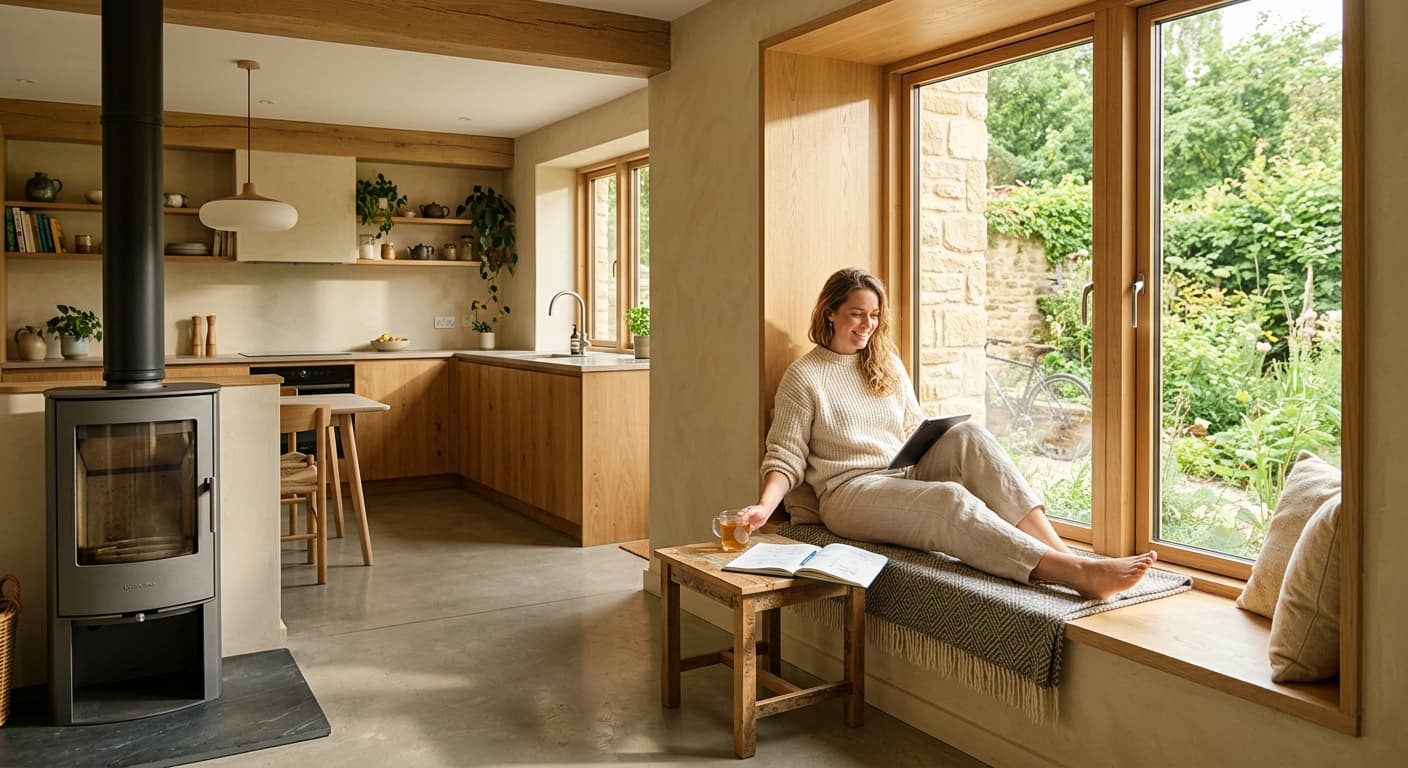
The push towards greener living has transformed how UK homeowners approach property improvements. Eco home improvements UK are no longer just about saving the planet—they're about cutting energy bills, increasing property values, and accessing generous government incentives. With energy costs remaining volatile and Building Regulations becoming stricter, making your home more sustainable is both financially savvy and environmentally responsible.
Key Takeaways
- Solar panels typically cost £5,000–£11,000 for a standard UK home, with potential savings of £450–£1,000 annually on electricity bills
- Cavity wall insulation costs around £800–£1,500 and can save £200–£300 yearly, paying for itself within 5–7 years
- Air source heat pumps have higher upfront costs (£8,000–£18,000) but lower running costs than gas boilers, with the gap widening as gas prices rise
- Improving from EPC rating D to C can increase property value by up to 3% and is often achievable with 2–3 targeted improvements
- Government grants in 2025 include the Boiler Upgrade Scheme offering £7,500 for heat pumps and local authority grants for insulation
Are Solar Panels Worth It in the UK?
Despite our reputation for grey skies, solar panels are absolutely worth considering for most UK homes. The solar panel installation cost UK 2025 savings equation has shifted dramatically in recent years.
A typical 4kW system costs between £5,000 and £8,000, while a larger 6kW system runs £8,000–£11,000. These prices have dropped roughly 60% since 2010, whilst efficiency has improved significantly. Modern panels generate electricity even on cloudy days—crucial for British weather—and most systems come with 25-year performance warranties.
The Energy Saving Trust estimates annual savings of £450–£1,000 depending on your location, energy usage, and whether you're home during daylight hours to use the electricity directly. Add battery storage (£3,000–£6,000) and you can store surplus energy for evening use, potentially doubling your savings.
The Smart Export Guarantee (SEG) means suppliers pay you for excess electricity sent to the grid. Rates vary from 1p to 15p per kWh depending on the supplier and tariff. Octopus Energy's Outgoing Fixed rate currently offers 4.1p per kWh, whilst their Agile Export pays based on wholesale prices.
Payback periods typically range from 10–15 years, but with energy prices likely to remain high, panels installed today should save tens of thousands over their lifetime. We've seen substantial interest from homeowners across London and the South East, though properties in Scotland and the North also benefit despite slightly lower solar irradiance.
For quality installations, browse eco & sustainable specialists in your area who are MCS-certified—essential for warranty protection and any future government schemes.
How Much Does Home Insulation Save UK?
Insulation remains the most cost-effective eco improvement available. The cavity wall insulation cost and savings UK figures are compelling: installation typically costs £800–£1,500 for a semi-detached house, saving £200–£300 annually according to the Energy Saving Trust.
That's a payback period of just 5–7 years, after which it's pure profit. Cavity wall insulation involves drilling small holes in exterior walls and pumping in insulating material—usually mineral wool, polystyrene beads, or foam. The process takes just a few hours.
Loft insulation offers even better value. Topping up from 120mm to the recommended 270mm costs £400–£600 for a typical house and saves around £250–£350 yearly. Many homes built before 2000 have inadequate loft insulation by current standards.
Solid wall insulation is pricier—£4,000–£14,000 depending on whether you choose internal or external—but essential for older properties without cavities. External solid wall insulation (EWI) costs more but doesn't reduce room sizes and can completely transform a property's appearance.
Floor insulation, often overlooked, costs £800–£1,200 for a typical ground floor and saves around £80–£120 annually. It makes an enormous difference to comfort, particularly in older homes with suspended timber floors.
Building Regulations Part L now requires any extension or major renovation to meet strict thermal efficiency standards. We recommend addressing insulation before other improvements—there's little point installing an expensive heating system if all the warmth escapes through walls and roofs.
What Is the Cheapest Way to Heat a Home UK?
This question has become fiendishly complicated since energy prices rocketed. The air source heat pump vs gas boiler cost comparison reveals a nuanced picture.
Gas boilers remain cheaper upfront: a new A-rated combi boiler costs £2,000–£4,000 installed. Running costs in 2025 average around £800–£1,200 annually for a typical three-bedroom home, though this fluctuates with wholesale gas prices.
Air source heat pumps cost significantly more initially—£8,000–£18,000 including installation and any necessary radiator upgrades. However, the Boiler Upgrade Scheme currently provides £7,500 towards heat pump installation, narrowing the gap considerably.
Running costs for heat pumps depend heavily on the system's Coefficient of Performance (COP). A well-designed system in a properly insulated home achieves a COP of 3.0–4.0, meaning it produces 3–4 units of heat for every unit of electricity consumed. This makes annual running costs comparable to or lower than gas boilers, typically £600–£1,000.
The critical factor: heat pumps work best in well-insulated homes with larger radiators or underfloor heating. They run at lower temperatures (45–55°C) than gas boilers (65–75°C), so require more radiator surface area. Installing a heat pump in a poorly insulated Victorian terrace without upgrading radiators will result in disappointing performance and high running costs.
Modern infrared heating panels offer an interesting alternative for well-insulated homes or specific rooms. Panels cost £150–£400 each and provide instant, targeted warmth. Running costs are reasonable if used intelligently with good insulation and time-of-use electricity tariffs.
Our experience working with UK tradespeople suggests the cheapest heating strategy combines excellent insulation, a modern heating system appropriate to your property type, and smart controls to minimise waste. There's no universal answer—a heat pump might be perfect for your new-build in Birmingham but inappropriate for your Georgian townhouse in Bath.
EPC Rating C: How to Improve UK Properties
The government's target for all rental properties to reach EPC rating C by 2028 has focused attention on this benchmark. Understanding EPC rating C how to improve UK homes requires knowing what assessors measure.
EPC ratings run from A (most efficient) to G (least efficient), based on energy costs per square metre. Rating C requires a score of 69–80 points. Most UK homes currently sit at D or E.
Common upgrades to reach C include:
- Loft insulation to 270mm – usually the cheapest win, adding 3–5 points
- Cavity wall insulation – typically adds 8–12 points for uninsulated homes
- Double glazing throughout – can add 5–8 points if replacing single glazing
- A-rated condensing boiler – adds 3–6 points over older G-rated boilers
- LED lighting – minor impact (1–2 points) but extremely cheap
- Solar panels – can add 10–15 points depending on system size
- Heating controls – programmable thermostats and thermostatic radiator valves add 2–4 points
Most properties need 2–3 major improvements to jump from D to C. A typical journey might involve cavity wall insulation (£1,200), loft insulation top-up (£500), and a new boiler (£3,000)—total investment around £4,700 to save £400–£500 annually and increase property value by up to 3%.
The Energy Performance Certificate itself costs just £60–£120 from an accredited assessor. We recommend getting one before planning improvements, as the report identifies the most cost-effective upgrades for your specific property.
Local authorities in Manchester and other areas sometimes offer free or subsidised energy assessments—worth investigating before paying privately.
Government Green Home Grants UK 2025
Navigating government green home grants UK 2025 requires staying current as schemes frequently change. Here's what's available now:
Boiler Upgrade Scheme (BUS): Provides £7,500 towards air source heat pump installation or £5,000 for ground source heat pumps. Available until 2028 or when the budget runs out. No means testing—any homeowner can apply through an MCS-certified installer.
ECO4 Scheme: Running until March 2026, ECO4 targets low-income households and those receiving certain benefits. It can fully fund insulation, heating upgrades, and other energy efficiency measures. Private homeowners might qualify if they receive benefits or have a household income under £31,000.
Home Upgrade Grant (HUG): Available in England for off-gas-grid properties, providing up to £10,000 for insulation and heating improvements. Administered by local authorities—check your council's website.
Local authority grants: Many councils offer additional funding. The Greater London Authority, for instance, runs various schemes for Londoners. Scotland's Home Energy Scotland offers interest-free loans up to £7,500 (or £9,000 for rural/island properties).
VAT reduction: Energy-saving materials benefit from 0% VAT when installed by a professional, including solar panels, heat pumps, and insulation. Standard installations attract 20% VAT, so this represents significant savings.
These grants change regularly. The Energy Saving Trust's grants calculator (energysavingtrust.org.uk/grants-calculator) provides current information based on your postcode and circumstances.
We've observed that many homeowners miss out on grants simply because they're unaware they exist. Check eligibility before booking any major work—the savings can be substantial.
Finding Reliable Eco Specialists
The explosion of interest in sustainable improvements has attracted both excellent specialists and opportunistic cowboys. Finding trustworthy installers matters enormously for quality, warranties, and accessing grants.
Key certifications to verify:
- MCS certification – mandatory for heat pumps, solar panels, and battery storage if you want grants or SEG payments
- TrustMark – government-endorsed scheme for reliable tradespeople
- PAS 2030 & PAS 2035 – required for installers working on government-funded energy efficiency projects
- Competent Person Schemes – for self-certification under Building Regulations (e.g., NAPIT, NICEIC for electrical work)
Don't accept the first quote. We recommend obtaining at least three detailed quotes for major work, ensuring they include the same specifications for fair comparison. London pricing typically runs 15–20% higher than the national average, whilst rates in the North and Wales are often 10–15% below.
The HouseJester directory includes verified eco & sustainable businesses across the UK. You can browse all categories to find specialists for related work like fitted kitchens incorporating energy-efficient appliances or bathroom specialists installing water-saving fixtures.
Trade associations like the Heat Pump Association, MCS, and the Sustainable Energy Association maintain member directories. Businesses serious about quality typically belong to relevant professional bodies.
If you're an eco specialist yourself, consider how to list your business to reach homeowners actively seeking sustainable improvements.
Making Your Eco Investment Count
The best approach combines quick wins with long-term planning. Start with simple, high-impact changes: LED bulbs throughout (£50–£100 investment, £40+ annual saving), draught-proofing doors and windows (£200–£300, saving £60–£100 yearly), and bleeding radiators to ensure efficient heating.
Next, address insulation comprehensively. Heat retention forms the foundation of any efficient home. Only then should you consider expensive heating system upgrades—you need less capacity when your home holds heat better.
Think about your timeline. Solar panels make most sense if you're staying put for 10+ years. If you might move within five years, prioritise improvements that increase property value and have broad appeal—all buyers appreciate low energy bills.
Consider whole-house retrofits if you're planning major renovation anyway. Combining works saves on scaffolding, labour, and disruption. External wall insulation, new windows, solar panels, and heat pump installation work well as a coordinated project.
Monitor your energy use before and after improvements. Smart meters provide real-time feedback, helping you understand whether changes deliver expected savings. The EST estimates that simply being aware of energy use reduces consumption by 5–15%.
Maintenance matters too. Solar panels need occasional cleaning, heat pumps require annual servicing, and insulation should be checked for settling or damage. Factor ongoing costs into your calculations.
The Property Value Equation
Sustainable improvements increasingly affect property values. Research by Nationwide Building Society found that homes with EPC rating B command a 5% premium over identical properties rated E. The gap widens as buyers become more energy-aware.
Some improvements offer better returns than others. Solar panels and heat pumps appeal strongly to environmentally conscious buyers but might put off those unfamiliar with the technology. Quality insulation and double glazing have universal appeal.
Location matters. Eco features command higher premiums in Brighton, Bristol, Edinburgh, and other cities with strong green credentials than in areas where sustainability hasn't yet gained traction.
When selling, obtain an updated EPC showing post-improvement ratings. Estate agents report that prominent display of EPC rating C or above attracts more viewings and stronger offers. The tangible evidence of low running costs reassures buyers facing mortgage affordability assessments.
Rental investors face additional considerations. The 2028 EPC C requirement for rentals means improvement costs are often mandatory rather than optional. Tenants increasingly prioritise energy efficiency, and properties with low bills command higher rents and attract better tenants.
Conclusion: Take Action Today
Eco home improvements UK have reached a sweet spot: technology has matured, costs have fallen, grants are available, and energy savings are substantial. The combination makes this the ideal time to act.
Start by understanding your current performance through an EPC assessment. Prioritise insulation and draught-proofing before considering expensive heating upgrades. Take advantage of available grants—particularly the Boiler Upgrade Scheme if you're considering a heat pump.
Choose certified installers, obtain multiple quotes, and plan improvements strategically rather than piecemeal. The homes performing best combine multiple measures: excellent insulation, efficient heating, renewable generation, and smart controls working together.
Your investment will pay dividends through lower bills, increased comfort, higher property values, and reduced environmental impact. The question isn't whether to make eco improvements—it's which ones to prioritise and when to start.
Browse eco & sustainable businesses on HouseJester to find certified specialists in your area and begin your journey towards a greener, more efficient home.
Sources & Further Reading
- Energy Saving Trust – Comprehensive guidance on home energy efficiency, grants calculator, and savings estimates
- MCS Certification – Find certified renewable energy installers and understand quality standards
- Simple Energy Advice – Government-backed service providing personalised recommendations and connecting homeowners with local schemes
This article was created with AI assistance and reviewed by the HouseJester editorial team for accuracy and relevance.