
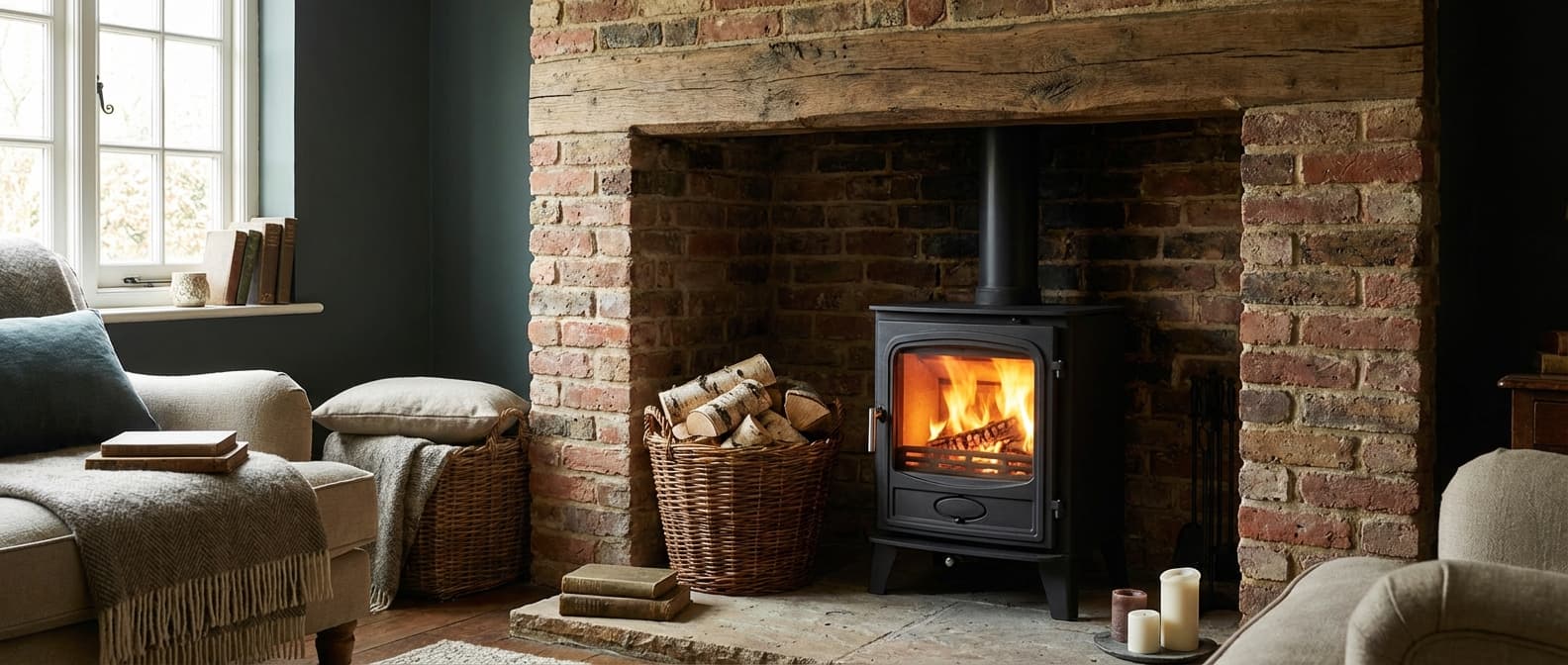
1. How much does it cost to install a wood-burning stove in the UK?
A complete wood-burning stove installation typically costs £1,500-£4,500 mid-range, including the stove (£800-£2,500), flue liner (£600-£1,200), hearth, register plate, and labour. If you need a new twin-wall flue system (no existing chimney), add £1,500-£4,000. Premium stoves from brands like Contura, Hwam, and Morso cost £3,000-£5,000+ for the stove alone. Budget installations using a smaller stove and existing chimney can start from £1,500. The most common additional cost is chimney relining (£600-£2,000), which is required if the existing liner is damaged, the wrong diameter, or absent. Always use a HETAS-registered installer — their work is self-certified for Building Regulations, saving you a separate Building Control application.
2. What is the difference between a wood-burning stove and a multi-fuel stove?
A wood-burning stove is designed exclusively for burning seasoned logs. It has a flat base or grate optimised for wood combustion and typically achieves the highest efficiencies with wood fuel. A multi-fuel stove has a riddling grate that allows ash from coal and smokeless fuels to fall through for efficient burning — it can burn both wood and solid fuels. Multi-fuel stoves offer greater fuel flexibility but may not burn wood quite as efficiently as dedicated wood burners. In Smoke Control Areas, only smokeless fuels or wood in Defra-exempt appliances are permitted. If you intend to burn only seasoned logs, a dedicated wood burner is the optimal choice.
3. What are Ecodesign stoves, and are they required?
Ecodesign is a European-wide standard that sets strict limits on emissions from wood-burning stoves, including particulate matter (PM), carbon monoxide (CO), organic gaseous compounds (OGC), and nitrogen oxides (NOx). Since January 2022, all new stoves sold in the UK must meet Ecodesign standards. They produce approximately 80% fewer emissions than older stoves and achieve efficiencies of 75-85%. Existing stoves do not need to be replaced (they are grandfathered), but when you upgrade, an Ecodesign model is mandatory. The SIA (Stove Industry Alliance) maintains a list of Ecodesign-compliant stoves. These stoves are cleaner, more efficient, and often more controllable than older models.
4. Can I burn wood in a Smoke Control Area?
You can burn wood in a Smoke Control Area only in a Defra-exempt appliance — a stove that has been independently tested and approved for use in Smoke Control Areas. These stoves are designed to burn wood so cleanly that they meet the emissions limits set by Defra. The Defra website maintains a list of exempt appliances. Burning wood in a non-exempt appliance (or in an open fire) in a Smoke Control Area is an offence that can result in a fine of up to £1,000. You can check whether you live in a Smoke Control Area via your local council's website. Approved smokeless fuels can be burned in any appliance in Smoke Control Areas.
5. What type of wood should I burn in a wood-burning stove?
Burn only well-seasoned or kiln-dried hardwood with a moisture content below 20% (ideally below 15%). Hardwoods like oak, ash, beech, and birch burn longer and produce more heat than softwoods. Seasoned wood has been air-dried for at least 12-18 months after splitting. Kiln-dried wood is dried commercially and is immediately ready to burn. Never burn wet or green wood — it produces excessive smoke, creosote build-up in the chimney (a fire hazard), poor heat output, and higher emissions. Since 2021, wood sold in volumes under 2m³ must be certified as Ready to Burn (moisture content below 20%). Use a moisture meter (£10-£20) to check your wood supply.
6. How efficient are different types of fireplaces?
Open fires are the least efficient — only 15-30% of the heat energy reaches the room, with the rest going up the chimney. Closed wood-burning stoves achieve 75-85% efficiency — a dramatic improvement. Gas fires range from 50-90% efficiency depending on the type (decorative vs high-efficiency models). Electric fires are 100% efficient at point of use (all electricity converts to heat), but electricity costs more per kWh than gas. Bioethanol fires produce real flames but minimal heat output — they are primarily decorative. For heating effectiveness, a modern Ecodesign wood-burning stove or a high-efficiency gas fire are the best choices.
7. How do I choose a fireplace surround?
The surround should complement both the fire and the room's architectural style. For period homes: traditional materials like marble, limestone, slate, or cast iron suit Victorian and Edwardian interiors. For contemporary homes: minimalist designs in concrete, steel, natural stone, or simple timber beams work well. The surround size should be proportionate to the wall — a large surround on a small chimney breast looks top-heavy, while a small surround on a large wall looks lost. Consider whether the surround will house a fire (open fire, gas fire) or frame a freestanding stove. Fireplace surrounds range from £200-£5,000+, with natural stone and bespoke designs at the higher end.
8. Do I need a carbon monoxide alarm with a fireplace?
Yes. Building Regulations require a carbon monoxide (CO) alarm in any room where a new solid fuel appliance (wood burner, multi-fuel stove) is installed. It is also strongly recommended (though not legally required) for rooms with gas fires. The alarm should be positioned on the ceiling at least 1 metre from the appliance, or on a wall at head height. CO is odourless and colourless — exposure can be fatal. Choose an alarm that meets BS EN 50291 and carries the Kitemark. Replace the alarm according to the manufacturer's instructions (typically every 5-7 years). Battery-powered and mains-wired models are both acceptable.
9. Can I install a fireplace in a flat or apartment?
Electric fires and bioethanol fires can be installed in any flat without restrictions (no chimney or flue required). Gas fires are possible in some flats if there is a suitable flue route (balanced flue through an external wall or existing shared chimney). Wood-burning stoves are generally not permitted in flats due to flue routing complications, fire safety concerns, and building management restrictions. Always check your lease, building management rules, and insurance policy before installing any fireplace. For most flats, a quality electric fire with realistic flame effects and a stylish surround is the most practical and attractive option.
10. How does the Future Homes Standard affect fireplaces?
The Future Homes Standard primarily affects heating in new-build homes, which will not have gas connections. This means gas fires will not be available in new-build homes from 2025 onwards. Wood-burning stoves remain permitted in new builds (subject to Ecodesign compliance and air quality regulations) but are typically supplementary rather than primary heating. Electric fires are compatible with the Standard's all-electric approach and are likely to become more popular. For existing homes, the Standard does not mandate changes to existing fireplaces, but homeowners are encouraged to upgrade to Ecodesign stoves and high-efficiency gas fires as part of broader energy-efficiency improvements.
This article was created with AI assistance and reviewed by the HouseJester editorial team for accuracy and relevance.