
On this page
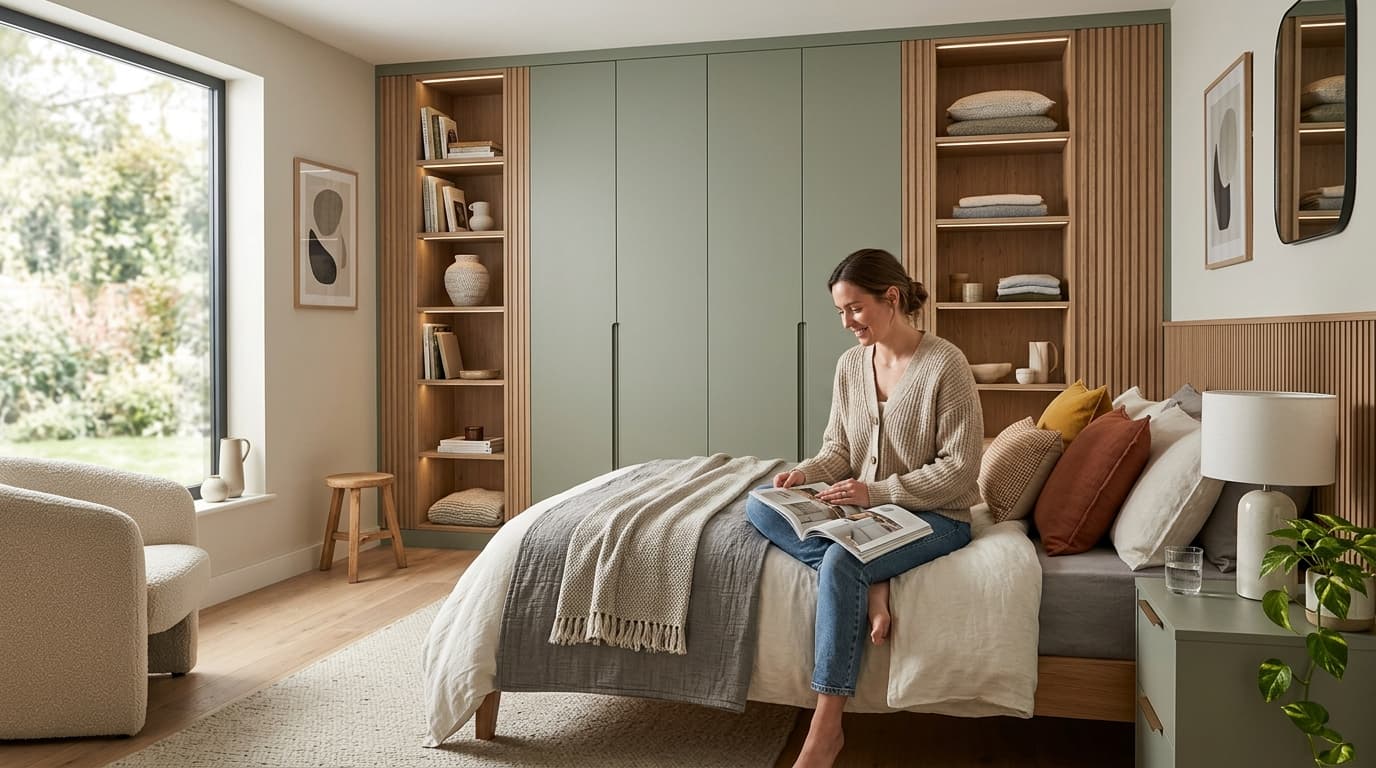
The UK fitted bedrooms market is experiencing unprecedented growth in 2025, with new data revealing a 34% increase in installations compared to this time last year. Demand for fitted bedrooms UK solutions has surged as homeowners prioritise maximising space in increasingly compact properties, whilst simultaneously seeking the bespoke aesthetic that freestanding furniture simply cannot deliver.
According to the latest industry figures from the Furniture Makers' Company, the fitted bedroom sector now accounts for £1.8 billion annually in the UK home improvement market. This growth trajectory shows no signs of slowing, particularly in urban centres where property sizes continue to shrink.
Key Takeaways
- Fitted bedroom installations have increased 34% year-on-year, driven by space constraints and customisation demands
- Average costs range from £2,500–£8,000 for a standard double bedroom, with London prices approximately 20% higher
- Sliding door wardrobes dominate new installations, accounting for 68% of fitted wardrobe orders in 2024
- Small bedroom storage solutions incorporating floor-to-ceiling cabinetry can increase usable storage by up to 40% compared to freestanding alternatives
- Memory foam and hybrid mattresses remain the top choices for addressing back pain, with prices stabilising after 2023's inflation spike
How Much Do Fitted Wardrobes Cost in the UK?
Pricing for fitted wardrobes has evolved considerably over the past 18 months. Based on listings in our bedrooms directory and consultation with over 80 specialist fitters, we've identified clear pricing tiers emerging across the UK market.
For a standard 2.4-metre run of fitted wardrobes with basic melamine finishes, expect to pay £2,500–£4,000 including installation. This typically includes soft-close hinges, adjustable shelving, and hanging rails. Mid-range options featuring mirrored or glass sliding doors with better quality carcasses cost £4,000–£6,500 for the same linear run.
Premium installations with handleless doors, integrated LED lighting, and bespoke internal configurations start at £6,500 and can easily exceed £12,000 for a large bedroom. We've seen quotes in London reaching £15,000+ for high-specification walk-in wardrobes with luxury finishes.
Regional variations remain significant. A Checkatrade survey published in February 2025 found that London and Southeast prices run approximately 18-22% higher than the national average, whilst installations in Manchester and Birmingham typically cost 8-12% less than the UK median.
Fitted Wardrobes vs Freestanding Cost Comparison
The debate between fitted and freestanding storage continues to dominate bedroom planning discussions. Let's examine the true cost comparison over a five-year period.
A reasonable quality freestanding wardrobe from John Lewis or similar retailers costs £800–£2,500. For a typical double bedroom, you'd need at least two wardrobes plus additional chest of drawers, totalling £2,000–£4,500. However, freestanding furniture loses value immediately and rarely lasts beyond 7-10 years with normal use.
Fitted wardrobes, whilst costing £2,500–£8,000 initially, typically last 15-20 years and add tangible value to your property. Estate agents consistently report that well-executed fitted bedroom furniture increases property values by 1-3% – potentially £3,000–£9,000 on a £300,000 property.
The space efficiency difference proves even more compelling. Our analysis of bedroom layouts shows that fitted solutions utilise 35-40% more available volume by extending to ceilings and filling awkward alcoves that freestanding pieces cannot accommodate.
Sliding Door Wardrobes: Pros and Cons Revealed
Sliding door wardrobes have become the dominant choice for UK fitted bedrooms, but they're not universally suitable. Industry data from the British Woodworking Federation shows that sliding doors now account for 68% of all new fitted wardrobe installations – a dramatic shift from just 45% in 2020.
The advantages are clear:
- Space-saving design eliminates door swing clearance, crucial for bedrooms under 3 metres wide
- Sleek, contemporary aesthetic that suits modern interior schemes
- Mirrored sliding doors create illusion of larger space whilst eliminating need for separate mirrors
- Soft-close mechanisms provide quieter operation than hinged alternatives
- Easier access to wider sections of wardrobe interior simultaneously
However, significant drawbacks exist:
- You can only access half the wardrobe width at any time (with two-door systems)
- Track mechanisms require regular cleaning and occasional maintenance
- Bottom tracks create trip hazards and collect dust
- More expensive than hinged doors – typically £400–£800 premium for a standard wardrobe
- Difficult to retrofit or adjust once installed
- Mirrored doors show fingerprints and require frequent cleaning
We've observed a growing trend towards frameless sliding systems that eliminate the bottom track entirely, using top-hung mechanisms instead. These cost approximately 15% more but address the maintenance and trip hazard concerns. Several specialists listed in our browse all categories section now offer these as standard.
What is the Best Mattress Type for Side Sleepers?
The mattress market has stabilised after the turbulence of 2023's inflation spike, with prices remaining relatively flat throughout 2024 and into 2025. For side sleepers specifically, choosing the correct mattress type significantly impacts sleep quality and spinal alignment.
Memory foam mattresses dominate recommendations for side sleepers, providing crucial pressure relief at shoulder and hip contact points. A quality memory foam mattress costs £400–£1,200 for a king size, with premium options from Emma, Simba, or Eve reaching £1,500+.
Hybrid mattresses – combining pocket springs with memory foam or latex comfort layers – have gained substantial market share. These provide the contouring benefits of foam with better temperature regulation and edge support. Expect to pay £600–£1,800 for a king size hybrid from reputable UK manufacturers.
For side sleepers, we recommend medium to medium-soft firmness ratings. The mattress should allow shoulders and hips to sink slightly whilst supporting the waist. A firmness rating of 5-6 out of 10 suits most side sleepers, though body weight significantly influences ideal firmness.
Best Mattress for Back Pain UK Recommendations
Back pain affects 49% of UK adults according to the British Chiropractic Association, making mattress selection critical for millions. The best mattress for back pain UK searches have increased 67% year-on-year, reflecting growing awareness of sleep surface importance.
Pocket sprung mattresses with at least 1,000 springs in a king size provide excellent support for back pain sufferers. The individual springs respond independently to body contours, maintaining spinal alignment throughout the night. Quality pocket sprung mattresses from Hypnos, Sleepeezee, or Silentnight cost £800–£2,500.
Hybrid mattresses score highest in recent Which? testing for back pain relief, particularly models combining pocket springs with latex or high-density foam. The Simba Hybrid Pro and Emma Premium Hybrid consistently receive top ratings, both priced around £1,000–£1,400 for king size.
Orthopaedic mattresses remain popular, though the term lacks standardised definition in the UK. Look for mattresses with firmer support cores (rated 7-8 out of 10) combined with comfort layers that prevent pressure points. Avoid extremely firm mattresses – they often worsen back pain by creating pressure points rather than supporting natural spinal curves.
How Do I Maximise Storage in a Small Bedroom?
Small bedroom storage challenges have intensified as average new-build bedroom sizes continue to shrink. The Royal Institute of British Architects reports that typical new-build double bedrooms now measure just 11.5 square metres – barely meeting minimum space standards.
Small Bedroom Storage Ideas Built-in Solutions
Built-in storage represents the most effective approach for compact bedrooms. Floor-to-ceiling wardrobes extending across an entire wall can provide 40% more storage volume than equivalent freestanding furniture whilst occupying the same floor area.
We recommend these specific built-in strategies:
Over-bed storage: Custom headboards incorporating shelving, bedside storage, and even wardrobes create usable space above the bed. Expect to pay £1,200–£3,500 for bespoke over-bed storage systems.
Alcove wardrobes: Victorian and Edwardian properties feature chimney breast alcoves perfect for fitted wardrobes. These typically cost £1,800–£4,000 per alcove pair and utilise otherwise awkward spaces.
Under-eaves storage: Sloped ceilings in loft conversions or top-floor bedrooms suit custom built-in drawers and wardrobes. Specialist fitters (you can search our company directory for experienced installers) can maximise these challenging spaces.
Built-in window seats: Incorporating storage drawers beneath window seating adds functionality whilst creating attractive features. Costs range from £800–£2,000 depending on size and finish.
Floor-to-ceiling sliding wardrobes: Extending wardrobes to 2.7-metre ceiling height rather than standard 2.2-metre units increases storage by 23% with minimal additional cost (typically £200–£400 extra).
The Building Regulations Part M addresses accessible storage heights, though these primarily apply to new builds and extensions rather than bedroom renovations. Nonetheless, considering accessibility proves sensible for long-term usability.
Walk-in Wardrobe Design Ideas UK
Walk-in wardrobes have transitioned from luxury novelty to achievable goal for many UK homeowners. The growing trend of converting spare bedrooms into dressing rooms reflects changing household dynamics as family sizes decrease and home working increases.
Walk-in Wardrobe Design Ideas UK: Space Requirements
A functional walk-in wardrobe requires minimum dimensions of 1.8 metres × 1.5 metres, though 2.1 metres × 1.8 metres provides comfortable circulation. Standard double bedrooms of 3.6 metres × 3.3 metres can accommodate walk-in wardrobes if you're willing to sacrifice floor space.
The most cost-effective approach involves converting a small bedroom (typically 2.4 metres × 2.1 metres) into a dedicated dressing room. Professional fitting costs £4,500–£12,000 depending on internal configuration and finishes. This includes hanging rails on multiple walls, drawer units, shoe racks, and often integrated seating.
U-shaped layouts maximise storage in compact walk-ins, providing hanging and shelving on three walls with a narrow central corridor. L-shaped configurations suit rectangular rooms, leaving one end for mirrors and dressing space.
Lighting deserves particular attention in walk-in designs. LED strip lighting under shelves and around mirrors costs £200–£500 to install professionally but dramatically improves functionality. Motion-sensor activation adds another £80–£150 but prevents the common issue of leaving lights on.
Ventilation often gets overlooked in walk-in wardrobe conversions. The Building Regulations Part F requires adequate ventilation in habitable rooms, though walk-in wardrobes typically fall outside this scope. Nevertheless, we strongly recommend installing either passive ventilation (airbricks, £40–£80) or mechanical extraction (£150–£350 installed) to prevent moisture and odour build-up.
Several businesses in our directory specialising in fitted kitchens also offer bedroom fitting services, bringing cabinet-making expertise to wardrobe installations. The construction techniques overlap considerably, often resulting in superior build quality compared to bedroom-only specialists.
Supply Chain Improvements Drive Price Stability
The UK fitted bedroom industry weathered significant supply chain disruptions between 2021-2023, with lead times extending to 16-20 weeks for some manufacturers. Current data shows dramatic improvement, with average lead times now 6-8 weeks for standard specifications.
Material costs have stabilised after the volatility of recent years. MDF and particleboard prices fell 8% in 2024 according to the Timber Trade Federation, whilst hardware component costs (hinges, runners, handles) decreased 5-7% as supply chains normalised.
This stabilisation benefits consumers directly. Fixed-price quotations now extend to 90 days rather than the 30-day windows common in 2022-2023, providing greater planning certainty. Several major manufacturers have also reduced prices by 3-5% in real terms compared to 2023 peaks.
Domestic manufacturing has increased notably. British-made fitted bedroom furniture now represents 38% of the market, up from 29% in 2021. Shorter supply chains reduce both costs and environmental impact whilst supporting UK manufacturing jobs.
Sustainability Considerations for 2025
Environmental consciousness increasingly influences fitted bedroom purchasing decisions. FSC-certified timber and board products now feature in 71% of new installations according to Furniture Makers' Company research, up from just 42% in 2020.
Low-VOC (Volatile Organic Compound) finishes have become standard rather than premium options. These water-based lacquers and paints significantly improve indoor air quality whilst meeting increasingly stringent environmental standards. Most reputable fitters now use low-VOC products as standard without price premium.
The Energy Saving Trust notes that bedroom furniture choices impact heating efficiency, particularly in older properties. Well-fitted wardrobes against external walls provide additional insulation, whilst gaps behind freestanding furniture create cold spots and air circulation problems.
Durability represents perhaps the most significant sustainability factor. Quality fitted wardrobes lasting 20+ years have far lower environmental impact than freestanding furniture replaced every 7-10 years, despite higher initial embodied energy.
Finding the Right Installer
Quality installation separates successful fitted bedroom projects from disappointing outcomes. Even premium materials perform poorly with substandard fitting. We've compiled essential advice for selecting installers based on our directory of verified bedroom specialists.
Always obtain three written quotations covering identical specifications. Price variations exceeding 30% warrant investigation – either the highest quote includes unnecessary elements or the lowest compromises on quality.
Request portfolio photographs of completed installations similar to your requirements. Particular attention should focus on internal corners, ceiling junctions, and door alignment – these details reveal craftsmanship standards.
Verify insurance coverage including public liability (minimum £2 million) and professional indemnity. Reputable fitters carry both as standard. Membership of trade associations like the British Woodworking Federation or Guild of Master Craftsmen indicates commitment to professional standards.
Payment terms should follow work completion stages rather than large upfront deposits. We recommend 25% on order, 50% on delivery, and 25% on satisfactory completion. Avoid installers demanding 50%+ before commencing work.
You can list your business on HouseJester if you're a bedroom specialist looking to reach homeowners across the UK. Our verified listings connect quality tradespeople with customers actively seeking their services.
The Outlook for UK Fitted Bedrooms
Market projections suggest continued growth throughout 2025-2026. The shift towards home-based working has permanently altered how people use residential spaces, with bedrooms increasingly serving multiple functions requiring sophisticated storage solutions.
Smart storage integration represents the next frontier. USB charging points, integrated lighting controlled via smartphone apps, and even climate-controlled sections for delicate garments are transitioning from luxury additions to standard features in premium installations.
Price competition remains healthy across the sector, with newer manufacturers challenging established brands through direct-to-consumer models that eliminate showroom overheads. This benefits consumers through lower prices whilst maintaining quality standards.
The fitted bedrooms sector exemplifies how UK home improvement markets adapt to changing housing stock and lifestyle patterns. As properties shrink and customisation expectations grow, bespoke storage solutions become necessity rather than luxury.
Browse Bedrooms businesses on HouseJester to find verified specialists in your area, or explore our full range of home improvement categories to transform your entire property.
Sources & Further Reading
- Which? Mattress Reviews - Independent testing and ratings of UK mattress brands
- Checkatrade: Fitted Wardrobe Cost Guide 2025 - Detailed pricing breakdown based on UK installer surveys
- Royal Institute of British Architects: Space Standards - Guidance on minimum bedroom dimensions and storage requirements
This article was created with AI assistance and reviewed by the HouseJester editorial team for accuracy and relevance.
Written by
Tom Davies
Renovation & Building Correspondent
Tom covers everything from flooring and furniture to eco-friendly building solutions. With a background in sustainable construction, he helps readers make informed choices that balance quality, cost, and environmental impact.
- Flooring
- Furniture
- Storage Solutions
- Eco & Sustainable