
On this page
Flooring is one of the most impactful elements of any interior. It sets the tone for a room, affects acoustics and comfort, and needs to withstand years of daily wear. Choosing the right flooring company — one that combines product knowledge with skilled installation — is essential to achieving a result that looks beautiful and performs well for decades.
The UK flooring market offers an extraordinary range of options: solid and engineered hardwood, luxury vinyl tile (LVT), laminate, carpet, natural stone, porcelain tile, bamboo, cork, and resin. Each material has distinct characteristics in terms of durability, warmth, maintenance, moisture resistance, and cost. A professional flooring specialist will assess your room, subfloor condition, lifestyle, and budget before recommending the most suitable option.
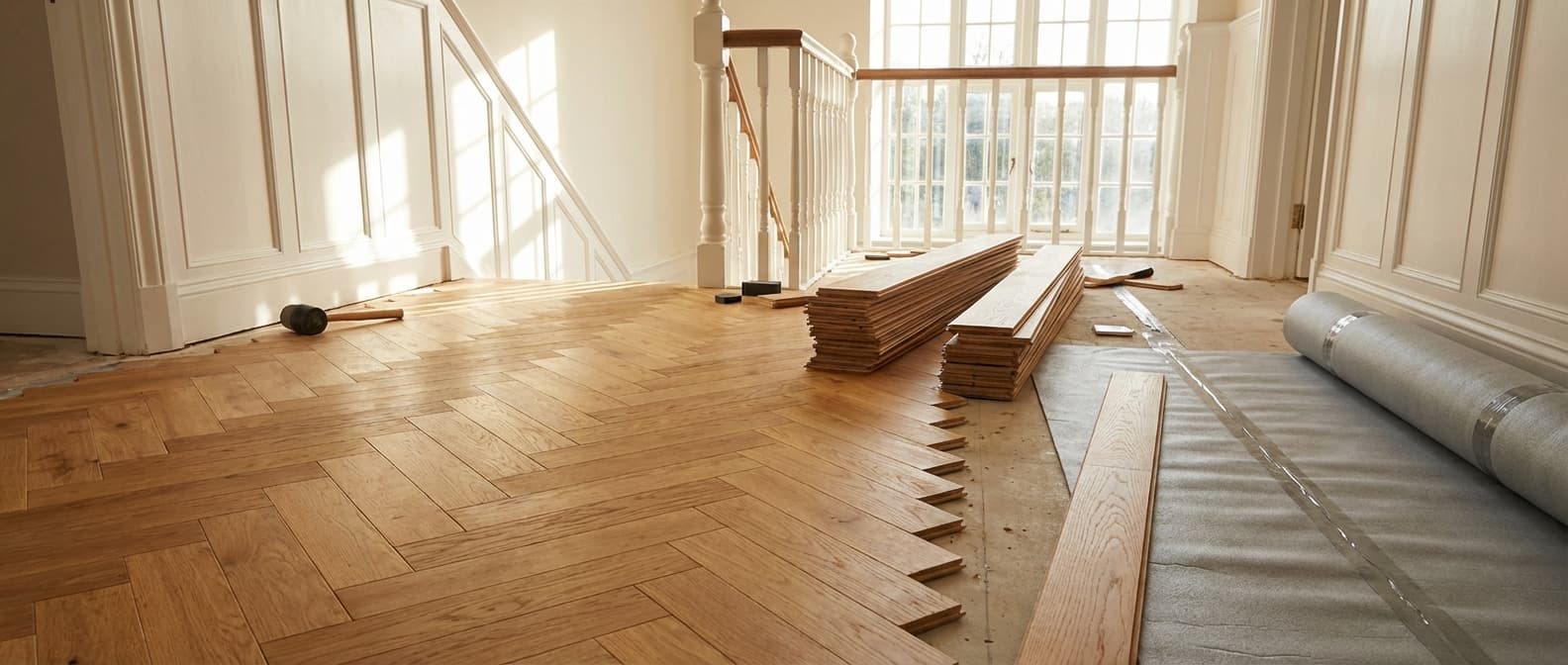
Installation quality is just as important as product quality. A poorly fitted floor can develop gaps, creaks, or uneven wear within months. Professional fitters prepare the subfloor meticulously — levelling, priming, and moisture-testing — before laying your chosen material. This groundwork is invisible once finished but critical to the floor's longevity. Cutting corners on preparation is the single most common cause of flooring failure.
HouseJester's directory features verified flooring companies across the UK, from specialist hardwood fitters and carpet retailers to large-format tile installers and resin flooring experts. Browse by location, read genuine customer reviews, and request quotes from multiple companies to compare prices and specifications.
Sustainability is an increasingly important consideration in flooring choices. FSC or PEFC certification ensures timber is responsibly sourced. Many LVT manufacturers now use recycled content and phthalate-free plasticisers. Natural materials such as wool carpet, cork, and bamboo are inherently renewable. Under the 2026 Future Homes Standard's emphasis on healthy indoor environments, low-VOC flooring adhesives and finishes are becoming standard specification.
Browse flooring companies on HouseJester
How Much Does New Flooring Cost in the UK?
Flooring costs vary significantly by material. Below are 2026 prices per square metre, including supply and professional fitting:
| Flooring Type | Budget | Mid-range | Premium |
|---|---|---|---|
| Carpet | £15 – £25/m² | £25 – £50/m² | £50 – £100+/m² |
| Laminate | £20 – £30/m² | £30 – £45/m² | £45 – £65/m² |
| Engineered hardwood | £40 – £60/m² | £60 – £90/m² | £90 – £150+/m² |
| Solid hardwood | £50 – £70/m² | £70 – £110/m² | £110 – £200+/m² |
| Luxury Vinyl Tile (LVT) | £25 – £40/m² | £40 – £65/m² | £65 – £100/m² |
| Porcelain/ceramic tiles | £30 – £50/m² | £50 – £80/m² | £80 – £150+/m² |
| Natural stone | £60 – £100/m² | £100 – £180/m² | £180 – £300+/m² |
Add £5-£15/m² for subfloor preparation, underlay, and finishing trims. Underfloor heating adds £50-£80/m² for electric systems.
What to Look For When Choosing a Flooring Company
- Product range and expertise — Choose a company that specialises in your chosen material rather than a generalist.
- Subfloor assessment — A reputable fitter will inspect and moisture-test the subfloor before quoting.
- Sample viewing — Always view samples in your home under natural and artificial light; colours change dramatically between showroom and home.
- Accreditations — Look for CFA (Contract Flooring Association) membership, NICF (National Institute of Carpet and Floorlayers), or manufacturer-approved installer status.
- Guarantee — Expect a minimum 1-year installation guarantee, plus separate manufacturer warranties on the product.
- Underfloor heating compatibility — If you have or plan underfloor heating, confirm the product and adhesive are compatible.
- Waste and uplift — Check whether the quote includes removing existing flooring and disposing of waste.
- Acclimatisation guidance — Natural materials need acclimatising to your home's temperature and humidity before fitting. Your fitter should advise on this.
- Reviews and references — Read reviews on HouseJester and ask for references, particularly for the same flooring type.
- Aftercare advice — A good company provides clear maintenance instructions and recommends appropriate cleaning products.
Frequently Asked Questions
What is the most durable flooring for a busy family home?
LVT (luxury vinyl tile) and porcelain tiles are the most durable options for high-traffic family homes. Both are waterproof, scratch-resistant, and easy to clean. LVT is warmer and quieter underfoot, while porcelain is harder and more heat-resistant. Engineered hardwood with a thick wear layer (4mm+) is also highly durable and can be sanded and refinished 2-3 times. Avoid solid hardwood in kitchens and bathrooms where moisture is a risk.
Is engineered hardwood better than solid hardwood?
For most UK homes, engineered hardwood is the superior choice. It is more dimensionally stable than solid wood, meaning it is less susceptible to expansion and contraction caused by changes in temperature and humidity. This makes it compatible with underfloor heating and suitable for use over concrete subfloors. Engineered boards are available in the same species and finishes as solid wood and, with a wear layer of 4mm or more, can be sanded and refinished multiple times. Solid hardwood is best suited to homes with consistent humidity levels and timber subfloors.
How long does it take to fit new flooring?
For a typical room of 15-20m², most flooring types can be fitted in a single day by an experienced team. Larger projects or multiple rooms usually take 2-3 days. However, preparation work can add time: subfloor levelling takes a day (plus drying time for levelling compound), and natural wood floors need 48-72 hours of acclimatisation in the room before fitting. Tile installation, especially with underfloor heating, may take 2-3 days per room plus grouting and drying time. Plan the sequence carefully if multiple rooms are being done.
Can I fit flooring over existing flooring?
In many cases, yes. LVT, laminate, and engineered hardwood can often be fitted over existing hard floors provided the subfloor is flat, dry, and stable. Carpet should usually be removed first. Fitting over existing tiles avoids the dust and disruption of removing them, but it raises the floor height by 10-15mm, which may affect door clearance and thresholds. Your fitter will assess whether the existing floor is a suitable base or needs removing.
What flooring works best with underfloor heating?
Porcelain and ceramic tiles are the best conductors of heat, making them the most efficient choice for underfloor heating. Engineered hardwood (up to 15mm thick) is also compatible, as is LVT. Solid hardwood and thick carpet with heavy underlay are poor heat conductors and are not recommended. Always check the manufacturer's maximum temperature rating and ensure the adhesive is heat-compatible. Electric underfloor heating mats are the most practical option for retrofit installations.
This article was created with AI assistance and reviewed by the HouseJester editorial team for accuracy and relevance.
Written by
HouseJester Editorial
Editorial Team
The HouseJester editorial team brings together specialists in furniture, interior design, and home improvement to provide trusted guidance for UK homeowners.