
On this page
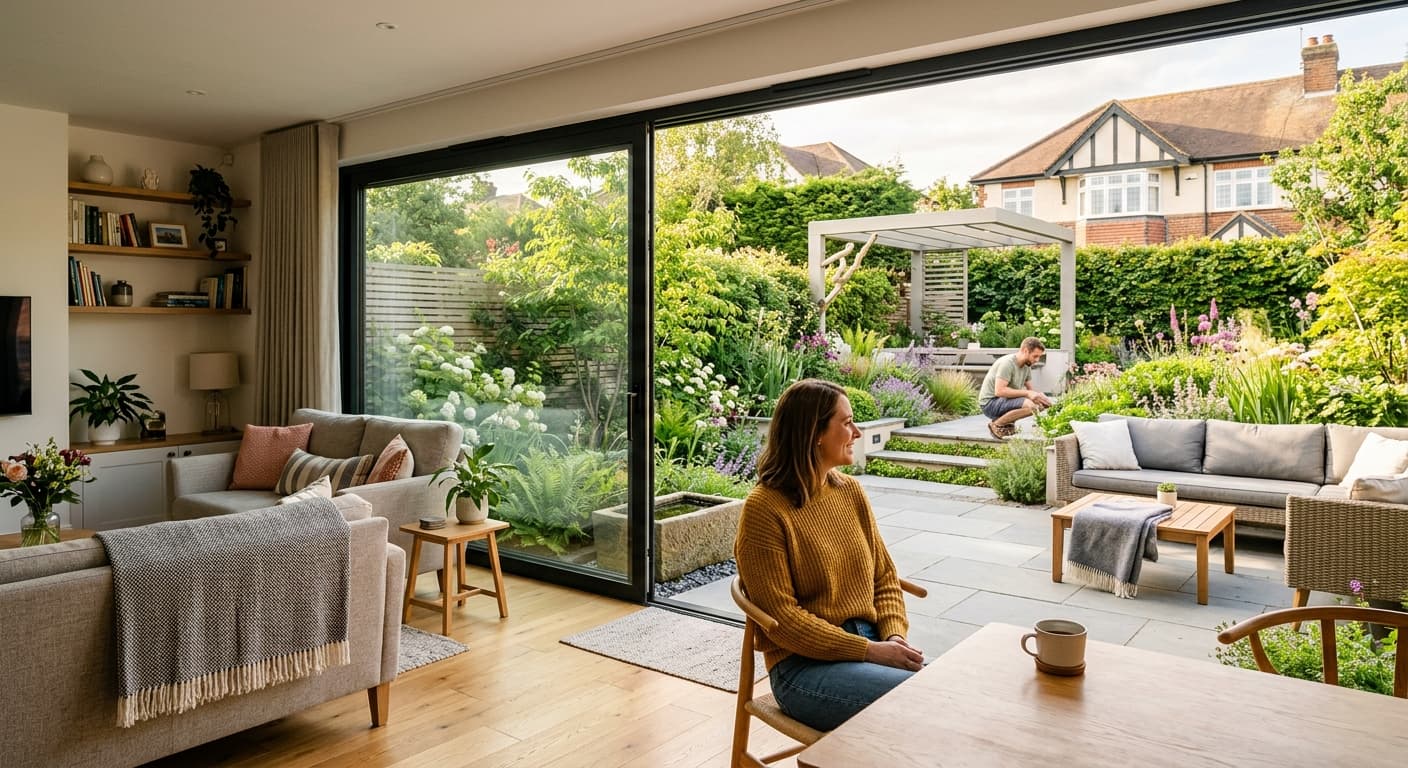
British homeowners are investing more in their outdoor spaces than ever before, with the garden design ideas UK market experiencing significant shifts in both aesthetic preferences and material choices. Recent industry data reveals a notable pivot towards low-maintenance solutions and sustainable materials, driven by changing lifestyles and environmental awareness.
Key Takeaways
- Composite decking now accounts for 42% of new decking installations, up from 28% in 2021, despite higher upfront costs
- Average patio installation costs have risen to £85-£140 per m2 for standard materials, with porcelain commanding £120-£180 per m2
- Low-maintenance garden designs are the fastest-growing segment, particularly among homeowners aged 45-65
- Garden room installations continue to surge, though 80% require Building Regulations approval despite not needing planning permission
- Rattan furniture sales have plateaued as consumers reconsider durability versus initial savings
The Composite Revolution: Decking Materials Under Scrutiny
The debate around composite versus timber decking has effectively been settled by UK homeowners voting with their wallets. According to the Timber Decking and Cladding Association, composite materials now represent nearly half of all new residential decking projects—a dramatic shift from just three years ago.
The composite decking vs timber comparison UK discussion centres on lifecycle costs rather than initial outlay. Whilst timber decking typically costs £35-£65 per m2 installed, composite alternatives range from £80-£150 per m2. We've seen this price differential narrow slightly as timber costs have climbed due to supply chain pressures and increased demand for sustainably sourced materials.
Tradespeople listed in our garden & outdoor directory report that composite materials require virtually no annual maintenance beyond occasional washing, whilst timber demands yearly treatment costing £200-£400 for an average garden. Over a fifteen-year period, composite proves cheaper in most scenarios.
The performance gap has widened too. Modern composite boards from brands like Millboard and Trex resist fading, splintering, and warping far better than their predecessors. Several Manchester landscapers we spoke with noted they're now specifying composite as standard unless clients specifically request timber for aesthetic reasons.
How Much Does a New Patio Cost UK?
Patio installation costs have climbed steadily since 2022, with material and labour inflation both contributing. The patio installation cost per m2 UK now breaks down as follows for a standard 20m2 installation:
- Indian sandstone: £85-£110 per m2 installed
- Porcelain paving: £120-£180 per m2 installed
- Concrete slabs: £55-£75 per m2 installed
- Natural granite: £140-£200 per m2 installed
- Gravel with edging: £40-£60 per m2 installed
These figures include excavation, sub-base preparation, and laying. London prices typically run 15-25% higher than the national average, whilst northern regions often see savings of 10-15%.
Checkatrade's 2024 landscaping survey found that preparation work frequently exceeds homeowners' expectations. Poor drainage, tree roots, or unstable ground can add £500-£2,000 to quoted prices. We always recommend getting at least three detailed quotes that explicitly state what groundwork is included.
Porcelain has emerged as the premium choice despite its cost. The material's resistance to staining, frost damage, and algae growth makes it particularly suitable for Britain's damp climate. Marshalls and Bradstone have both expanded their porcelain ranges significantly over the past eighteen months, responding to sustained demand.
Low Maintenance Garden Ideas Dominate Design Briefs
The low maintenance garden ideas UK trend isn't merely about aesthetics—it reflects fundamental lifestyle changes. The Royal Horticultural Society reports that 61% of gardeners now prioritise reducing maintenance time, up from 43% in 2019.
Several design approaches have gained traction:
- Artificial grass: Once stigmatised, quality synthetic turf from Namgrass or Easigrass (£45-£85 per m2 installed) has become socially acceptable, particularly for small urban gardens and families with young children
- Gravel gardens with architectural plants: Mediterranean-style plantings using drought-tolerant species require minimal watering and no mowing
- Raised beds with automatic irrigation: Initial investment of £1,200-£3,500 pays dividends in reduced maintenance
- Hard landscaping dominance: Designs where 60-70% of space is paved, decked, or gravelled rather than planted
We've noticed regional variations in adoption. Water-stressed areas in the Southeast have embraced drought-tolerant designs more enthusiastically than wetter regions. Several Birmingham garden designers report that clients still prefer traditional lawns despite the maintenance burden.
The environmental credentials of these approaches vary considerably. Artificial grass eliminates pesticide and fertiliser use but creates microplastic pollution and heat islands. Native plant meadows offer superior biodiversity benefits whilst requiring just two cuts annually, but many homeowners find the aesthetic too informal.
Garden Boundaries: Navigating Height Regulations
Garden fence regulations height UK requirements catch many homeowners off guard. The general rule permits fences up to 2 metres high without planning permission, but this drops to 1 metre for boundaries adjacent to highways or public footpaths.
These regulations apply to new fences only. Replacing an existing fence at the same height doesn't require permission, even if that height exceeds 2 metres—though you'd struggle to enforce this if a neighbour complained.
The Party Wall Act 1996 adds another layer of complexity. Building a fence or wall on the boundary line technically requires written agreement from adjoining owners, though enforcement is patchy. Disputes often arise when homeowners assume they can fence their entire perimeter without consultation.
Local authorities have grown stricter about enforcement since 2022. Camden Council alone issued 47 enforcement notices for oversized garden structures last year. We recommend checking with your council's planning department before installing anything substantial.
Permitted development rights also restrict fence materials in conservation areas. Stone or brick walls often require planning permission even at standard heights. The complexity has created steady work for planning consultants who charge £300-£800 to navigate these requirements.
Is Composite Decking Worth the Extra Cost?
The financial case for composite decking has strengthened considerably. Whilst the initial premium remains significant—typically 80-120% more than pressure-treated softwood—the total cost of ownership favours composite in most scenarios.
Consider a typical 25m2 deck:
Timber option:
- Initial installation: £1,500-£2,000
- Annual treatment (years 1-15): £3,000-£4,500
- Partial board replacement (year 10): £400-£600
- Total 15-year cost: £4,900-£7,100
Composite option:
- Initial installation: £2,800-£4,200
- Annual cleaning: £150-£300 (optional, DIY possible)
- Repairs: Negligible
- Total 15-year cost: £2,950-£4,500
The Federation of Master Builders emphasises that quality matters enormously with composite materials. Budget options under £60 per m2 often fade badly within five years and may not honour warranties. Premium brands cost more initially but justify the investment.
Composite decking's slip resistance has improved dramatically. Early products became dangerously slippery when wet—a significant concern in UK climates. Modern boards incorporate textured surfaces and drainage channels that perform well in rain.
Installation complexity differs too. Composite materials require precise fastening systems and allow less room for error than timber. We've seen botched DIY composite installations that cost more to fix than professional installation would have cost initially. For projects exceeding 15m2, professional installation through businesses in our company directory typically proves worthwhile.
The Garden Furniture Durability Question
The rattan vs metal garden furniture durability debate has evolved beyond simple material comparisons. Quality grades within each category matter more than the material itself.
Synthetic rattan furniture from retailers like John Lewis or Kettler (£400-£1,800 for a four-seat set) uses high-density polyethylene woven over aluminium or steel frames. This combination delivers 7-12 years of service with minimal maintenance. Cheap rattan sets from budget retailers (£150-£350) typically fail within 2-4 years as UV exposure degrades the plastic and frames corrode.
Metal furniture quality varies just as dramatically. Powder-coated aluminium from brands like Fermob or Gloster (£800-£3,000 for a dining set) resists corrosion indefinitely and requires only occasional cleaning. Mild steel furniture with painted finishes demands annual maintenance to prevent rust.
The sustainability angle increasingly influences purchasing decisions. Aluminium furniture's high embodied energy is offset by extreme longevity—quality pieces can last 25+ years. Rattan's lighter weight reduces shipping emissions but plastic components rarely enter recycling streams.
Storage requirements differ significantly. Metal furniture generally winters outdoors without damage, whilst rattan benefits from covered storage or at minimum, waterproof covers. Many homeowners underestimate how inconvenient seasonal storage becomes when dealing with bulky six-seat dining sets.
Do I Need Planning Permission for a Garden Room?
Garden rooms occupy a regulatory grey zone that confuses many homeowners. Most garden rooms qualify as permitted development and don't require planning permission, but this doesn't mean they're regulation-free.
Permitted development allows outbuildings up to 2.5 metres high (4 metres with a dual-pitched roof) covering up to 50% of garden area. Buildings must be at least 2 metres from boundaries if they exceed 2.5 metres in height. These rules apply across England, though Scotland, Wales, and Northern Ireland have different requirements.
The crucial distinction: planning permission differs from Building Regulations approval. Garden rooms exceeding 15m2 with electrical installations or those used for sleeping typically require Building Regulations approval covering structural integrity, fire safety, and electrical work. The Building Control fee adds £400-£800 to project costs.
Homebuilding & Renovating magazine's 2023 survey found that only 22% of garden room installations obtained necessary Building Regulations approval, creating potential issues for future house sales. Solicitors increasingly request documentation for garden buildings during conveyancing.
Manufacturers like Crown Pavilions or Green Retreats often handle Building Regulations applications as part of their service, though this isn't universal. We strongly recommend confirming exactly what regulatory compliance is included before signing contracts.
Insurance implications deserve attention too. Most home insurance policies require notification of garden structures exceeding £5,000 in value. Some insurers exclude garden rooms used as home offices from standard policies, requiring commercial cover.
Material Costs and Availability: Supply Chain Update
UK garden material supply chains have stabilised after the disruption of 2020-2022, though prices haven't returned to pre-pandemic levels. Timber costs remain 30-45% higher than 2019 despite falling from their 2021 peak. Paving materials have seen more modest increases of 12-18%.
Manufacturers report lead times for custom items like bespoke gates or metalwork have normalised to 4-8 weeks, down from 12-16 weeks in 2022. Standard products from builders' merchants like Wickes or Travis Perkins generally offer next-day availability.
Seasonal pricing patterns persist. Late autumn through winter typically offers 8-15% better rates for materials and installation as landscapers seek to maintain workflow during quieter periods. However, weather constraints mean projects often run longer, potentially erasing savings through extended timelines.
The shift toward direct-to-consumer sales has intensified. Companies like Marshalls and Bradstone now sell substantial volumes through their own websites, bypassing traditional merchant channels. This can save 10-20% versus high-street retailers but requires homeowners to arrange delivery and handle any quality issues directly with manufacturers.
Professional Installation vs DIY: Making the Call
The economic case for DIY garden improvements depends heavily on project complexity and available time. We've observed that homeowners typically overestimate their capabilities and underestimate time requirements by factors of two to three.
Projects suitable for competent DIYers:
- Gravel paths and borders (£100-£300 in materials vs £400-£800 installed)
- Fence panel replacement (£150-£400 in materials vs £500-£1,200 installed)
- Raised bed construction (£200-£600 in materials vs £600-£1,500 installed)
- Planting schemes (£300-£800 in plants vs £800-£2,000 designed and installed)
Projects where professionals deliver better value:
- Patio installation (poor sub-base preparation causes 70% of early failures)
- Decking construction (structural issues and building regulations compliance)
- Artificial grass laying (poor installation creates visible joins and drainage problems)
- Garden rooms and structures (regulatory compliance and insurance implications)
The Energy Saving Trust notes that poor installation of garden infrastructure frequently creates unintended consequences. Patios without adequate drainage can direct water toward house foundations, whilst incorrectly positioned decking may breach building regulations setback requirements.
Finding qualified tradespeople has become easier with online directories. Browse all categories on HouseJester to identify local specialists with verified credentials and customer reviews. The directory includes businesses across all major UK cities with transparent pricing guidance.
What's Next for UK Garden Design
Several emerging trends will shape garden design through 2024 and beyond. Climate adaptation has moved from niche concern to mainstream priority, with drought-resistant planting and water capture systems appearing in ordinary suburban gardens.
Biodiversity features like insect hotels, log piles, and native plant meadows are transitioning from enthusiast gardens to standard design elements. Several volume housebuilders now include wildlife features in show gardens, signalling broader acceptance.
Smart irrigation systems with weather sensors and smartphone control have dropped below £300 for basic installations, making them accessible to average homeowners rather than exclusively high-end projects. These systems typically reduce water consumption by 30-50% compared to manual watering.
Outdoor lighting has evolved beyond functional security lights toward atmospheric schemes using low-voltage LED systems (£800-£2,500 installed for average gardens). The running costs have become negligible—£15-£30 annually for systems that operate 6-8 hours nightly.
The garden office boom shows signs of maturing. Initial pandemic-driven demand has stabilised, but improved hybrid working acceptance means garden rooms retain appeal as dedicated workspace separate from domestic areas. Planning for electrical, heating, and broadband connectivity from the outset prevents expensive retrofitting.
Taking Action on Your Garden Project
Successful garden improvements require more planning than most homeowners anticipate. Start by defining your priorities: aesthetics, functionality, maintenance reduction, or property value enhancement. These objectives often conflict, requiring conscious trade-offs.
Budget realistically by adding 20-30% contingency to initial quotes. Ground conditions, boundary disputes, and hidden drainage regularly create unexpected costs. We recommend phasing larger projects across multiple years rather than compromising on quality to meet immediate budget constraints.
Obtain multiple detailed quotes that itemise materials, labour, and timescales separately. This transparency enables meaningful comparison and provides leverage if disputes arise. Be suspicious of quotes significantly below market rates—they typically indicate poor-quality materials, inadequate preparation, or unexpected extras later.
Verify credentials carefully. Trustmark and Checkatrade memberships provide some assurance, whilst trade association membership (British Association of Landscape Industries, Association of Professional Landscapers) indicates commitment to professional standards. Insurance coverage (public liability minimum £2 million, employer's liability £10 million) is non-negotiable.
Consider seasonal timing strategically. Autumn planting establishes better than spring for most species. Hardscaping proceeds faster in dry weather but books up months in advance for summer slots. Winter often offers better rates but weather delays are likely.
If you're a landscaping business, garden designer, or outdoor furniture specialist, list your business on HouseJester to connect with homeowners planning their garden projects. Our directory helps customers find qualified professionals across all aspects of garden design and installation.
Browse Garden & Outdoor businesses on HouseJester to find qualified professionals for your project.
Sources & Further Reading
- Which? Guide to Hiring a Tradesperson - Consumer advice on finding and vetting garden contractors
- Royal Horticultural Society - Garden Planning Resources - Expert guidance on plant selection and garden design principles
- Planning Portal - Permitted Development Rights - Official government guidance on planning permission and Building Regulations for garden structures
This article was created with AI assistance and reviewed by the HouseJester editorial team for accuracy and relevance.
Written by
Tom Davies
Renovation & Building Correspondent
Tom covers everything from flooring and furniture to eco-friendly building solutions. With a background in sustainable construction, he helps readers make informed choices that balance quality, cost, and environmental impact.
- Flooring
- Furniture
- Storage Solutions
- Eco & Sustainable