
On this page
Transforming your home from a functional space into something genuinely beautiful requires more than just good taste. Professional interior design services UK homeowners can access range from quick consultations to full-scale project management, but knowing which service suits your needs—and budget—makes all the difference between a successful transformation and an expensive disappointment.
Key Takeaways
- Professional interior designers typically charge £50-£150 per hour in the UK, with full project fees ranging from £2,000-£15,000+ depending on scope and location
- Initial consultations (usually £150-£350) help you test compatibility and get actionable advice before committing to a larger project
- Design styles like Japandi, industrial, and traditional Georgian suit different UK home types—matching style to your property's architecture creates more cohesive results
- Colour psychology significantly impacts mood and perceived space, with strategic choices making rooms feel larger, calmer, or more energising
- Regional pricing varies considerably, with London designers charging 30-50% more than those in northern cities like Manchester or Leeds
How much does it cost to hire an interior designer UK?
Let's address the elephant in the room straightaway: how much does an interior designer cost UK homeowners realistically? The answer depends heavily on your location, the designer's experience, and how you structure the engagement.
Most designers offer three pricing models. Hourly rates typically range from £50-£80 in northern England and Scotland, £70-£120 in the Midlands and South West, and £100-£150+ in London and the Home Counties. We've seen established designers in Chelsea or Notting Hill charge upwards of £200 per hour, though that's the premium end.
Fixed project fees work better for whole-room or whole-home redesigns. A single room might cost £2,000-£5,000 for design services alone (excluding furniture and materials). Full-home projects in average three-bedroom properties typically run £8,000-£15,000, whilst luxury renovations can exceed £50,000 in design fees alone. According to the Society of British and International Interior Design (SBID), their members report average project values of £12,500 for residential work.
The percentage-of-budget model—where designers charge 10-20% of the total project cost—suits larger renovations. This aligns their interests with yours but requires transparency about total spend from the outset.
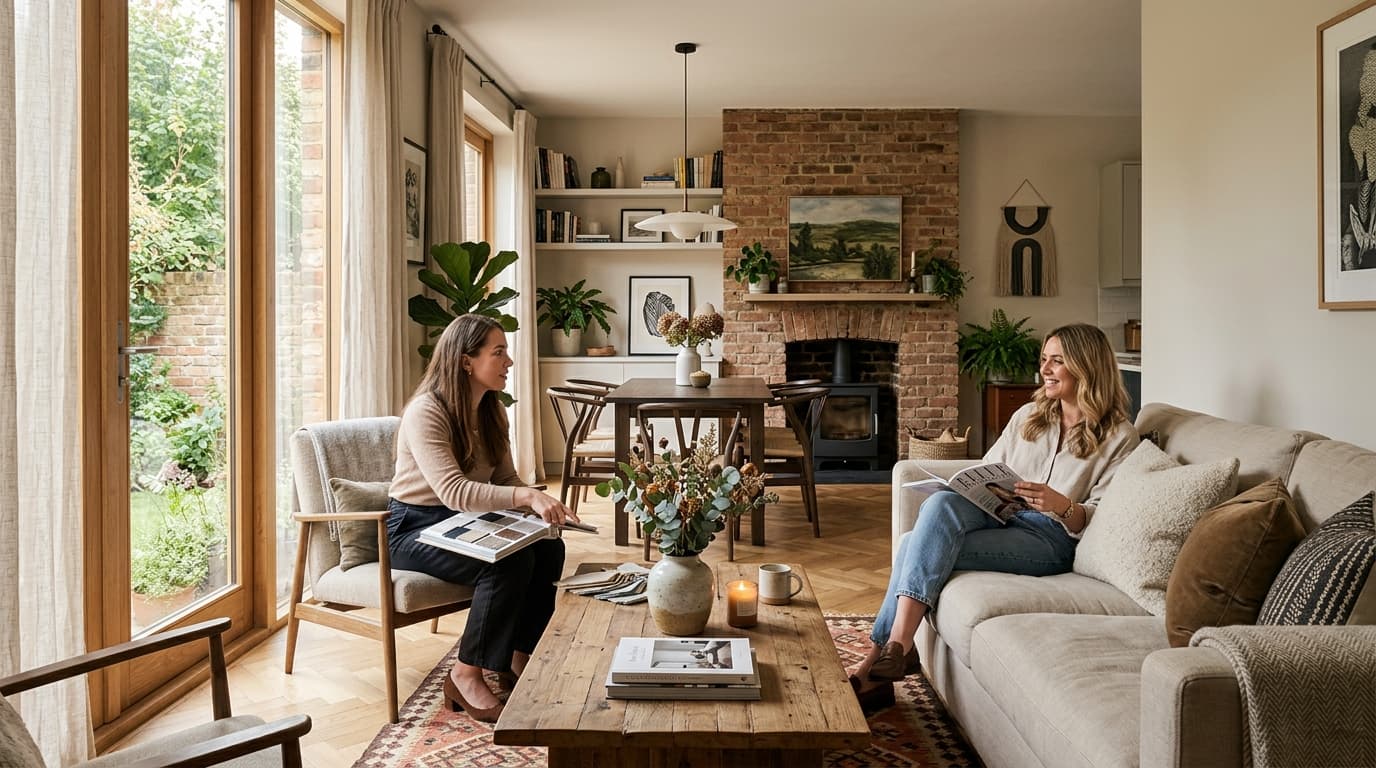
Initial consultations deserve special mention. Most designers charge £150-£350 for a two-hour interior design consultation what to expect session. This investment buys you professional eyes on your space, mood boards, preliminary sketches, and a shopping list. For many homeowners, this proves sufficient without proceeding to full design services.
What to expect from your first consultation
Walking into your first design consultation feeling uncertain is completely normal. The best designers make this process collaborative rather than prescriptive.
Expect your designer to spend significant time asking questions. They'll probe how you actually use each room, who lives in the house, whether you entertain frequently, and what frustrates you about your current layout. We recommend preparing photographs of rooms or styles you love—Pinterest boards work brilliantly for this—even if you can't articulate why something appeals to you.
A good consultant will also assess practical constraints. They'll measure rooms, note architectural features worth highlighting, identify problem areas (awkward radiator placements, poor natural light, dated features), and discuss your budget candidly. This honesty matters enormously. Designers who promise the world on unrealistic budgets create disappointment.
You should leave with actionable next steps. This might include paint colour recommendations with specific brand codes (Farrow & Ball, Little Greene, or Dulux ranges), furniture layouts showing improved flow, lighting suggestions, and a phased implementation plan if budget requires spreading costs. Many designers provide a written summary document—if this isn't offered automatically, request it.
The consultation also serves as a compatibility test. Chemistry matters when someone's helping shape your home. If the designer talks over you, dismisses your ideas, or pushes a signature style regardless of your preferences, walk away. Our directory of interior design professionals across the UK gives you options—use them.
Is an interior designer worth the money?
This question deserves a nuanced answer because it genuinely depends on your circumstances, skills, and the complexity of what you're attempting.
Designers prove their worth most clearly in three scenarios. First, when you're tackling structural changes alongside aesthetic updates. An experienced designer coordinates with architects and builders, catches planning mistakes before they're built, and ensures Building Regulations compliance doesn't compromise your vision. They speak the language of contractors, which saves you becoming a reluctant project manager.
Second, for open plan living room design ideas UK homes particularly need. Knocking through walls creates spatial opportunities but also challenges: how do you zone areas without physical barriers? Where should lighting be positioned? How do you maintain acoustics and warmth? Designers solve these problems daily. The RIBA (Royal Institute of British Architects) reports that well-designed open-plan spaces add 5-10% to property values—potentially offsetting design fees entirely.
Third, when decision paralysis sets in. Homeowners frequently stall renovations for months, overwhelmed by choices. A designer provides frameworks for decision-making and prevents expensive mistakes. That £3,000 design fee looks reasonable compared to £8,000 worth of wrong-sized furniture gathering dust.
Designers may not justify their cost if you're simply refreshing a room with new soft furnishings, you have strong existing vision and just need execution help, or your budget is genuinely tight (under £5,000 total). Many homeowners in Birmingham and Manchester successfully use free design consultations from retailers like John Lewis or Heal's, then implement independently.
According to a 2023 Houzz UK survey, 73% of homeowners who used designers reported complete satisfaction, versus 51% who went it alone. That satisfaction gap represents real value.
What interior design style suits my home?
Matching design style to your property's architecture and your lifestyle creates coherence that fighting against your home's bones never achieves.
Japandi interior design style explained has gained tremendous traction in UK homes recently, particularly in new-builds and modern conversions. This fusion of Japanese minimalism and Scandinavian functionality emphasises natural materials (oak, bamboo, linen), neutral palettes with warm undertones, minimal ornamentation, and quality over quantity. It suits open-plan layouts brilliantly because the style inherently creates calm, uncluttered spaces. IKEA's recent collaboration with Japanese designers brought Japandi accessibility to UK high streets, making the aesthetic achievable at various price points.
Victorian and Edwardian terraces—abundant across London, Bristol, and northern cities—cry out for respectful period styling or bold contemporary contrast. Half-measures rarely work. Either embrace picture rails, deep colours (Farrow & Ball's Railings or Hague Blue), pattern mixing, and vintage furniture, or go completely contemporary with white walls, stripped floors, and modern furniture that celebrates the architectural envelope without mimicking period details.
Georgian and older properties demand particular sensitivity. Their proportions were designed for specific furniture scales and lighting conditions. Modern minimalism can look cold and wrong in these spaces. We've seen successful Georgian interiors blend antiques with contemporary art and lighting—the contrast works when you respect the room's bones.
New-builds and 1960s-80s properties offer blank canvases with fewer architectural constraints. Industrial style (exposed brick, metal accents, concrete), mid-century modern, or Scandi all work beautifully. These properties particularly benefit from professional space planning since their rooms often lack character you can emphasise.
Colour psychology in interior design deserves serious consideration beyond simply choosing shades you like. Blues and greens genuinely reduce stress responses—backed by environmental psychology research from the University of Sussex. They work beautifully in bedrooms and bathrooms. Warm terracottas and ochres stimulate appetite and conversation, making them ideal for dining areas. Greys create sophistication but can feel cold in north-facing rooms; adding warm undertones (greige rather than pure grey) prevents this.
Pale colours demonstrably make small rooms feel larger by reflecting light, but dark colours create drama and intimacy in larger spaces that might otherwise feel cavernous. Many UK living rooms benefit from deeper colours simply because our light levels suit them. The notion that small spaces must be white is outdated—dark colours can make dimensions harder to perceive, creating mystery rather than obvious smallness.
Open-plan living: getting it right
British homes have embraced open-plan living enthusiastically over the past two decades, but execution separates successful spaces from echoey, draughty disappointments.
Zoning proves essential. Without walls, you need other devices to define areas: changes in flooring material (tiles to wood), rugs anchoring furniture groups, lighting zones on separate circuits, and partial-height dividers (bookshelves, glass screens, or peninsular kitchen units). We recommend planning at least three distinct zones in typical kitchen-diner-living spaces: cooking, eating, and relaxing. Each needs appropriate lighting, electrical outlets, and furniture scale.
Acoustics require specific attention. Hard surfaces (wooden floors, glass, plaster) create reverberation that makes conversation exhausting. Introduce sound absorption through upholstered furniture, heavy curtains, rugs, and acoustic panels disguised as art. Building Regulations Part E addresses sound transmission between dwellings but says nothing about acoustics within open spaces—this falls to you or your designer.
Heating and ventilation challenges multiply in open-plan spaces. You're heating larger volumes, and cooking smells travel everywhere without doors. Budget for powerful extraction (minimum 600m³/hour for kitchen areas) and consider underfloor heating, which distributes warmth more evenly than radiators. The Energy Saving Trust notes that poorly zoned open-plan heating can increase bills 15-20%.
If you're planning structural work to create open-plan spaces, involve fitted kitchens specialists early. Kitchen layout fundamentally shapes how open-plan spaces function, and retrofitting around poor kitchen design proves frustrating and expensive.
Finding the right designer for your project
The UK interior design market ranges from one-person consultancies to large firms, with varying specialisms, styles, and price points. Finding your match requires more than scrolling Instagram.
Start by defining your budget and scope honestly. Approaching a high-end designer with a £3,000 budget wastes everyone's time. Browse portfolios specifically for projects similar in scale and style to what you envision. Many designers specialise—period properties, sustainable design, small spaces, or particular aesthetics. This specialisation brings efficiency that generalists can't match.
Check credentials selectively. BIID (British Institute of Interior Design) and SBID memberships indicate professional training and standards, but excellent designers exist outside these bodies too. What matters more: relevant project experience and references you can contact.
Request detailed proposals from 2-3 designers before committing. These should specify exactly what's included (concepts, drawings, project management, procurement), payment schedules, and how variations are handled. Vague proposals create dispute later.
Our directory of verified interior design businesses across the UK helps homeowners compare local options efficiently. You can browse all categories to find related specialists like bathroom specialists if your project spans multiple areas. Designers working on your project should complement each other rather than clash.
Trust your instincts during initial conversations. Designers should listen more than they talk in early meetings. If someone's already decided what your home needs before understanding how you live, reconsider.
Making the most of your designer relationship
Once you've committed to working with a designer, several practices ensure you get maximum value.
Be honest about budget from day one, including contingency. Designers can't create appropriate solutions if they're guessing at financial constraints. Most recommend holding back 10-15% for unexpected issues—sensible advice given that UK renovation projects typically encounter at least one surprise.
Communicate openly about what's negotiable and what isn't. If you're emotionally attached to existing furniture, say so immediately. If you hate pattern, speak up before your designer develops a scheme around printed fabrics. These aren't awkward constraints—they're essential parameters.
Respect the process and timelines. Design development takes time. Rushing decisions leads to regret. Most residential projects require 2-4 weeks for initial concepts, another 2-3 weeks for refinement, then procurement and installation timelines on top. Pressure doesn't improve outcomes.
Provide feedback constructively. "I hate it" doesn't help; "the colour feels too cold for me" or "this furniture scale feels wrong for the room" gives designers actionable direction. Remember they're not mind readers, and preferences you consider obvious may not be.
Understand that good designers sometimes push back on your ideas. If you're paying for expertise, ignoring professional advice wastes money. Consider their reasoning carefully before overruling recommendations.
Regional considerations and finding local expertise
Design trends, pricing, and material availability vary significantly across UK regions. Understanding these differences helps set realistic expectations.
London and the South East command premium pricing—typically 30-50% above northern regions—but also offer greatest choice of specialists, suppliers, and high-end showrooms. Competition paradoxically makes both the most expensive and potentially best value, depending on who you hire.
Scotland's design community particularly excels at working with period properties and challenging climates. Designers here understand moisture management, heating efficiency, and maximising limited daylight—expertise directly applicable to older properties throughout the UK.
The Midlands and North offer excellent value, with talented designers charging more accessible rates. Cities like Manchester, Leeds, and Birmingham support vibrant design communities serving everything from terraced renovations to new-build developments. Finding qualified professionals in these markets is straightforward through directories like HouseJester's company directory covering 472,000+ UK businesses.
Seaside and rural locations present specific challenges: salt air corrosion, limited trade access, and higher material delivery costs. Designers familiar with these contexts save you from expensive material failures and scheduling nightmares.
If you're looking for local expertise, searching by city—whether London, Manchester, or Birmingham—helps you find designers who understand regional property types, planning requirements, and supplier networks.
The future-proofing question
Smart design considers not just current needs but how your life might evolve. Designers should ask about future plans: growing families, aging in place, potential resale, or rental income.
Accessibility features increasingly appear in mainstream design rather than retrofit additions. Wider doorways, level-access showers, and good lighting benefit everyone whilst maintaining adaptability. Building Regulations Part M sets minimum accessibility standards for new builds and extensions—good designers exceed these minimums without creating institutional aesthetics.
Sustainability has shifted from niche concern to standard consideration. This means specifying durable materials over fast-fashion furniture, choosing natural fibres, planning for disassembly and future reuse, and considering embodied carbon. Many UK designers now actively source vintage and reclaimed pieces, which often cost less than new whilst offering better quality.
Technology integration requires forethought. Smart lighting, heating controls, and entertainment systems need infrastructure planned during renovation, not bodged in afterward. Discuss these requirements explicitly—designers aren't necessarily tech experts but can coordinate with specialists.
Taking the next step
Transforming your home through professional interior design services represents a significant investment, but one that pays dividends in daily enjoyment, functionality, and often property value.
Start small if you're uncertain. A single-room project or initial consultation provides experience working with designers without overwhelming commitment. Many homeowners begin with a kitchen or main bedroom, then expand to other areas once they've seen results.
Gather inspiration but avoid Pinterest paralysis. Collect images of spaces you love, but focus on identifying common threads—colour palettes, lighting qualities, furniture styles—rather than trying to replicate specific rooms. Your designer synthesises these preferences into something unique to your home.
Be realistic about timelines. Quality design and execution can't be rushed. From initial consultation to project completion, expect 3-6 months minimum for single rooms, 6-12 months for whole-home projects. Factor this into life planning—Christmas deadlines rarely end well.
Browse Interior Design businesses on HouseJester to find qualified professionals in your area. Our verified directory helps you compare local specialists, read verified reviews, and make informed decisions. You can also list your business if you're a design professional looking to connect with homeowners seeking expertise.
Your home should work beautifully for how you actually live, not how magazines suggest you should. The right interior design partnership makes that vision achievable, enjoyable, and worth every pound invested.
Sources & Further Reading
- Society of British and International Interior Design (SBID) - Professional body offering designer verification and industry standards
- British Institute of Interior Design (BIID) - Accreditation body with designer directory and homeowner guidance
- The RIBA (Royal Institute of British Architects) - Resources on integrating interior design with architectural projects and Building Regulations compliance
This article was created with AI assistance and reviewed by the HouseJester editorial team for accuracy and relevance.
Written by
Sarah Mitchell
Interior Design Editor
Sarah has spent over 12 years covering UK interiors and design trends. She works closely with interior designers and soft furnishings specialists across the country to bring readers expert insights on creating beautiful, functional living spaces.
- Interior Design
- Soft Furnishings
- Paint & Wallpaper
- Lighting