
On this page
Introduction
Choosing to work with interior design services UK professionals can transform your home from functional to exceptional. Yet many homeowners remain unclear about what designers actually do, how much they charge, and whether the investment delivers genuine value. We've compiled answers to the most frequently asked questions we hear from UK homeowners considering professional design help. Based on insights from our directory of verified interior design specialists across England, Scotland, Wales, and Northern Ireland, this guide cuts through the confusion.
Key Takeaways
- Interior designers in the UK typically charge £50-200 per hour, with full room designs ranging from £1,500-8,000+ depending on complexity and location
- Professional designers save you money by avoiding costly mistakes, negotiating trade discounts, and creating cohesive schemes that enhance property value
- Colour psychology principles can dramatically affect mood and perceived space in your home
- Open plan living requires careful zone planning to balance family life with entertaining needs
- Regional pricing varies significantly, with London designers charging 30-50% more than those in Manchester, Birmingham, or Newcastle
How much does it cost to hire an interior designer UK?
The answer depends entirely on your project scope and chosen payment structure. We've seen three main pricing models across the UK market.
Hourly rates remain the most transparent option. Expect £50-80 per hour outside London, rising to £100-200 per hour for experienced London designers. A typical consultation lasts 2-3 hours, meaning you'll pay £150-600 for initial advice.
Fixed project fees suit larger renovations better. A single room design package typically costs £1,500-3,000, covering mood boards, layouts, lighting plans, and supplier recommendations. Whole-house projects start around £5,000 and can exceed £25,000 for luxury properties requiring architectural liaison and bespoke furniture commissioning.
Percentage-based fees see designers charging 10-20% of the total project budget. This works well for extensive renovations where the designer manages contractors and procurement. The British Institute of Interior Design suggests this model aligns designer and client interests, as both benefit from value-conscious purchasing.
How much does an interior designer cost UK homeowners in real terms? According to our analysis of HouseJester-listed professionals, most residential projects fall between £3,000-12,000 for design services alone. This excludes furniture, materials, and contractor fees.
Regional variations matter significantly. Manchester designers might quote £2,500 for a living room redesign that would cost £4,500 in London. Birmingham rates tend to sit comfortably in the middle ground.
Is an interior designer worth the money?
Absolutely, but only if you're willing to implement their recommendations properly.
Designers prevent expensive mistakes. That seemingly perfect sofa might block natural light flow or overwhelm your room's proportions. We've worked with homeowners who spent £8,000 on furniture that simply didn't work together. A £500 consultation would have saved them considerable grief and expense.
Trade discounts offset fees substantially. Established designers access trade-only suppliers and negotiate 20-40% discounts on furniture, fabrics, and lighting. These savings often cover their design fees entirely on projects exceeding £15,000 in furnishings.
Property value increases justify the investment. Estate agents consistently report that well-designed homes sell faster and achieve 5-10% higher prices than comparable properties with dated or poorly conceived interiors. The Royal Institution of Chartered Surveyors confirms that good design represents one of the most cost-effective home improvements for resale value.
Time savings matter enormously. Sourcing furniture, comparing finishes, coordinating contractors, and managing installations consume weeks of your time. Designers handle this professionally whilst you continue earning your salary.
What is an interior design consultation and what to expect?
An interior design consultation what to expect guide should cover these typical elements.
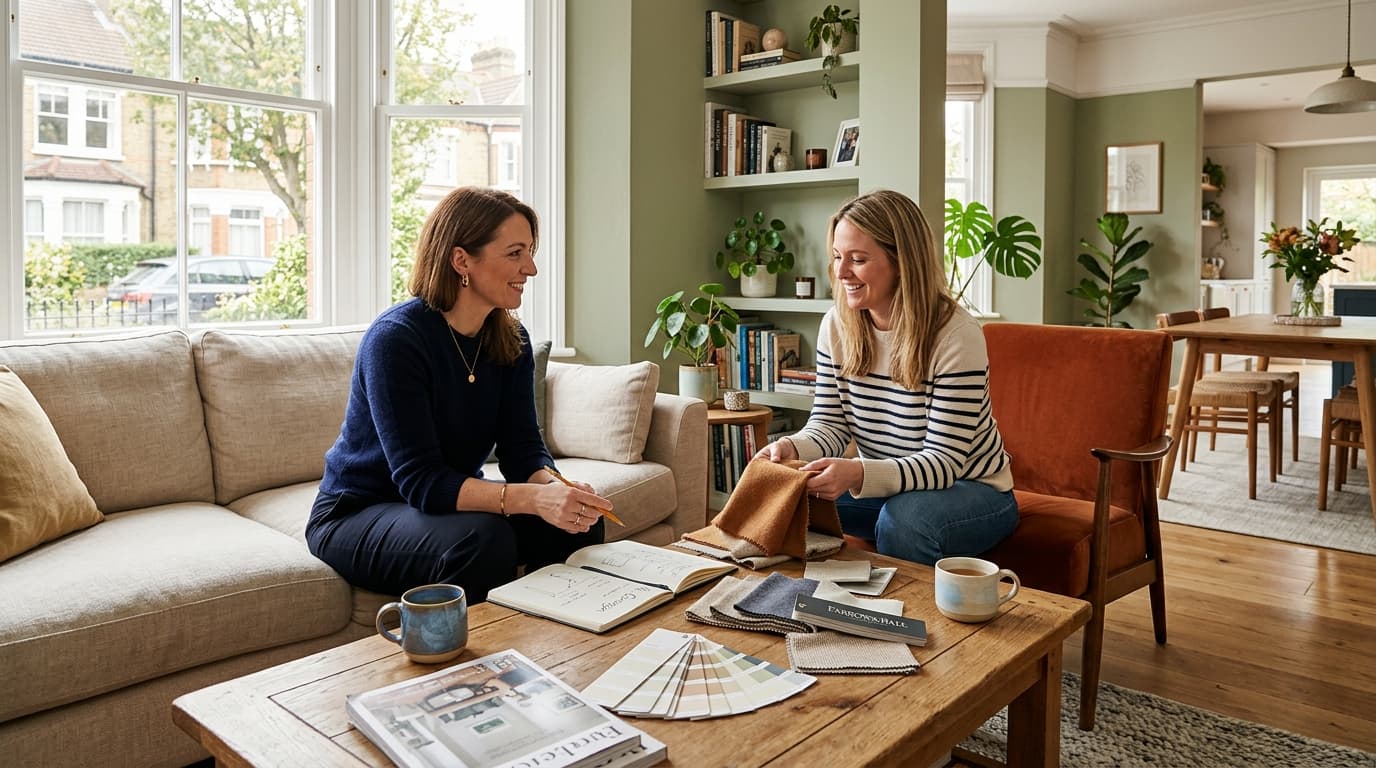
Most initial consultations last 90 minutes to 2 hours at your property. The designer will photograph rooms, take detailed measurements, and discuss your lifestyle needs, aesthetic preferences, and budget parameters. Expect questions about how you use each space, storage requirements, and colour preferences.
You'll receive preliminary recommendations within 1-2 weeks. These typically include mood boards showing colour palettes, style direction, spatial layouts, and reference images. Some designers provide this as a fixed-fee package (£400-800), whilst others offer a free initial consultation if you proceed with the full project.
Bring inspiration images, but don't expect literal recreation. Pinterest boards help communicate preferences, but good designers interpret your taste rather than copying others' homes. They'll identify which elements suit your specific space and budget.
Be honest about numbers. Designers can't create miracles with unrealistic budgets. A £3,000 budget won't transform a large living room with new furniture, lighting, flooring, and window treatments. Transparent conversations prevent disappointment and wasted fees.
Check qualifications carefully. Members of the British Institute of Interior Design or Interior Designers & Decorators Association maintain professional standards and insurance. Our browse all categories page helps you find appropriately qualified specialists across multiple home improvement sectors.
What is the difference between interior design and decorating?
The distinction matters more than many homeowners realise.
Interior designers address spatial planning, lighting design, building regulations compliance, and functional layouts. They work with architects on structural changes, specify technical elements like acoustic treatments, and understand Building Regulations Part M (accessibility) and Part F (ventilation). Their training covers architectural principles, ergonomics, and construction processes.
Interior decorators focus on aesthetic finishes: paint colours, wallpaper, soft furnishings, and accessories. They won't typically redesign room layouts or specify electrical installations. Think of decorating as the final layer applied to an already functional space.
For simple refreshes—new paint, curtains, and cushions—a decorator suffices and costs less. For structural changes, space replanning, or technical challenges like awkward room proportions, hire a qualified interior designer.
Many professionals offer both services, which creates market confusion. Always clarify their qualifications and precisely what their fee includes before committing.
What interior design style suits my home?
Architectural context should guide your decision more than personal taste alone.
Victorian and Edwardian properties suit traditional or transitional styles that respect original features whilst introducing modern comfort. Ripping out period details rarely improves these homes. We recommend working with designers experienced in period properties who understand how to integrate contemporary kitchens and bathrooms without compromising character.
Post-war and modern builds offer more stylistic freedom. The japandi interior design style explained concept—a fusion of Japanese minimalism and Scandinavian functionality—works beautifully in these neutral boxes. This approach emphasises natural materials, uncluttered spaces, and quality over quantity. Expect oak, linen, ceramics, and muted earth tones.
1930s semi-detached houses present specific challenges with their compartmentalised layouts. Many homeowners exploring open plan living room design ideas UK professionals recommend find these properties ideal candidates. Removing the wall between dining room and kitchen creates flexible family spaces whilst retaining a separate lounge for quieter activities.
Consider resale implications if you're not in your forever home. Highly personal or trendy schemes date quickly. Contemporary classic styles—clean lines, quality materials, neutral bases with accent colours—appeal to broader markets.
How do I create a colour scheme for my home?
Colour psychology in interior design principles provide a scientific starting point.
Blues reduce heart rate and blood pressure, making them ideal for bedrooms and bathrooms where relaxation matters. Darker navy shades like Farrow & Ball's Hague Blue create cocooning evening spaces, whilst pale duck eggs suit north-facing rooms needing brightness.
Yellows and oranges stimulate conversation and appetite—hence their popularity in kitchens and dining areas. Use cautiously in large doses, as they can overwhelm. Dulux's 'Honey Glow' or Little Greene's 'Mister David' offer sophisticated takes on these energising hues.
Greens connect us to nature and suit virtually any room. From sage to emerald, green's versatility makes it Britain's favourite interior colour according to recent surveys. Breathing Space by Crown Paints perfectly captures the calming mid-tone green that works in both traditional and contemporary settings.
Neutrals remain the safest whole-home choice. Warm greys like Cornforth White (Farrow & Ball) or cooler tones like Goose Down (Farrow & Ball) provide flexible backdrops. Layer three shades of your chosen neutral—walls, woodwork, and ceilings—to create subtle depth.
Test properly before committing. Purchase sample pots (£3-5 at B&Q or Homebase) and paint A2-sized boards. Move these around your room throughout the day, observing how natural and artificial light affects the colour. Northern light casts blue tones, making warm colours appear muddy and cool colours harsh. Southern light enhances warm palettes beautifully.
The 60-30-10 rule simplifies scheme creation: 60% dominant colour (usually walls), 30% secondary colour (upholstery, curtains), and 10% accent colour (cushions, artwork). This proportion feels balanced to the human eye.
How do I find a good interior designer near me?
Personal recommendations trump online searches, but verified directories help when you're new to an area.
Our HouseJester platform features verified interior design professionals across the UK, allowing you to filter by location, specialisation, and project type. Reading genuine reviews from other homeowners provides insight into communication styles, punctuality, and budget management.
Portfolio review reveals far more than credentials. Do their previous projects reflect the aesthetic and budget level you're targeting? A designer specialising in £500,000 renovations won't easily adapt to your £15,000 refresh—and nor should they need to.
Meet at least three designers before deciding. Chemistry matters enormously. You'll spend months discussing personal preferences, lifestyle habits, and financial priorities. Choose someone you'd happily invite for coffee.
Check professional memberships and insurance. The British Institute of Interior Design maintains a searchable register of qualified members. Professional indemnity insurance (typically £2-5 million coverage) protects you if design errors cause financial loss.
Request detailed proposals comparing scope of work and deliverables. "Full design service" means different things to different designers. Clarify whether fees include site visits during installation, contractor liaison, and styling with accessories. Itemised proposals prevent scope creep and additional charges later.
For specialist projects—such as fitted kitchens or bathroom specialists requiring technical knowledge—seek designers with relevant experience. Kitchen design involves plumbing, electrical, and ventilation complexities that pure decorators won't necessarily understand.
You can search our company directory to compare qualified professionals across all home improvement categories, ensuring you find the right expertise for your specific project.
Open Plan Living: Getting It Right
The open plan living room design ideas UK homeowners request most frequently involve kitchen-diner-lounge combinations. These require careful planning to succeed.
Zoning prevents the "big barn" feeling. Use furniture placement, lighting layers, and flooring changes to delineate cooking, dining, and relaxing areas without physical barriers. An L-shaped sofa with its back to the kitchen creates subtle separation whilst maintaining sightlines.
Acoustics matter more than most people anticipate. Hard surfaces—tiles, glass, painted walls—create echo chambers. Incorporate soft furnishings, acoustic panels disguised as artwork, and textured materials to absorb sound. Building Regulations Part E governs sound transmission between properties but doesn't address internal acoustics, so this falls entirely to good design.
Extraction and ventilation become critical. Part F of Building Regulations mandates minimum ventilation rates, but go beyond minimums with a powerful extractor hood (minimum 600m³/hour for open plan spaces) to prevent cooking smells permeating soft furnishings.
Lighting flexibility transforms usability. You need task lighting over kitchen counters and dining tables, plus ambient lighting creating evening atmosphere. Multiple circuits controlled by dimmer switches (£25-45 per dimmer at Screwfix) allow you to adjust lighting to activities.
Heating these volumes efficiently challenges outdated systems. Underfloor heating works brilliantly in open plan spaces, providing even temperature distribution without radiators consuming valuable wall space. Expect £75-100 per m² installed, excluding floor finishes.
Taking the Next Step
Professional interior design services deliver measurable value through space optimisation, cost-effective purchasing, and increased property values. Whether you're planning a single-room refresh or whole-house transformation, investing in expert guidance prevents costly mistakes and delivers cohesive, functional results.
Ready to transform your home? Browse interior design businesses on HouseJester to find verified professionals serving your area. Our directory includes detailed profiles, genuine reviews, and direct contact details for specialists across every UK region.
Design professionals looking to reach homeowners actively seeking services can list your business on HouseJester to join our growing community of verified home improvement specialists.
Sources & Further Reading
- British Institute of Interior Design (BIID) - Professional standards, designer register, and consumer guidance
- Royal Institution of Chartered Surveyors (RICS) Home Survey Service - Property valuation insights including design impact
- Building Regulations Approved Documents - Parts E, F, and M covering sound, ventilation, and accessibility requirements
This article was created with AI assistance and reviewed by the HouseJester editorial team for accuracy and relevance.
Written by
Sarah Mitchell
Interior Design Editor
Sarah has spent over 12 years covering UK interiors and design trends. She works closely with interior designers and soft furnishings specialists across the country to bring readers expert insights on creating beautiful, functional living spaces.
- Interior Design
- Soft Furnishings
- Paint & Wallpaper
- Lighting