
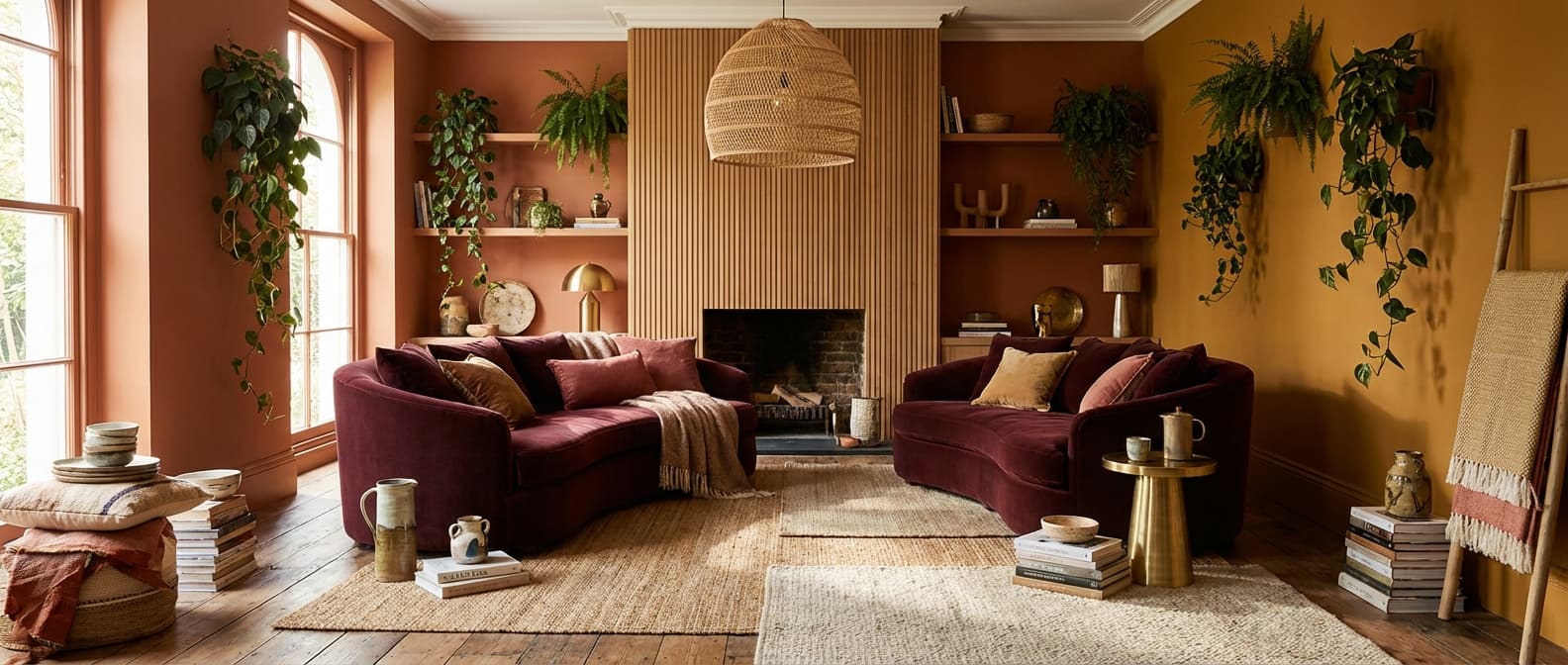
UK interiors are undergoing a quiet revolution in 2026. The cool, grey-dominated aesthetics that defined the last decade are giving way to warmer, richer, more tactile spaces that feel grounded and inviting. From the colours on our walls to the shapes of our furniture, the materials we choose, and the technology we integrate, this year's trends reflect a collective desire for homes that feel genuinely comfortable, authentically personal, and environmentally responsible.
Here is your definitive guide to what is shaping UK interiors right now — and what is quietly being left behind.
Colour: Warm Earth Tones Replace Cool Greys
In: Rich chocolate browns, sage and forest greens, Dulux's indigo blues, warm terracotta, mushroom taupes, and Pantone's 2026 Colour of the Year, Cloud Dancer — a soft, warm off-white with creamy undertones that feels embracing rather than clinical.
Out: Cool greys, stark whites, and the ubiquitous greige that dominated the 2010s and early 2020s.
The shift is unmistakable. UK homeowners are craving warmth, and colour is delivering it. Chocolate brown — once dismissed as dated — has returned with sophistication, appearing on feature walls, kitchen cabinetry, and upholstered furniture. Deep sage greens (think English countryside rather than tropical jungle) create calm, nature-connected bedrooms and living rooms. Indigo blue adds depth and drama to studies, dining rooms, and powder rooms.
The common thread is warmth and earthiness. Even neutral palettes are shifting: cold greys are giving way to warm putty, oatmeal, and clay tones that feel organic and restful. Pantone's Cloud Dancer captures this perfectly — it is not a cold, bright white but a gently warm, enveloping neutral that pairs beautifully with natural materials.
Designers listed on HouseJester can help you navigate colour selection and create schemes that work with your home's natural light.
The Neo Deco Movement
In: Art Deco-inspired details — fluted columns, fan-arch motifs, curved niches, metallic accents in brushed brass and burnished gold, and geometric patterns with a 1930s spirit.
Out: Purely minimalist interiors with no decorative detail, bare industrial aesthetics, and exposed brick as a default feature.
Neo Deco is the defining decorative movement of 2026. It takes the glamour and geometric precision of Art Deco and reinterprets it for contemporary living — less Gatsby excess, more refined elegance. Fluted detailing appears on everything from kitchen island panels and bathroom vanity units to console tables and wardrobe doors. Arched niches with integrated lighting create architectural interest on plain walls. Brushed brass hardware, metallic pendant lights, and gold-toned mirror frames add warmth and sophistication without feeling ostentatious.
A fluted kitchen island, a fan-arch mirror in a hallway, or a velvet headboard with brass legs can introduce the look without overwhelming a scheme.
Curved Furniture Over Angular
In: Softly curved sofas with rounded arms, kidney-shaped coffee tables, arched bookcases, circular dining tables, and organically shaped armchairs upholstered in bouclé or textured linen.
Out: Sharp-edged, boxy furniture with strict right angles, hard-lined modular sofas, and angular coffee tables.
Curves are everywhere in 2026 interiors. Sofas with gently rounded backs and rolled arms have replaced the square-armed, low-slung designs that dominated for a decade. Coffee tables feature soft organic shapes — pill-shaped, oval, and free-form silhouettes in natural stone, solid wood, and terrazzo. Dining tables are increasingly round or oval, encouraging conversation and creating a softer flow in open-plan spaces.
The psychological appeal is real: curved forms are inherently more welcoming and soothing than sharp angles. In open-plan living spaces (now the default in new-build homes), curved furniture helps define zones without creating hard visual barriers.
Dark Woods Over Light Oak
In: Walnut, dark oak, smoked timber, ebonised wood, mahogany tones — rich, warm, and deeply grained.
Out: Pale Scandinavian-inspired light oak and bleached timber that dominated kitchens and furniture through the 2010s.
The love affair with pale, Nordic-inspired wood is cooling. In its place, dark, characterful timbers are making a confident return. Walnut — with its rich, warm brown tones and striking grain — is the wood of the moment, appearing in dining tables, kitchen cabinetry, bedroom furniture, and flooring. Dark-stained oak and smoked timber finishes add depth and gravitas to living rooms and studies.
This does not mean Scandinavian simplicity is dead — rather, it is evolving. The best 2026 interiors combine dark wood furniture with lighter wall colours and natural textiles, creating warmth and contrast rather than the all-over-light palette that could sometimes feel washed out.
Biophilic Design Goes Mainstream
In: Indoor planting integrated into architecture (living walls, plant shelves, window greenhouses), natural light maximisation, organic materials, nature-inspired colour palettes, and views to gardens through large-format glazing.
Out: Artificial or purely decorative indoor planting as a trend accessory; sealed, light-starved rooms; plastic imitation plants.
Biophilic design — the principle of connecting interior spaces with nature — has moved from design-world theory to mainstream practice. Architects and interior designers are incorporating natural elements as structural features rather than decorative afterthoughts. Kitchen designs include herb gardens integrated into windowsills. Bathroom designs feature natural stone, pebble features, and plants that thrive in humidity. Living rooms are arranged to maximise natural light and frame garden views.
The evidence base is compelling: research consistently shows that natural elements in interiors reduce stress, improve concentration, and enhance wellbeing. In a work-from-home era, this is not merely aesthetic — it is functional.
Material Honesty
In: Honed stone, limewash paint, patina leather, raw plaster, brushed and oxidised metals, handmade ceramics with visible imperfections, and dark woods that show their natural grain.
Out: Polished, perfect, mass-produced surfaces; high-gloss everything; plastic-wrapped furniture masquerading as something it is not.
2026 interiors celebrate the authenticity of real materials. Limewash paint — with its chalky, subtly uneven finish and beautiful depth of colour — has become the wall finish of the moment, replacing flat emulsion in living rooms and bedrooms. Honed (matt) marble and limestone replace polished stone, showing the natural beauty of the material without the reflective sheen. Leather is chosen for its ability to age and develop patina rather than being treated to resist it.
This trend extends to ceramics (handmade tiles with slight irregularities), metals (brushed and oxidised finishes rather than mirror-polished chrome), and textiles (nubby, textured weaves rather than smooth, synthetic perfection). The message is clear: real materials, honestly expressed, age gracefully and create interiors with soul.
Kitchen-Living Integration
In: Kitchen cabinetry that extends seamlessly into the living area, creating a continuous furniture language across open-plan spaces. Sage green, olive, mushroom, and terracotta replacing ubiquitous grey and white cabinetry.
Out: The kitchen as a visually separate zone within an open-plan space, with a hard line between kitchen units and living furniture. All-white kitchens.
The boundary between kitchen and living room continues to dissolve. In 2026, the most forward-thinking kitchen designs extend their material language — cabinet finishes, handle profiles, and timber tones — into the adjacent living space. A bank of kitchen tall units flows into a living room bookcase or media unit in the same finish. The kitchen island serves as both a cooking workstation and a social hub.
Smart kitchen technology via the Matter protocol enables seamless connectivity between ovens, fridges, dishwashers, and home assistants without brand lock-in. Integrated wellness features — water filtration taps, air purification built into extractors, and circadian lighting — are moving from luxury to expected.
Browse fitted kitchen specialists on HouseJester to find companies working with these latest design directions.
Smart Home Integration via Matter
In: Invisible smart home technology that works seamlessly, allowing devices from different brands to communicate. Smart lighting controlled by elegant wall switches (not apps), automated heating, and motorised blinds that respond to daylight.
Out: Obvious, gadget-heavy smart home setups; smart speakers in every room as the primary control method; brand-locked ecosystems.
The Matter protocol has solved the compatibility problem, allowing homeowners to mix and match devices without ecosystem lock-in. The best smart homes feature elegant, design-conscious controls — keypads that look like premium light switches rather than tech gadgets. Smart lighting scenes, automated blinds, and zoned heating are the most popular applications, saving energy while enhancing daily comfort.
Sustainability as Standard
In: FSC-certified timber, recycled-content materials, low-VOC finishes, energy-efficient appliances, vintage and reclaimed furniture, buying less but buying better.
Out: Disposable, fast-furniture culture; greenwashing without substance; ignoring the environmental impact of interior choices.
With 78% of UK consumers now saying they prioritise eco-friendly products and materials, sustainability has moved from niche preference to baseline expectation. Reupholstery, furniture restoration, and material reuse are thriving. Quality over quantity is the defining philosophy — buying one beautiful, well-made piece rather than three disposable ones.
The Future Homes Standard is accelerating this shift, with low-VOC finishes, sustainably sourced materials, and energy-efficient specifications becoming regulatory expectations rather than optional upgrades.
How to Incorporate These Trends on a Budget
You do not need to renovate your entire home to embrace 2026 trends:
- Paint is the cheapest transformation: A feature wall in deep sage green or warm chocolate brown costs under £50. Limewash paint creates an on-trend textured finish at a similar price per tin.
- Swap cushions and throws: Introduce warm earth tones, bouclé textures, and curved shapes through affordable textile changes (£100-£300 for a living room refresh).
- Add curves with accessories: A round mirror (£30-£100), an organic-shaped vase (£15-£40), or a curved tray on a coffee table introduces the curved trend without new furniture.
- Dark wood through accessories: A walnut chopping board, a dark wood-framed mirror, or a reclaimed timber shelf adds warmth for under £100.
- Bring nature in: A few well-chosen houseplants in quality pots (£30-£80 per plant and pot) deliver instant biophilic impact.
- Upgrade hardware: Replace chrome handles and knobs with brushed brass for a Neo Deco touch (£5-£20 per piece — one of the highest impact, lowest cost changes you can make).
- Shop vintage: Secondhand furniture in rich dark woods and curved shapes is both on-trend and affordable.
- Smart lighting: A starter kit of smart bulbs (£40-£80) lets you adjust colour temperature from cool daylight to warm evening ambience.
Find a Designer Who Understands These Trends
Whether you are planning a full renovation or a room refresh, working with an interior designer ensures a cohesive result that will look as good in five years as it does today. Browse verified interior designers on HouseJester to find professionals who understand the latest trends and can translate them into a scheme that suits your home, your lifestyle, and your budget.
This article was created with AI assistance and reviewed by the HouseJester editorial team for accuracy and relevance.