
On this page
The UK appliance market has undergone significant transformation in 2024, with new energy labelling regulations, stricter efficiency standards, and a wave of innovative products changing how we shop for kitchen equipment. This comprehensive kitchen appliances guide UK covers everything homeowners need to know about the latest developments affecting washing machines, dishwashers, ovens, hobs, and refrigeration.
Key Takeaways
- New energy rating labels introduced in March 2024 have rescaled efficiency grades, making most appliances now rate between B and E rather than the old A+++ system
- Heat pump tumble dryers now cost £400-£900 but can save £50-£80 annually on energy bills compared to condenser models
- Induction hobs have dropped 15-20% in price since 2023, with decent models now available from £300
- Integrated appliances add £200-£400 per unit versus freestanding but improve kitchen aesthetics and resale value
- The best washing machine brands UK reliability surveys consistently rank Miele and Bosch at the top, with 10-year+ lifespans common
Understanding the New Energy Rating Labels Explained UK Appliances
The Energy Saving Trust confirmed in early 2024 that revised labelling has finally taken full effect across all appliance categories. Gone are the confusing A+++, A++, and A+ grades that dominated for over a decade. The new system runs from A (most efficient) to G (least efficient), though you'll struggle to find any A-rated products yet.
Most modern appliances now land between B and E ratings. That washing machine showing a C rating isn't mediocre—it's actually quite efficient under the tougher new standards. We've seen considerable confusion in our directory listings, with customers in London and Manchester questioning why their "downgraded" appliances cost more than old A++ models.
The new labels also include QR codes linking to the European Product Database for Appliances (EPREL), where you'll find detailed specifications, noise levels, and running costs. This transparency helps considerably when comparing models, though few retailers actively promote this feature.
According to Which?, the typical household can still save £50-£100 annually by choosing B-rated over E-rated appliances across a full kitchen suite. With energy prices remaining elevated throughout 2024, these savings matter more than ever.
What Is the Most Reliable Washing Machine Brand UK?
Reliability surveys from both Which? and consumer protection bodies consistently place Miele at the top, with Bosch following closely. Our experience working with appliances specialists across the UK confirms these findings.
Miele washing machines typically cost £800-£1,600—substantially more than mainstream brands—but failure rates under five years sit below 5%. Their 10-year+ lifespans make the cost per wash competitive. Bosch offers similar reliability at £400-£900, hitting a sweet spot for quality-conscious buyers without Miele's premium.
LG and Samsung dominate the mid-market (£350-£600) with feature-rich machines, though repair rates slightly exceed European manufacturers. AEG and Siemens, both part of larger manufacturing groups, perform well in the £450-£800 range.
Beko and Hotpoint serve the budget segment (£250-£400) adequately, though expect 5-7 year lifespans rather than 10+. For rental properties or temporary situations, they represent sensible value.
The best washing machine brands UK reliability data shows front-loaders significantly outlast top-loaders, and machines with fewer electronic features generally prove more durable. Simple dial controls beat touchscreens for longevity, though manufacturers increasingly push "smart" connectivity that adds failure points.
Capacity matters for reliability too. An 8kg drum running half-full lasts longer than a 6kg drum constantly maxed out. We recommend buying one size larger than your immediate need if budget permits.
Integrated vs Freestanding Dishwasher Comparison: What Makes Sense?
This decision affects both upfront costs and long-term kitchen flexibility. Integrated dishwashers hide behind cabinet doors for seamless aesthetics but cost £200-£400 more than equivalent freestanding models. A mid-range freestanding Bosch sits around £450-£550, while the integrated version costs £650-£800.
Integrated models require precise cabinet dimensions (typically 60cm width, though 45cm slimline versions exist) and professional installation adds £80-£150 depending on region. Birmingham and other Midlands cities tend towards the lower end; London installation easily hits £150-£200.
Freestanding units offer flexibility—you can take them when moving house or reposition them if kitchen layouts change. Integrated appliances stay with the property, which matters if you're in a starter home planning to move within five years.
For new fitted kitchens, integrated makes sense aesthetically and improves resale appeal. Period properties and rental situations favour freestanding for practicality. Semi-integrated models, where the control panel remains visible, split the difference at moderate cost premiums (£100-£200 over freestanding).
Noise levels become crucial with integrated units, as cabinet doors amplify sound. Look for models under 44dB—anything above 46dB proves noticeably louder in open-plan spaces. Bosch, Miele, and Neff lead for quiet operation.
Is an Induction Hob Better Than Ceramic?
The induction hob vs ceramic hob pros cons debate shifted decisively in 2024 as induction prices dropped substantially. Entry-level four-zone induction hobs now start around £300, down from £450-£500 two years ago. Ceramic hobs cost £200-£350 for comparable sizes.
Induction advantages:
- Boils water 40-50% faster than ceramic, saving time and energy
- Precise temperature control rivals gas for cooking performance
- Surface stays cooler (only the pan heats), improving safety with children
- Easier cleaning—spills don't burn onto the surface
- Energy efficiency roughly 90% versus 70% for ceramic
- Running costs approximately £40-£50 annually lower for typical use
Induction disadvantages:
- Requires magnetic cookware (cast iron, steel)—aluminium and copper pans won't work without adaptor discs
- Initial cookware investment of £150-£300 if replacing full set
- Some users report high-pitched humming with certain pan types
- Repairs cost more due to complex electronics
Ceramic makes sense only if you're strongly attached to non-magnetic cookware or have a very tight budget. Otherwise, induction's speed, safety, and running cost savings justify the premium. The Energy Saving Trust estimates induction saves £25-£40 annually versus ceramic for average households.
Gas remains available but faces uncertain long-term prospects as building regulations increasingly favour electric cooking for new builds. Many appliances retailers report declining gas hob sales in 2024.
Are Heat Pump Tumble Dryers Worth the Cost?
Heat pump dryers dominated sales growth in 2024, despite costing £400-£900 versus £180-£350 for vented or condenser models. The answer depends entirely on your usage patterns.
Heat pump technology recycles warm air rather than venting it, cutting energy consumption by 50-60%. For households running 3-4 loads weekly, annual savings reach £50-£80 on electricity. The premium of £250-£400 pays back in 4-6 years, after which you're ahead financially.
They also run cooler and gentler on fabrics, extending clothing lifespan—harder to quantify but valuable. Lower operating temperatures mean safer operation and less room heating in summer.
The downsides: longer cycle times (typically 2-2.5 hours versus 1-1.5 hours), more complex maintenance (condenser filters need regular cleaning), and higher repair costs. For single-person households doing 1-2 loads weekly, payback stretches beyond 8-10 years—probably not worth it.
Miele heat pump dryers (£900-£1,400) lead reliability surveys, but Bosch (£450-£700) offers better value for most buyers. Budget brands like Beko now produce competent heat pump models at £400-£500, though longevity remains unproven given the technology's relative newness at lower price points.
We've seen increased uptake in browse all categories of home improvement, particularly among environmentally conscious homeowners and those with solar panels who benefit most from lower consumption.
American Fridge Freezer vs Standard Size UK: Space and Running Costs
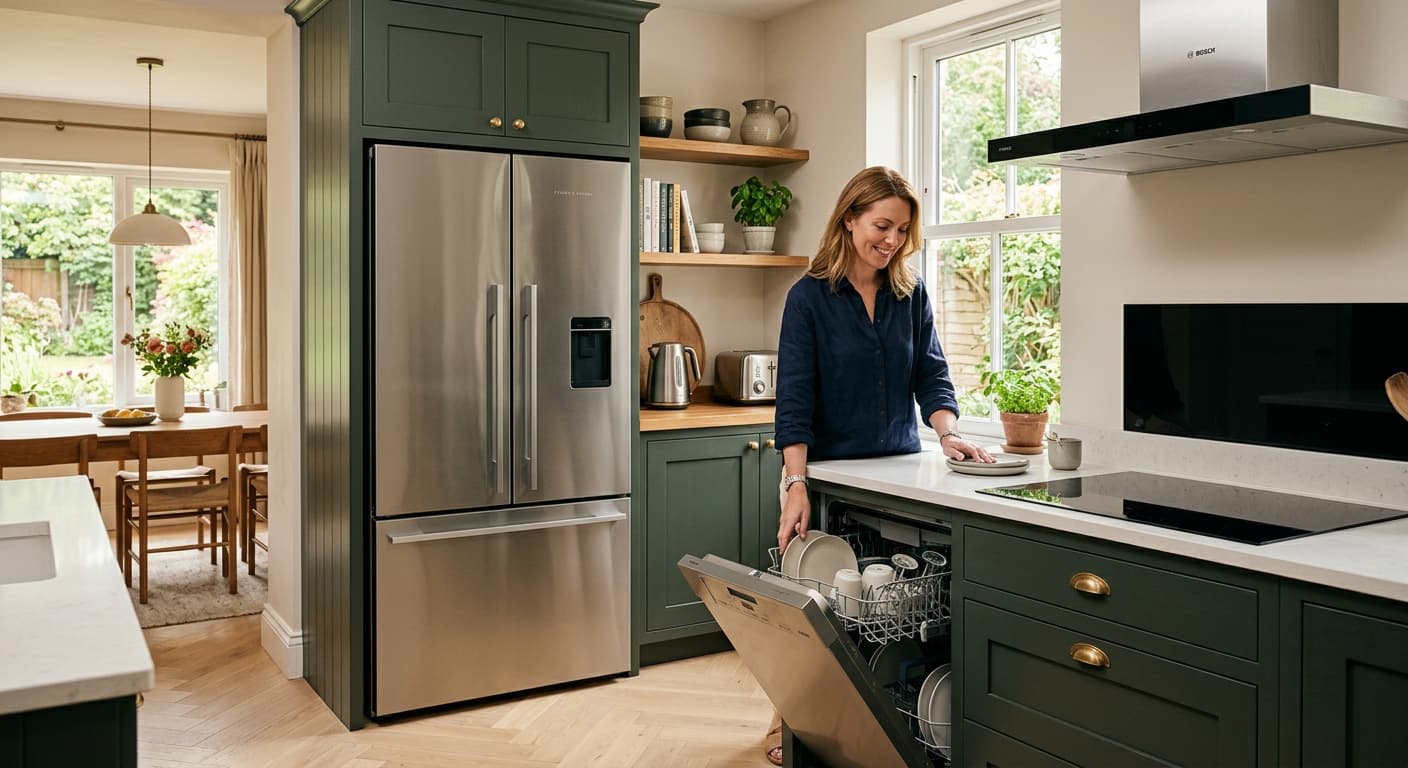
American-style fridge freezers surged in popularity during 2023-2024, but the practical realities often surprise buyers. These behemoths measure 90cm wide versus 55-60cm for standard UK models, requiring substantial kitchen space and doorway clearance.
American models cost £600-£2,500 (luxury brands reach £3,500+), while standard fridge freezers range £300-£900. Annual running costs differ significantly: American units consume 300-450 kWh yearly (roughly £100-£150 at current rates), standard models use 150-250 kWh (£50-£85).
The space argument seems obvious but proves deceptive. Yes, American models offer 500-700 litres total capacity versus 250-350 litres for standard UK units. However, they consume 3-4 square metres of floor space (considering clearance) versus 1.5-2 square metres for standard models. In absolute terms, standard models provide better storage per square metre occupied.
American fridges suit large families (5+ people), keen entertainers who store substantial quantities, or those with genuinely spacious kitchens. The integrated ice/water dispensers add convenience, though they increase failure points and require plumbing connections (budget £100-£200 for installation).
For typical UK households, a standard 60cm fridge freezer or even a 70cm model provides ample capacity at half the running cost and greater placement flexibility. The best American models (Samsung, LG, Hisense) now offer improved efficiency, but physics limits how economical they can become.
Several businesses in our search our company directory report customers downsizing from American to standard models after moves to smaller properties, struggling to sell used units due to limited demand.
Smart Appliances: Worthwhile Innovation or Unnecessary Complexity?
Connectivity features exploded across 2024 appliance ranges, with manufacturers pushing Wi-Fi-enabled everything. Our honest assessment: most smart features add minimal practical value while increasing costs £50-£150 per appliance and creating additional failure points.
Receiving notifications when your washing cycle completes sounds useful until you realise you're probably home anyway and can hear it. Remote oven preheating might help occasionally, but how often do you genuinely need it? Voice control through Alexa or Google Assistant works inconsistently and requires compatible ecosystems.
The exceptions: smart fridges with internal cameras (see contents remotely while shopping) provide genuine utility if you frequently shop without lists. Smart dishwashers that auto-order detergent refills via Amazon Dash save minor hassle. Diagnostic features that identify faults before engineer visits potentially save call-out fees (£60-£100).
Reliability concerns us most. Each connected feature represents another component that can fail, potentially rendering otherwise functional appliances unusable. Manufacturers routinely discontinue app support after 3-5 years, leaving "smart" appliances dumber than basic models.
Unless specific smart features solve problems you actually experience, we recommend saving the premium and buying higher build quality or better energy ratings instead. If you do want connectivity, stick to major brands (Samsung, LG, Bosch) most likely to maintain long-term software support.
Where to Buy: Retailer Options and Price Variations
Appliance pricing varies considerably across UK retailers. John Lewis typically prices 5-15% higher than competitors but includes standard two-year guarantees (versus one year elsewhere) and excellent customer service. Currys PC World offers the broadest selection and competitive pricing, particularly during promotional periods.
AO.com frequently undercuts high street retailers by 10-20% and includes free delivery/installation on most items. Their delivery slots and service quality receive consistently positive feedback. Argos suits buyers wanting immediate collection but stocks limited ranges.
Specialist appliance retailers listed in our directory often match or beat major chains while providing superior expertise. Independent retailers prove especially valuable for complex installations or unusual requirements. You can list your business if you're an appliances specialist looking to reach more customers.
Price matching policies at John Lewis and Currys mean you can secure better service/warranty terms while maintaining competitive pricing if you find lower prices elsewhere. Always check before purchasing.
Delivery and installation matter enormously. Free delivery means kerbside—not installed. Installation costs £50-£150 depending on appliance type and complexity. Removal of old appliances adds £20-£40. Factor these costs when comparing prices, as they significantly impact total outlay.
Regional variations exist primarily around installation labour. London and South East prices run 20-30% higher than Midlands, North, Wales, or Scotland. The appliance itself costs the same nationwide from major retailers, but local independent specialists in Manchester or Birmingham often charge notably less for installation than London equivalents.
Making Your Decision
Buying appliances in 2024 requires balancing efficiency regulations, reliability data, and practical requirements. Start by identifying genuine needs rather than wants—that American fridge might look impressive but could prove impractical.
Prioritise energy efficiency for high-use items (washing machines, fridges, dishwashers) where running costs accumulate significantly over 10-15 year lifespans. Accept lower efficiency in rarely-used appliances where the premium won't pay back.
Invest in reliability for appliances that would significantly disrupt daily life when failing. A washing machine breakdown affects most households immediately; a tumble dryer failure merely inconveniences. Budget accordingly.
Consider total cost of ownership: purchase price + installation + running costs + likely repair costs over expected lifespan. That £400 Miele washing machine costing £50 yearly to run and lasting 15 years (total: £1,150) beats a £250 budget machine costing £80 yearly and lasting 6 years (total: £730), requiring two purchases in 15 years (£1,460 total).
Browse appliances specialists on HouseJester to find qualified installers and retailers in your area. Our verified listings help you connect with reputable businesses offering competitive pricing and reliable service.
Sources & Further Reading
- Which? Appliance Reviews and Reliability Data - Comprehensive independent testing and reliability surveys
- Energy Saving Trust: Choosing Energy Efficient Appliances - Official guidance on efficiency standards and running costs
- EPREL Database - European Product Database for Energy Labelling with detailed specifications
This article was created with AI assistance and reviewed by the HouseJester editorial team for accuracy and relevance.
Written by
Emma Richardson
Kitchen & Bathroom Specialist
Emma has reviewed hundreds of kitchen and bathroom installations across the UK. She combines product knowledge with real-world testing to help homeowners choose the right fitters and materials for their projects.
- Fitted Kitchens
- Bathrooms
- Tiles
- Heating & Plumbing