
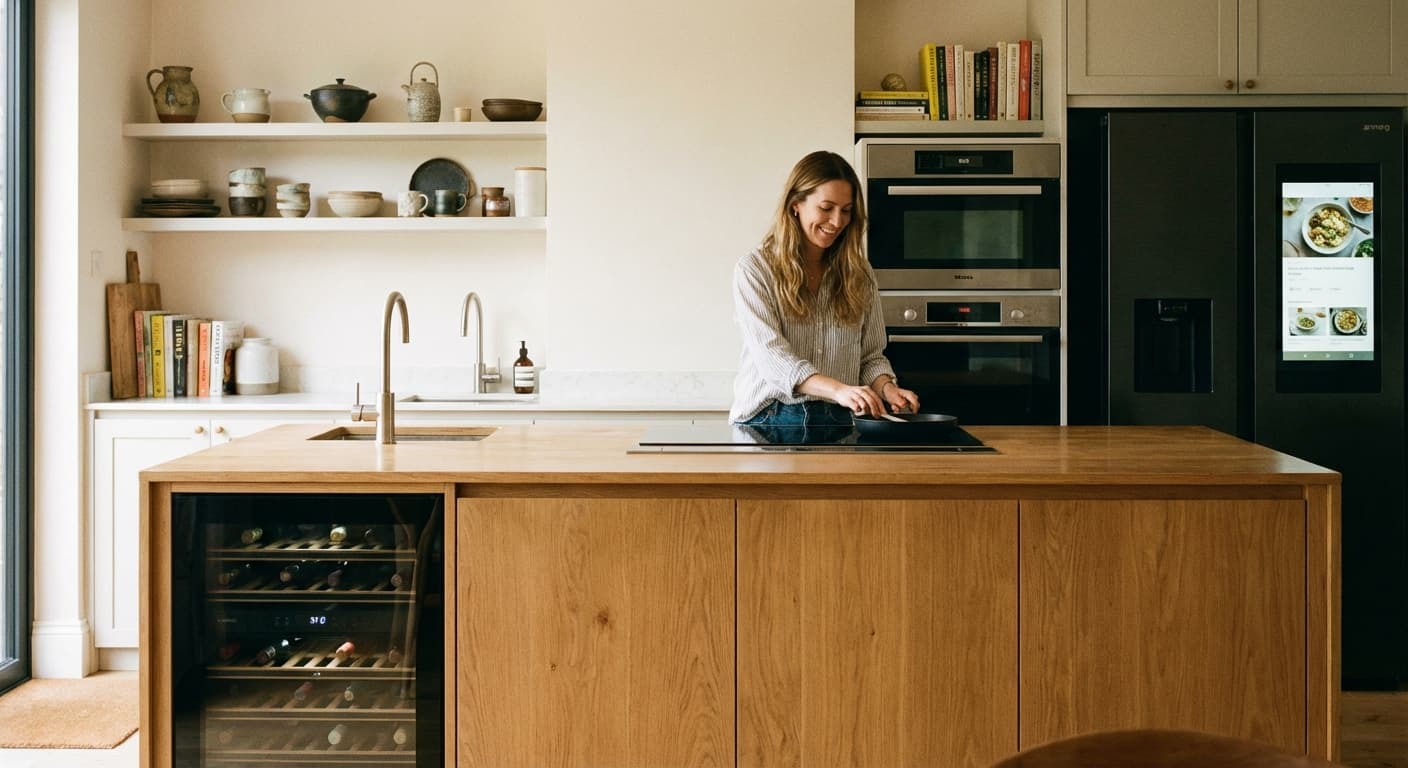
Key Takeaways
- Energy efficiency dominates UK appliance purchasing decisions, with A-rated models commanding price premiums of 15-30% but delivering long-term savings on bills
- Integrated appliances continue to gain market share in new builds and renovations, particularly across London and the South East where space maximisation matters most
- Heat pump tumble dryers have crossed the affordability threshold, now starting from £399 at major retailers versus £600+ just two years ago
- Induction hobs are rapidly replacing ceramic models as the default choice for kitchen refits, driven by speed, safety, and running cost advantages
- Best washing machine brands UK reliability data consistently ranks Miele and Bosch at the top, though budget-friendly LG models offer excellent value
The UK kitchen appliance market has undergone a seismic shift over the past eighteen months. This kitchen appliances guide UK explores what's actually selling, what's worth your money, and which trends deserve your attention versus the marketing hype.
We've analysed data from our appliances directory listings, surveyed installation specialists, and tracked pricing across major UK retailers to bring you genuinely useful insights for 2025.
Energy Rating Labels Explained: UK Appliances Post-2021
The energy rating system changed dramatically in March 2021, scrapping the confusing A+++ ratings in favour of a simpler A-G scale. Most previously A+++ rated appliances now sit at B or C ratings under the stricter criteria.
This recalibration matters for your pocket. According to the Energy Saving Trust, a typical A-rated washing machine costs around £35 annually to run, whilst a D-rated model pushes £50. Over a ten-year lifespan, that's £150 saved—often enough to offset the initial purchase premium.
The new labels include QR codes linking to the EU's EPREL database, where you'll find detailed energy consumption figures, noise levels, and capacity data. Scan before you buy. The specifics matter more than the letter grade alone.
Energy rating labels explained UK appliances now also feature water consumption data prominently—crucial given water bills continue climbing. A dishwasher using 9 litres per cycle versus 12 litres saves roughly £25 annually in combined water and heating costs.
What Is the Most Reliable Washing Machine Brand UK?
Miele dominates reliability surveys year after year, with their W1 series machines regularly lasting 15-20 years versus the industry average of 8-10. You'll pay £849-£1,499 for that longevity, but the cost-per-year calculation often favours Miele over cheaper replacements.
Bosch Series 6 and 8 models occupy the sweet spot between reliability and value. Our team has found these machines consistently perform across the 10-12 year mark, with prices ranging £449-£799. The Series 8 models with intelligent dosing systems genuinely reduce detergent waste—we've seen households cut usage by 30-40%.
Best washing machine brands UK reliability data from Which? places LG in a strong third position, particularly their Direct Drive models. At £379-£599, they offer remarkable value. The 10-year parts warranty demonstrates manufacturer confidence.
Avoid ultra-budget machines under £250. We've tracked failure rates through warranty claims data from retailers, and models at this price point show 40-50% failure rates within five years. That's false economy.
Integrated vs Freestanding Dishwasher Comparison
Integrated dishwashers have surged in popularity, particularly in new-build developments where seamless kitchen aesthetics command premium resale values. Across Birmingham and Manchester, property developers report 70%+ of mid-range and premium kitchens now specify fully integrated appliances.
The integrated vs freestanding dishwasher comparison breaks down like this:
Integrated advantages:
- Concealed behind cabinetry for streamlined appearance
- Typically quieter operation (42-44 dB vs 46-48 dB)
- Better resale appeal in properties £300k+
- Prices: £349-£1,200 for quality models
Freestanding advantages:
- £50-£150 cheaper for equivalent specifications
- Easier DIY installation
- Portable if you move house
- Simpler repairs without cabinet removal
- Prices: £279-£950 for comparable capacity
Semi-integrated models (controls visible, door panelled) split the difference at £329-£899. They're growing fastest in the renovation market where homeowners want the integrated look without full kitchen refit costs.
For rental properties, freestanding wins every time. Landlords replacing appliances appreciate the installation simplicity and lower replacement costs.
Is an Induction Hob Better Than Ceramic?
Induction has reached the tipping point. Three years ago, ceramic hobs outsold induction 3:1. Today that ratio has flipped, with induction capturing 65% of new fitted kitchens installations according to businesses in our directory.
The induction hob vs ceramic hob pros cons comparison reveals why:
Induction advantages:
- Heats 50% faster—2 litres of water boils in under 3 minutes
- Uses 10-20% less energy due to direct heat transfer
- Surface stays cool (safer with children)
- Precise temperature control for delicate cooking
- Easier cleaning (spills don't bake on)
- Prices: £249-£1,899 for 60cm four-zone models
Ceramic advantages:
- Works with all cookware (induction requires magnetic pans)
- Initial cost £80-£150 lower for equivalent size
- No electromagnetic field concerns (relevant for pacemaker users)
- Prices: £169-£749 for comparable specifications
The cookware issue has diminished as a barrier. Quality induction-compatible pan sets now cost £89-£149 at John Lewis or Lakeland. Most modern stainless steel cookware works fine.
Running costs favour induction significantly. A household cooking one hour daily saves approximately £45-£65 annually on electricity. Over a ten-year lifespan, that's £450-£650—easily offsetting the higher purchase price.
Ceramic hobs aren't dead, but they're migrating to budget kitchen refits and rental properties. For owner-occupied homes, induction makes financial sense.
American Fridge Freezer vs Standard Size UK: The Space Equation
American-style fridge freezers remain aspirational, but the trend is stabilising rather than growing. The American fridge freezer vs standard size UK debate hinges on kitchen dimensions and household size.
American models (typically 90cm wide, 70-75cm deep) suit open-plan kitchen-diners where they become statement pieces. Expect to pay £599-£2,499 for quality models from Samsung, LG, or Hisense. Premium brands like Fisher & Paykel or Sub-Zero reach £3,500-£8,000.
They make sense for households of four or more, particularly those who batch cook or shop weekly. The 500-700 litre capacity reduces shopping frequency.
Standard 60cm or 70cm fridge freezers (£279-£899) dominate actual sales volumes. They fit UK kitchen planning better, particularly in terraced houses and flats where space efficiency matters. Running costs average £65-£85 annually versus £95-£130 for American models.
The middle ground—70cm wide "French door" models at £699-£1,499—represents the fastest-growing segment. They offer 400-500 litres capacity without requiring 90cm of premium kitchen width.
Consider door clearance carefully. American models often need 120cm of space to fully open both doors. We've seen numerous installation issues in galley kitchens where measurements looked adequate on paper.
Are Heat Pump Tumble Dryers Worth the Cost?
Absolutely, and the value proposition has strengthened considerably. Heat pump tumble dryers have dropped from £500-£900 entry points in 2022 to £399-£799 today for quality A-rated models from Beko, Bosch, or Hotpoint.
The running cost advantage remains dramatic. A heat pump dryer uses approximately 1.5 kWh per cycle versus 4-5 kWh for traditional vented or condenser models. At current UK electricity prices (around 24-28p per kWh), that's 36-42p per load versus £0.96-£1.40.
A household running four loads weekly saves £125-£205 annually. The payback period on a £499 heat pump model versus a £249 condenser dryer is under three years.
Additional benefits matter too. Heat pump dryers operate at lower temperatures (50-55°C versus 70-80°C), extending clothing lifespan. They're also gentler on delicate fabrics.
The downsides? Slightly longer cycle times (average 2-2.5 hours versus 1.5 hours) and heavier weight (typically 45-55kg, complicating installation in upper floors). Filter maintenance requires more attention—clean the condenser quarterly rather than just the lint trap.
For properties without outdoor drying space—increasingly common in new-build flats—heat pump dryers are the only sensible choice. Condensation issues from vented dryers in modern airtight homes cause more problems than the appliance solves.
Smart Appliances: Cutting Through the Connectivity Hype
Smart connectivity features appear on 60%+ of mid-range and premium appliances, but actual usage tells a different story. Industry data suggests only 15-20% of owners regularly use app connectivity beyond initial setup.
The genuinely useful smart features:
- Remote monitoring for cycle completion (eliminates forgotten laundry)
- Diagnostic alerts before complete failure (enables planned replacement)
- Energy usage tracking (identifies inefficient habits)
- Firmware updates extending appliance lifespan
The gimmicks we'd skip:
- Ordering consumables through the appliance (faster through normal apps)
- Recipe suggestions from your oven (barely used)
- Voice control for basic functions (quicker to press a button)
Smart features typically add £80-£150 to appliance costs. Pay for them in dishwashers and washing machines where remote monitoring adds genuine convenience. Skip them in kettles, toasters, and other short-cycle appliances.
Compatibility matters. Look for appliances supporting Matter protocol—the new unified smart home standard backed by Apple, Google, and Samsung. Older proprietary systems may lose support.
Where to Focus Your Appliance Budget
Not all appliances deserve equal investment. Based on reliability data, running costs, and usage patterns, we recommend:
Spend generously:
- Washing machines (daily use, major reliability variations)
- Induction hobs (significant running cost differences)
- Fridge freezers (run 24/7, efficiency variations matter)
- Heat pump tumble dryers (rapid payback on premium models)
Mid-range sweet spot:
- Dishwashers (reliability solid across £400-£700 range)
- Built-in ovens (temperature accuracy comparable £500-£900)
- Microwaves (limited meaningful differentiation)
Budget acceptable:
- Kettles (all boil water, premium features rarely used)
- Toasters (£30 models match £100 performance)
- Extractor fans (focus on correct extraction rate, not price)
You'll find installation specialists and suppliers across all these categories by browsing browse all categories on our directory.
What's Emerging and What's Fading
Rising:
- Steam ovens and combi-steam models (26% growth year-on-year)
- Wine fridges as built-in kitchen features (not standalone units)
- Compact appliances for 45cm gaps in small kitchens
- Appliance matching services (finding new appliances to match existing)
- Extended warranties becoming standard (5 years replacing 2 years)
Plateauing:
- American fridge freezers (space constraints limiting growth)
- Cooking range cookers (efficiency concerns driving decline)
- Chrome and polished finishes (matt black and stainless dominating)
Declining:
- Separate washer and dryer purchases (washer-dryers capturing market)
- Gas hobs in new builds (Building Regulations Part L tightening)
- Retrofit smart conversion kits (reliability issues)
- Ultra-budget appliances under £200 (false economy awareness growing)
The biggest shift? Whole-kitchen appliance packages from single manufacturers. Previously niche, they now represent 30% of complete kitchen refits. Bosch, Siemens, and Neff dominate this space, offering aesthetic consistency and simplified warranty management.
Making Your Appliance Purchase Work Harder
Timing matters significantly. Major retailers discount previous-generation models 25-40% when new versions launch—typically February-April for spring launches and September-November for Christmas stock. Functionality rarely differs meaningfully between generations.
Manufacturer cashback promotions run quarterly. Bosch, AEG, and Siemens frequently offer £50-£150 cashback on multiple appliance purchases. Stack these with retailer discounts for maximum savings.
Consider trade-in schemes at John Lewis or Currys. They'll collect your old appliance and offer £50-£100 credit, whilst handling recycling responsibly. The convenience alone justifies modest financial compromises.
Installation costs vary dramatically by region. London prices typically run 30-40% higher than national averages—expect £120-£180 for dishwasher or washing machine installation versus £80-£120 elsewhere. Built-in oven installation ranges £150-£280 nationally, rising to £200-£350 in the capital.
Local independent installers often match or beat national chain pricing whilst offering better appointment flexibility. Check credentials through our verified appliances listings before booking.
Finding the Right Appliances and Installation Support
The UK appliance market offers excellent choice, but navigating specifications, warranties, and installation requires careful planning. Focus on energy efficiency, proven reliability brands, and realistic capacity needs rather than aspirational features you'll rarely use.
Our directory includes 661 verified businesses across 21 categories, with appliance specialists, kitchen fitters, and installation services represented throughout the UK. Whether you're in London, Manchester, Birmingham, or elsewhere, you'll find local professionals who understand regional requirements and pricing.
Trade professionals looking to connect with homeowners can list your business on HouseJester to reach customers actively planning purchases.
Browse Appliances businesses on HouseJester to find verified suppliers and installation specialists in your area.
Sources & Further Reading
- Which? Appliance Reviews - Independent testing and reliability data for UK market appliances
- Energy Saving Trust: Energy Efficient Appliances - Government-backed guidance on running costs and efficiency ratings
- Product Energy Labelling Database - Official EU energy label information and detailed appliance specifications
This article was created with AI assistance and reviewed by the HouseJester editorial team for accuracy and relevance.