
On this page
Introduction
Transforming your kitchen with the right lighting can completely change how the space looks and functions. When exploring kitchen lighting ideas, understanding the costs involved is essential for planning your budget effectively. From basic ceiling fixtures costing £50 to elaborate smart lighting systems exceeding £2,000, the investment you make depends on your requirements, the size of your space, and the quality of fittings you choose. We've put together this comprehensive guide to help UK homeowners navigate the pricing landscape and make informed decisions about their kitchen lighting projects.
Key Takeaways
- Expect to spend £800–£2,500 for a complete kitchen lighting redesign including installation, with London prices typically 15–25% higher
- LED bulbs cost more upfront (£5–£15 each) but use 75% less energy than halogen equivalents, saving £100+ annually on running costs
- Kitchen island pendant lighting remains the most popular focal point, with quality pendants ranging from £40–£300 each
- Professional electrical work is essential and costs £40–£80 per hour (£150–£250 day rate) depending on your region
- A layered lighting design approach combining ambient, task, and accent lighting delivers the best results
Understanding Lighting Costs: What You'll Actually Pay
The total cost of kitchen lighting breaks down into several components. We've seen basic DIY-friendly projects come in around £300–£500 for materials alone, whilst comprehensive professional installations with premium fixtures can reach £3,000–£5,000.
Light fittings themselves vary enormously. A simple LED ceiling panel from Screwfix might cost £25, whereas a designer pendant from John Lewis could set you back £250 or more. Track lighting systems typically range from £80–£400 depending on length and quality.
Electricians across the UK charge different rates. Outside London, expect £40–£60 per hour. In the capital and surrounding areas, rates climb to £60–£80 per hour. According to the Federation of Master Builders, a straightforward kitchen lighting installation usually takes one to two days, meaning labour costs alone could be £300–£1,200.
Don't forget the electrician needs to certify the work complies with Part P of Building Regulations. This certification is included in most professional quotes, but always confirm upfront.
Comparing Kitchen Lighting Options
Here's how different lighting approaches compare for a typical 4m x 3m kitchen:
| Lighting Type | Cost Range (Materials + Installation) | Energy Efficiency | Best Use Case |
|---|---|---|---|
| Basic ceiling lights (2-3 downlights) | £200–£500 | Good with LED | Small kitchens, rental properties |
| Island pendant lighting (3 pendants) | £300–£1,200 | Good with LED | Medium to large kitchens with islands |
| Full layered lighting (downlights, pendants, under-cabinet LED strips) | £800–£2,500 | Excellent | Comprehensive kitchen redesigns |
| Smart lighting system (Philips Hue, LIFX) | £500–£2,000+ | Excellent | Tech-savvy homeowners, open-plan spaces |
| Track lighting with spotlights | £400–£900 | Good | Flexible accent lighting, rental-friendly |
How Do I Plan Lighting for a Room?
Proper planning prevents expensive mistakes. The layered lighting design approach explained by lighting designers involves three distinct layers working together.
Ambient lighting provides overall illumination. This typically means ceiling-mounted fixtures like downlights or flush ceiling lights. For a kitchen, aim for 300–400 lux (a measurement of light intensity). A standard 4m x 3m kitchen needs approximately 4–6 LED downlights at 10–12 watts each to achieve this.
Task lighting illuminates work surfaces where you prepare food. Under-cabinet LED strips are the gold standard here, costing £20–£80 per metre including basic installation. These should produce 500–750 lux on worktops. We recommend warm white (2700–3000K) for a welcoming atmosphere.
Accent lighting adds visual interest and highlights features. This might include lighting inside glass-fronted cabinets (£15–£40 per unit) or toe-kick lighting beneath base units (£30–£90 per linear metre).
Start by sketching your kitchen layout and marking where you need light. Consider which areas you use most frequently. The sink, hob, and main prep areas are priorities. Then think about creating atmosphere for dining or entertaining.
Browse lighting specialists in our directory to find professionals who can create detailed lighting plans, typically costing £150–£400 for design services that often get deducted from installation costs if you proceed.
Kitchen Island Pendant Lighting Ideas
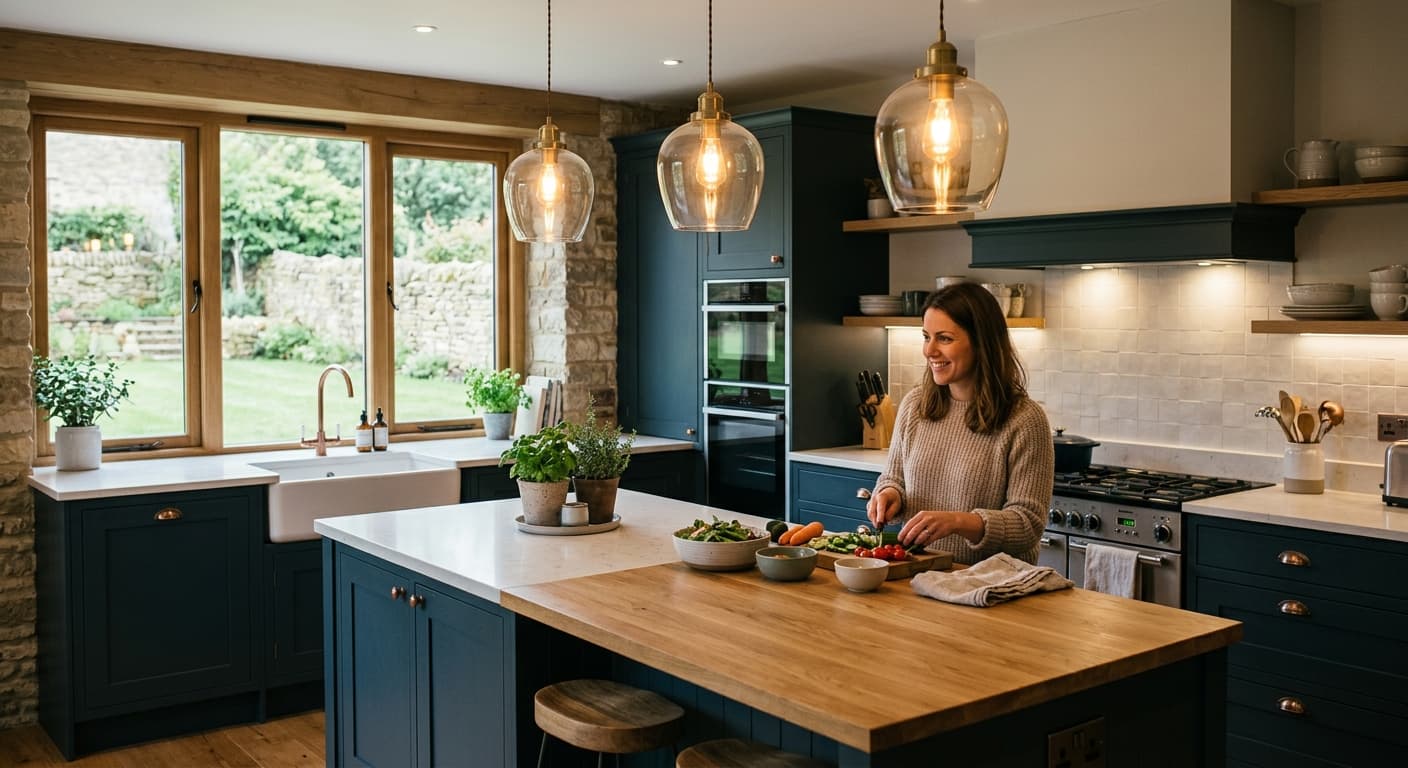
Pendant lights suspended over kitchen islands have become the defining feature of modern kitchen design. Three pendants arranged in a row create symmetry and provide excellent task lighting.
Budget options from B&Q or Wickes start around £30–£60 per pendant. Mid-range designer pendants from brands like Dar Lighting or Endon cost £80–£180 each. High-end options from Tom Dixon or Original BTC can exceed £300 per fitting.
Installation costs depend on existing wiring. If you already have a ceiling rose in the right position, an electrician might charge £100–£200 to install three pendants on a ceiling track or separate drops. Creating new electrical points costs significantly more—expect £250–£500 for the additional wiring work.
Hang pendants 70–80cm above the island surface. For a standard 180cm island, three 20–25cm diameter shades work well. Space them evenly with approximately 60–70cm between centres.
The LED colour temperature guide warm vs cool becomes crucial here. Warm white (2700–3000K) creates a cosy, inviting atmosphere perfect for kitchens that double as social spaces. Cool white (4000–5000K) provides clinical clarity better suited to professional-style kitchens or where precise food preparation is paramount.
LED Running Costs vs Halogen
Are LED lights cheaper to run than halogen?
Absolutely. The Energy Saving Trust confirms that LED bulbs use approximately 75% less electricity than halogen equivalents whilst lasting up to 25 times longer.
A 50-watt halogen downlight used for five hours daily costs roughly £32 per year to run at current UK electricity rates (34p per kWh). An equivalent LED producing the same light output uses just 6–8 watts, costing around £7 annually. Across six kitchen downlights, that's a £150 annual saving.
LED bulbs cost more upfront—£5–£15 each compared to £2–£4 for halogen. But with lifespans of 15,000–50,000 hours versus 2,000–4,000 for halogen, you'll replace them far less frequently.
Many electricians now refuse to install new halogen fittings. UK Building Regulations Part L has pushed the industry firmly towards LED solutions for energy efficiency.
If you're working with fitted kitchens specialists, confirm whether they include LED lighting in their quotes or if it's a separate line item.
Bathroom Lighting Considerations
What IP rating do I need for bathroom lights?
Bathroom IP rating lighting zones explained: bathrooms are divided into zones (0, 1, 2) based on proximity to water sources. The closer to water, the higher the Ingress Protection (IP) rating required.
Zone 0 (inside the bath or shower enclosure): IP67 minimum—completely waterproof
Zone 1 (directly above the bath/shower to 2.25m): IP65 minimum—protected against water jets
Zone 2 (area extending 0.6m outside the bath/shower): IP44 minimum—protected against water splashes
Outside zones (rest of bathroom): IP20 acceptable, but IP44 recommended for moisture protection
A quality IP65-rated bathroom downlight costs £15–£45 each. Installation by a qualified electrician (who must be Part P certified for bathroom work) typically costs £300–£600 for a complete bathroom lighting setup including 3–5 downlights and possibly a mirror light.
Businesses listed on HouseJester offering both bathroom specialists services and electrical work can coordinate these installations efficiently, often at better rates than hiring separate contractors.
Smart Lighting Systems Compared
Smart lighting systems compared UK: the market has matured considerably, with several reliable options now available.
Philips Hue remains the market leader. A starter kit with bridge and three bulbs costs £130–£180. Individual bulbs are £15–£50 depending on colour capability. The system works with Alexa, Google Home, and Apple HomeKit seamlessly.
LIFX bulbs don't require a hub, connecting directly to Wi-Fi. They're slightly cheaper at £12–£45 per bulb but can overwhelm your Wi-Fi network if you install many.
TP-Link Tapo and Kasa offer budget-friendly options at £10–£25 per bulb with decent smartphone control but fewer advanced features.
For a complete kitchen smart lighting setup including downlights, under-cabinet strips, and pendant controls, budget £500–£1,500 depending on room size and chosen system.
Installation is usually straightforward—most smart bulbs fit standard fittings. However, smart switches and advanced dimming often require professional electrical work, adding £200–£500 to the project.
We've seen impressive installations across various properties in London, Manchester, and Birmingham, where homeowners appreciate voice control and automated scheduling.
Money-Saving Tips for Kitchen Lighting
Timing your purchase strategically saves money. John Lewis and most major retailers run lighting sales in January and July, offering 20–40% discounts on premium brands.
Consider mixing price points. Spend more on statement pieces like island pendants that draw the eye, then choose budget options for hidden under-cabinet lighting or recessed downlights.
DIY-friendly tasks include fitting new LED bulbs, installing plug-in under-cabinet strips, and replacing light shades. Save the electrician for tasks requiring Part P certification: installing new circuits, adding ceiling roses, or any work inside consumer units.
Bulk buying helps. Purchasing six identical downlights often attracts trade discounts even for homeowners. Screwfix and Toolstation offer competitive multi-buy deals.
Don't over-light. More fixtures mean higher installation and running costs. A well-planned lighting design with fewer, properly positioned lights beats dozens of randomly placed fittings.
Explore the businesses in our search our company directory to compare quotes from multiple electricians and lighting specialists. We recommend obtaining at least three written quotes for significant projects.
Regional Price Variations
Location significantly impacts costs. Our analysis of businesses across the UK reveals clear patterns.
London and Southeast: Electrician day rates reach £200–£300. Premium lighting fixtures cost 10–15% more than elsewhere due to higher retail rents. Total project costs run 20–30% above national averages.
Major cities (Manchester, Birmingham, Leeds, Glasgow): Day rates of £150–£220 are typical. Competitive retail markets mean fixture prices align with online retailers.
Rural and smaller towns: Electrician rates drop to £120–£180 per day, though limited competition might mean fewer specialists. Travel charges sometimes apply if bringing in lighting designers from larger cities.
For a standard kitchen lighting installation (6 downlights, 3 island pendants, under-cabinet LED strips), expect:
- London: £1,800–£3,000
- Major cities: £1,400–£2,400
- Smaller towns: £1,200–£2,000
These ranges include mid-range fixtures and professional installation.
Factors Affecting Your Final Cost
Ceiling height matters. Standard 2.4m ceilings are straightforward. Vaulted or high ceilings (3m+) require additional access equipment and longer cable runs, adding £200–£500 to labour costs.
Existing wiring condition influences prices dramatically. Modern consumer units with spare circuits mean lower costs. Older homes with inadequate earthing or aluminium wiring might need significant upgrades before new lighting can be installed safely.
Structural considerations include solid concrete ceilings (common in flats) versus timber joists in houses. Concrete requires surface-mounted fittings or diamond drilling, both more expensive than recessed options in timber ceilings.
Fixture quality ranges from basic functional lighting to designer pieces. A complete kitchen could use £200 worth of basic fittings or £2,000+ in premium brands—the electrical installation cost remains similar either way.
Smart features, dimming capability, and colour-changing functions all increase costs but deliver enhanced functionality many homeowners value.
Working with Professionals
Hiring qualified electricians isn't optional—it's legally required for most fixed lighting work under Part P Building Regulations. Always verify contractors are registered with a competent person scheme (NICEIC, ELECSA, or similar).
Lighting designers charge £150–£500 for consultation and planning, but their expertise prevents costly mistakes. They'll specify exact fixtures, positions, and circuit requirements, which electricians then install to specification.
Many lighting showrooms offer free design consultations if you purchase fixtures through them. This can be excellent value, though you're limited to their stock range.
For comprehensive projects involving kitchen renovation, coordinate lighting decisions with your fitted kitchens installer to ensure optimal positioning of fixtures relative to cabinets and worktops.
If you're a lighting professional or electrician, you can list your business on HouseJester to connect with homeowners searching for qualified specialists.
Final Recommendations
Invest in quality where it matters. LED driver units, transformers, and dimmer switches should be premium brands—failures here cause ongoing frustration. Cosmetic elements like shades can be budget-friendly.
Prioritise task lighting over ambient lighting if budget is tight. Properly lit worktops make kitchens functional; atmospheric lighting is desirable but secondary.
Plan for flexibility. Track lighting or multiple circuits with separate switching let you adjust lighting levels for different activities and times of day.
Think long-term. Spending an extra £300–£500 on LED fittings versus halogen alternatives pays back within three years through energy savings and reduced maintenance.
Browse our browse all categories to find specialists across multiple trades if your lighting project forms part of a larger renovation.
Browse lighting businesses on HouseJester to find qualified electricians and lighting designers across the UK, compare verified listings, and read reviews from homeowners who've completed similar projects.
Sources & Further Reading
- Energy Saving Trust: Lighting - Comprehensive guidance on energy-efficient lighting choices and running costs
- Electrical Safety First: Part P Building Regulations - Official information about electrical work certification requirements
- Which? Guide to LED Lighting - Independent testing and advice on choosing LED bulbs and fittings
This article was created with AI assistance and reviewed by the HouseJester editorial team for accuracy and relevance.
Written by
Sarah Mitchell
Interior Design Editor
Sarah has spent over 12 years covering UK interiors and design trends. She works closely with interior designers and soft furnishings specialists across the country to bring readers expert insights on creating beautiful, functional living spaces.
- Interior Design
- Soft Furnishings
- Paint & Wallpaper
- Lighting