
On this page
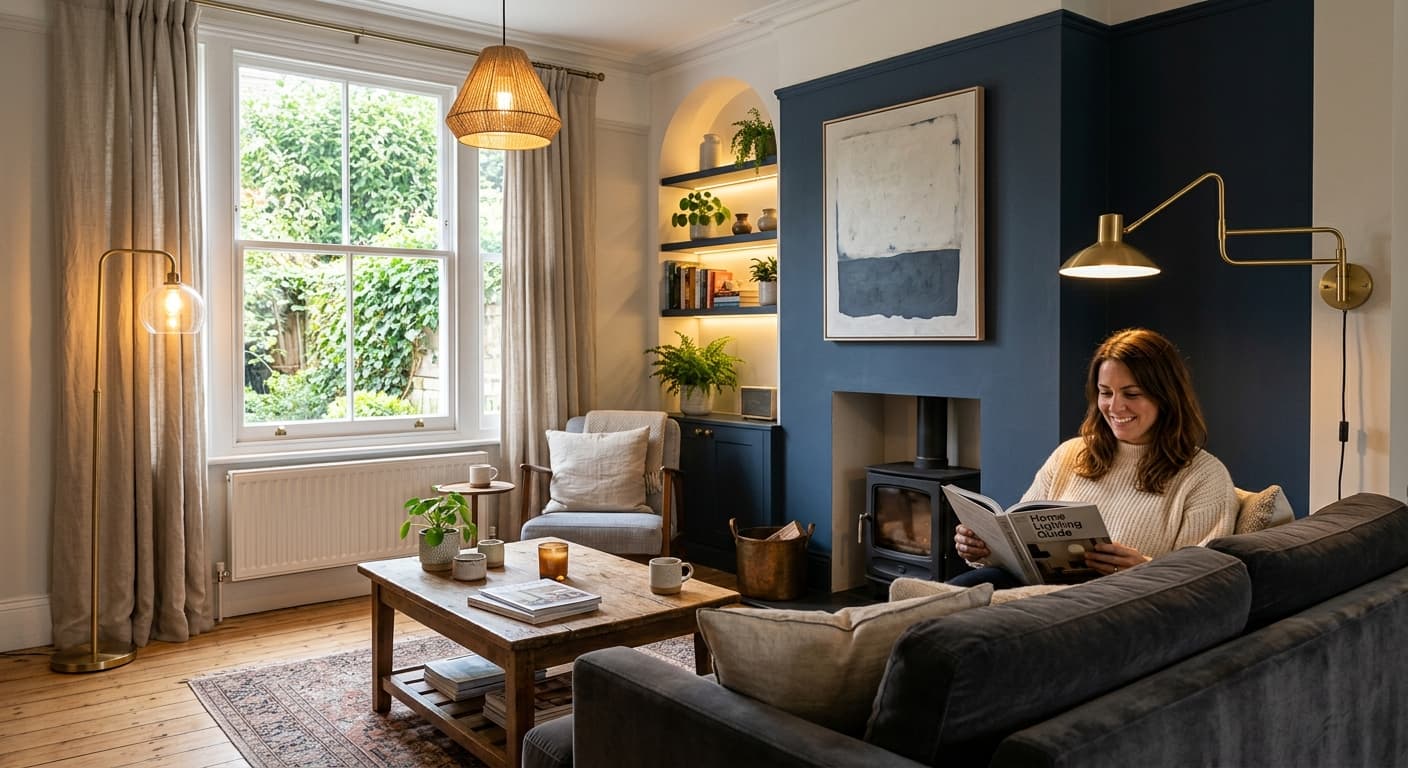
Creating an effective living room lighting plan has become increasingly sophisticated as UK homeowners move away from the single central pendant that dominated British homes for decades. The shift towards multi-layered schemes reflects our changing relationship with living spaces—rooms that now serve as home offices, entertainment hubs, and relaxation zones all at once.
Key Takeaways
- Layer your lighting: Successful schemes combine ambient, task, and accent lighting on separate circuits for maximum flexibility
- Circuit planning is crucial: Install at least three separate lighting circuits in living rooms to control different layers independently
- Warm LED temperatures (2700K-3000K) dominate: Cool white lighting is falling out of favour in residential settings across the UK
- Smart systems offer real value: Expect to pay £300-£800 for a quality smart lighting setup that integrates with existing systems
- IP ratings matter beyond bathrooms: Consider moisture levels even in living areas, particularly in period properties
The Layered Lighting Design Approach Explained
The concept of layered lighting isn't new, but it's finally becoming standard practice in UK homes. We've seen this shift accelerate dramatically since 2022, driven partly by working-from-home requirements and partly by the accessibility of controllable LED technology.
Ambient lighting provides overall illumination. This traditionally came from a central ceiling fitting, but modern schemes often use recessed downlights, cove lighting, or wall-mounted uplighters instead. The key is achieving even distribution without harsh shadows.
Task lighting serves specific activities—reading lamps beside sofas, directional spotlights over artwork, or dedicated desk lighting in dual-purpose living rooms. According to businesses listed on HouseJester, the most common task lighting request is for adjustable floor lamps with integrated USB charging, typically priced between £80-£300 depending on quality.
Accent lighting creates visual interest and atmosphere. This includes LED strip lighting behind media units, picture lights, or feature wall washes. These elements have moved from luxury additions to expected features in mid-range refurbishments.
The technical aspect matters: install these layers on separate circuits. A competent electrician will charge £400-£700 to retrofit multiple circuits in an existing living room, but this investment transforms functionality. We recommend at least three circuits for rooms over 20 square metres.
How Do I Plan Lighting for a Room?
Start with the room's functions. List every activity that happens there: watching television, reading, working, entertaining, children's homework. Each requires different lighting conditions.
Measure your ceiling height. Standard 2.4-metre ceilings need different treatment than the 3-metre ceilings found in Victorian conversions or the 2.1-metre heights common in 1960s builds. Lower ceilings benefit from wall-mounted and uplighting solutions to avoid a claustrophobic feel.
Calculate your lumen requirements. The Energy Saving Trust recommends 150-200 lumens per square metre for living spaces. A 20 square metre living room needs 3,000-4,000 lumens total from all sources combined. This might come from six 500-lumen downlights plus two 250-lumen table lamps.
Position lighting to avoid screen glare. We've noticed this becoming more critical as television sizes increase. Placing adjustable spotlights or wall lights either side of where the TV will sit, rather than directly behind or above, prevents reflection issues.
Consider architectural features. Original cornicing, ceiling roses, exposed beams, or alcoves all influence lighting placement. In our experience working with UK tradespeople, respecting these features rather than fighting them produces better results. A period property specialist from our lighting directory can advise on sympathetic installations that satisfy Building Regulations while preserving character.
Kitchen Island Pendant Lighting Ideas
Though not strictly living room territory, open-plan living means kitchen lighting directly impacts adjacent spaces. Pendant lights above islands have evolved significantly.
The oversized single pendant trend is fading. We're seeing a return to multiple smaller pendants—typically three over a standard island—which provide better task lighting distribution. Expect to pay £150-£400 for quality pendants in brushed brass or matte black finishes, the two dominant trends in 2024.
Height matters enormously. Building Regulations Part M recommends minimum 700mm clearance above worktop height, but 750-900mm works better for kitchen islands where people gather on both sides. Too high and the lights lose impact; too low and they obstruct sightlines.
Dimming capability is non-negotiable. LED dimmers cost £25-£60 installed and transform a kitchen from task-focused workspace to ambient entertaining area. Ensure your electrician uses LED-compatible dimmers—standard dimmers cause LED lights to flicker or fail.
Cable management increasingly influences pendant choice. Surface-mounted cable tracking in contrasting metallic finishes has become an intentional design feature rather than something to hide. London and Manchester showrooms particularly showcase this industrial-influenced aesthetic.
LED Colour Temperature Guide: Warm vs Cool
Colour temperature confusion causes more lighting disappointment than any other factor. The Kelvin scale runs from warm (2000K) to cool (6500K), and UK preferences have shifted dramatically.
Warm white (2700K-3000K) dominates residential projects. This replicates traditional incandescent light and creates the cosy atmosphere British homeowners favour. We recommend 2700K for living rooms, bedrooms, and dining areas.
Neutral white (3500K-4000K) works for kitchens, bathrooms, and home offices where colour accuracy matters. However, even here, the trend leans warmer than five years ago.
Cool white (5000K-6500K) has virtually disappeared from UK residential specifications. What looked "modern" in 2015 now reads as clinical. The Which? lighting tests from 2023 found that 89% of homeowners rated cool white as "too harsh" for living spaces.
Mixing temperatures within one room creates visual discord. Stick to a single colour temperature across all fittings in connected open-plan spaces. We've seen too many kitchen-diners where 4000K downlights clash with 2700K pendants, creating an unsettling patchwork effect.
The impact on perceived room warmth is substantial. A room lit entirely with 2700K LEDs feels approximately one degree warmer than identical lighting at 4000K, according to recent research. This affects both comfort and heating costs.
What IP Rating Do I Need for Bathroom Lights?
Bathroom IP rating lighting zones explained: this remains one of the most misunderstood aspects of UK lighting regulations, yet it's fundamental to safety and Building Regulations Part P compliance.
British Standard BS EN 60529 divides bathrooms into zones based on proximity to water sources:
- Zone 0 (inside bath/shower): Requires IP67 minimum (rare in domestic settings)
- Zone 1 (directly above bath/shower to 2.25m height): Requires IP65 minimum
- Zone 2 (0.6m radius from bath/shower to 2.25m height): Requires IP44 minimum
- Beyond zones (rest of bathroom): IP20 acceptable, but IP44 recommended
Most bathroom downlights sold at B&Q, Wickes, and Homebase meet IP65 standards, making them suitable for zones 1 and 2. These typically cost £15-£40 per fitting. Premium brands like Astro or John Cullen Lighting charge £60-£150 per fitting but offer better light quality and longer warranties.
The first number in IP ratings indicates solid particle protection (dust). The second number indicates liquid ingress protection. IP65 means complete dust protection and protection against water jets from any direction—essential above showers.
Competent electricians registered with NICEIC or NAPIT should handle bathroom lighting installation. Expect to pay £400-£800 for a complete bathroom lighting installation including five downlights, an extractor fan connection, and certification. Prices in Birmingham and other major cities outside London tend toward the lower end of this range.
Mirror lighting deserves particular attention. Illuminated mirrors with integrated lighting have surged in popularity, offering IP44-rated solutions that provide excellent task lighting for grooming. Quality units cost £200-£600 depending on size and features.
Are LED Lights Cheaper to Run Than Halogen?
Yes, dramatically so. A 50W halogen downlight costs approximately £15 per year to run for three hours daily at current UK electricity rates (34p per kWh average). An equivalent 5W LED costs £1.50 per year—a 90% reduction.
The payback calculation is straightforward. LED downlights cost £8-£25 each versus £3-£8 for halogen equivalents. The premium pays for itself within 6-12 months through reduced electricity consumption.
Lifespan differences amplify the savings. Halogen bulbs last 2,000-4,000 hours while quality LEDs last 25,000-50,000 hours. This means one LED outlasts 10-20 halogen bulbs, eliminating replacement costs and the hassle of changing bulbs in ceiling fittings.
Heat generation matters too. Halogen lights waste 90% of their energy as heat, which increases cooling costs in summer and creates potential safety issues in insulated ceilings. LEDs run cool enough to touch after hours of use.
The Energy Saving Trust estimates that replacing all halogen downlights in a typical home saves £35-£65 annually. Over a 15-year LED lifespan, this represents £525-£975 in savings.
Part L of Building Regulations now effectively mandates LED lighting in new builds and major renovations by requiring specific efficacy levels (lumens per circuit-watt) that only LED technology achieves. This regulatory push ensures LEDs remain the only viable option going forward.
Smart Lighting Systems Compared UK
Smart lighting has matured from expensive novelty to practical technology with genuine benefits. We've tested the major platforms available to UK consumers and found significant differences.
Philips Hue remains the premium choice. The ecosystem offers the widest accessory range and most reliable performance. A starter kit with hub and four bulbs costs £90-£140. Individual smart bulbs cost £15-£45 depending on specification. The system works with Alexa, Google Home, and Apple HomeKit.
IKEA Trådfri provides budget-conscious smart lighting. Bulbs cost £8-£15 and the gateway costs £25. Functionality is more basic but adequate for straightforward on/off and dimming schedules. Compatibility with other platforms requires some technical setup.
Hive Active Light integrates well if you already use British Gas's Hive heating system. Bulbs cost £12-£20 with good native smartphone control. However, the ecosystem feels limited compared to Philips Hue.
TP-Link Tapo offers no-hub solutions where bulbs connect directly to WiFi. This reduces upfront costs (no £50-£80 hub purchase) but creates network congestion if you install many bulbs. Prices run £10-£25 per bulb.
Installation complexity varies. Simple bulb replacement requires no professional help. Retrofit smart switches—which make any existing lights smart—need competent electrician installation at £150-£300 per room. Businesses in our browse all categories directory can advise on the most appropriate approach for your property.
The practical benefits are substantial: automated schedules reduce wasted electricity, away-from-home control improves security, and scene-setting transforms room ambiance instantly. We recommend starting with one room to test which platform suits your needs before committing to whole-house installation.
Current Trends in UK Residential Lighting
Several clear movements define 2024-2025 lighting choices across UK homes:
Decorative bulbs in minimal fittings continue strong. Oversized filament-effect LED bulbs in simple pendant holders or exposed wall brackets dominate Instagram-worthy interiors. These cost £8-£25 per bulb from retailers like John Lewis or Heal's.
Sculptural table and floor lamps as statement pieces rather than purely functional items. The trend toward fewer, larger, more distinctive pieces replaces multiple matching sets. Expect £150-£600 for designer pieces from brands like Anglepoise or Tom Dixon.
Architectural lighting integration conceals the source while highlighting surfaces. LED strip lighting in ceiling coffers, under kitchen cabinets, within shelving units, or below floating furniture creates ambient glow without visible fittings. Professional installation costs £400-£1,200 depending on complexity.
Brass and bronze finishes have overtaken chrome and brushed nickel. This warmer metallic palette complements the 2700K colour temperatures we're all installing. The trend shows no signs of fading.
Reduced downlight density marks a welcome change. The 2000s enthusiasm for filling ceilings with downlights ("more light is better") has reversed. We're now removing excessive downlights and supplementing with layered alternatives. Four well-positioned adjustable spotlights beat eight fixed downlights.
Outdoor lighting integration extends living spaces. Garden and patio lighting now connects seamlessly with interior schemes through smart systems. Fitted kitchens increasingly incorporate lighting control for adjacent outdoor entertainment areas.
Working with Lighting Professionals
Complex lighting installations require professional expertise. Electricians handle wiring and Building Regulations compliance, but lighting designers provide the creative vision.
Most UK electricians charge £40-£80 per hour outside London, or £200-£350 per day. London rates run 20-40% higher. Always verify NICEIC or NAPIT registration and request evidence of public liability insurance (minimum £2 million coverage).
Lighting designers typically charge £60-£150 per hour or work on fixed-price projects (£800-£2,500 for whole-house lighting plans). This investment makes sense for significant renovations or new builds where correcting mistakes later proves expensive.
Specialist lighting suppliers offer more sophisticated solutions than mainstream retailers. Companies in our directory provide technical support, product samples, and custom configurations impossible at big-box stores. The price premium (typically 15-30%) buys expertise and accountability.
Be wary of "free lighting design" offers from suppliers—these often push specific product ranges rather than objectively addressing your needs. Independent designers maintain product-agnostic advice.
Timing matters for electrical work. First-fix wiring happens before plastering; second-fix installation occurs after decoration completes. Missing the first-fix stage means surface-mounted cables or expensive remedial work. Coordinate with builders and decorators from day one.
Making Your Lighting Plan Future-Proof
Investing in flexible infrastructure saves money long-term. Install more circuits than currently needed—adding circuits later means lifting floorboards and patching ceilings.
Neutral wire inclusion in all switch locations enables future smart switch installation. Many older UK homes lack neutral wires at switch positions, limiting smart home options. An electrician can address this during any electrical work for £100-£200 per room.
Oversized conduit allows cable upgrades without destructive access. If running new cables through walls, use 25mm conduit even though 20mm suffices for current wiring. This costs pennies but preserves future options.
Quality LED drivers and transformers warrant the premium. Cheap power supplies cause premature LED failure and create fire risks. Specify branded drivers (MeanWell, Tridonic, Philips) even though they cost £30-£80 versus £10-£20 for unbranded alternatives.
Maintainability matters. Can you access all fittings to clean or replace them? We've seen too many installations where sealed ceiling designs prevent bulb changes without destructive access. Always consider long-term maintenance during design.
To find experienced professionals who understand current trends and Building Regulations requirements, list your business if you're a lighting specialist, or homeowners can search our company directory for qualified professionals in your area.
Conclusion
Your living room lighting plan shapes how you experience your home more than almost any other design decision. The shift toward layered, controllable, LED-based schemes reflects our more sophisticated understanding of light's impact on mood, productivity, and wellbeing.
The technical aspects—colour temperature, IP ratings, circuit design—matter enormously but needn't overwhelm. Start with clear functional requirements, specify warm LED colour temperatures (2700K-3000K), engage qualified professionals for anything beyond simple bulb changes, and install more control circuits than you currently need.
The investment ranges from £300-£800 for a simple retrofit with smart controls to £3,000-£8,000 for comprehensive multi-room installations with architectural integration. This sits among the best value improvements available—you'll use lighting every day for decades.
Browse lighting specialists in our directory to find professionals who can turn your lighting plan into reality.
Sources & Further Reading
- Energy Saving Trust - LED Lighting Guide - Comprehensive guidance on LED lighting efficiency and costs
- Electrical Safety First - Bathroom Lighting Zones - Official guidance on IP ratings and bathroom electrical safety
- CIBSE (Chartered Institution of Building Services Engineers) - Lighting Guides - Professional standards for UK lighting design and installation
This article was created with AI assistance and reviewed by the HouseJester editorial team for accuracy and relevance.
Written by
Sarah Mitchell
Interior Design Editor
Sarah has spent over 12 years covering UK interiors and design trends. She works closely with interior designers and soft furnishings specialists across the country to bring readers expert insights on creating beautiful, functional living spaces.
- Interior Design
- Soft Furnishings
- Paint & Wallpaper
- Lighting