
On this page
Introduction
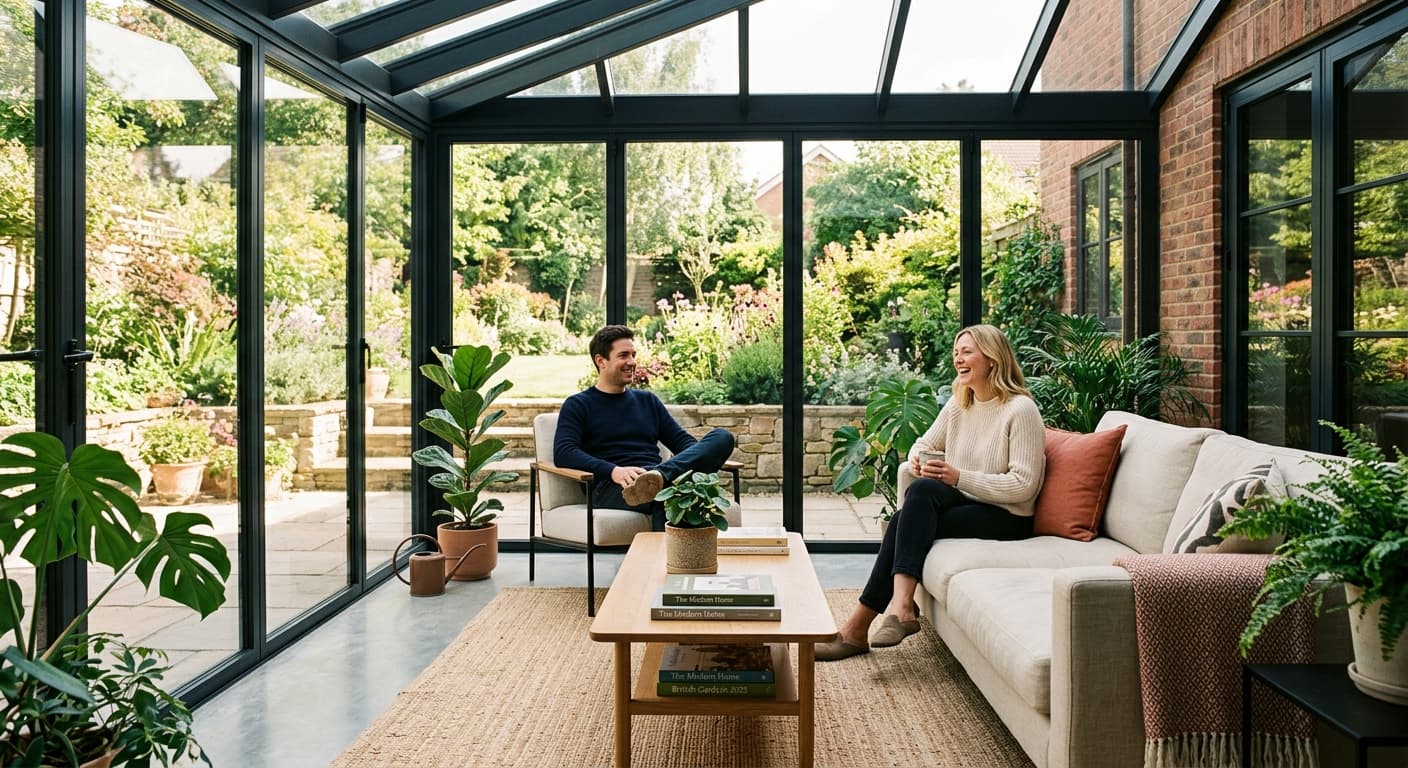
Modern conservatory designs have evolved dramatically from the traditional white uPVC structures that dominated British homes in the 1990s. Today's conservatories blend seamlessly with contemporary architecture, offering year-round living spaces that genuinely add value to your property. We've seen stunning lean-to designs with sleek aluminium frames in London penthouses, grand orangery-style extensions in Surrey, and minimalist glass boxes that transform modest terraced homes across Manchester and Birmingham. The question is no longer whether to add a conservatory, but which modern design will work best for your home and budget.
Key Takeaways
- Modern conservatories cost between £8,000 and £35,000+ depending on size, materials, and glazing specifications
- Most conservatories qualify as permitted development, but always check garden room planning permission rules UK before starting work
- Aluminium frames and high-performance glass dramatically improve thermal efficiency compared to older designs
- Orangeries cost 20-40% more than conservatories but offer superior insulation and a more substantial appearance
- Proper ventilation, tinted glass, and external shading are essential solutions for conservatory too hot in summer problems
How much does a conservatory cost in the UK?
The cost of a conservatory in 2025 varies enormously based on size, materials, and specification. We've analysed pricing data from conservatories specialists across our directory to give you realistic figures.
A basic 3m x 3m lean-to conservatory with uPVC frames and polycarbonate roof will start around £8,000-£12,000. Step up to a larger Victorian or Edwardian style (4m x 4m) with better glazing, and you're looking at £15,000-£25,000. Premium designs with aluminium bi-fold doors, underfloor heating, and high-performance glass easily reach £30,000-£35,000.
London prices typically run 15-25% higher than the national average. A conservatory costing £20,000 in Leeds might hit £24,000-£25,000 in the capital. According to the Federation of Master Builders, labour costs in the South East are consistently higher, and this filters through to every aspect of conservatory installation.
The roof represents roughly 30-40% of total costs. When considering conservatory roof replacement tiles vs glass, solid tiled roofs (Guardian Warm Roof, Ultraframe's UltraRoof380) cost £5,000-£9,000 for a typical conservatory, whilst high-performance glass roofs run £6,000-£11,000. Glass offers better natural light but requires solar control coatings to prevent overheating.
Cost Breakdown by Style
| Conservatory Style | Typical Size | Price Range (Standard) | Price Range (Premium) |
|---|---|---|---|
| Lean-to | 3m x 3m | £8,000-£12,000 | £14,000-£18,000 |
| Victorian | 4m x 3m | £13,000-£18,000 | £20,000-£28,000 |
| Edwardian | 4m x 4m | £15,000-£20,000 | £22,000-£30,000 |
| P-shaped | 5m x 4m | £20,000-£28,000 | £30,000-£40,000 |
| Orangery | 4m x 4m | £20,000-£30,000 | £35,000-£50,000+ |
Do I need planning permission for a conservatory?
Most conservatories qualify as permitted development under current regulations, meaning you won't need formal planning permission. The rules are straightforward but specific.
Your conservatory can extend up to 6 metres from the rear of a detached house, or 3 metres for terraced or semi-detached properties. It cannot exceed 4 metres in height or extend beyond the front elevation. The total area of all extensions (including the conservatory) must not exceed 50% of the total land around the original house.
Garden room planning permission rules UK become stricter if you live in a listed building, conservation area, or Area of Outstanding Natural Beauty. You'll need planning permission in these cases, regardless of size. Some developments have restrictive covenants that explicitly prohibit conservatories—check your deeds before committing to anything.
Building Regulations always apply, even when planning permission doesn't. Your installer must comply with Part L (energy efficiency), Part F (ventilation), Part B (fire safety if close to boundaries), and structural requirements. Reputable companies handle this automatically, but we recommend checking they're registered with FENSA or Certass, who self-certify compliance.
The Energy Saving Trust notes that thermal efficiency standards have tightened significantly. Modern conservatories must achieve U-values of 1.8 W/m²K or better for glazing, and roofs need even better performance. This regulation has driven much of the innovation in modern conservatory designs, pushing manufacturers toward better glass specifications and insulated roofing systems.
What is the difference between an orangery and conservatory?
The orangery vs conservatory price comparison reveals substantial differences in both cost and construction. An orangery features more brickwork or masonry in the walls—typically 50% or more solid construction—with a flat perimeter roof and a central glazed lantern. Conservatories are predominantly glass or polycarbonate with minimal solid structure.
Orangeries feel more like permanent room extensions. They blend better with traditional architecture, offer superior insulation, and retain value more effectively. The substantial brick pillars and flat roof sections create a room that's genuinely usable year-round without the temperature extremes that plague many conservatories.
The trade-off is cost and natural light. Orangeries cost 20-40% more than equivalent conservatories. A 4m x 4m orangery typically starts at £20,000-£25,000 and easily reaches £40,000-£50,000 for high-specification builds with bi-fold doors, underfloor heating, and premium finishes. You'll also get less natural light due to the solid sections, though many homeowners consider this acceptable given the improved thermal performance.
We've worked with businesses across our browse all categories listings, and the consensus is clear: orangeries suit traditional properties in conservation areas where planning officers want extensions that respect existing architecture. Modern conservatories with slim aluminium frames work better on contemporary homes where maximising glass and views is the priority.
Choosing Materials: The Frame Decision
Frame material fundamentally affects appearance, performance, and longevity. Each option has distinct advantages.
Material Comparison
| Material | Pros | Cons | Typical Cost |
|---|---|---|---|
| uPVC | Affordable, low maintenance, good insulation | Limited colours, can discolour, chunkier profiles | £8,000-£18,000 (full conservatory) |
| Aluminium | Slim sightlines, durable, wide colour range, BS EN 1090 compliance | Higher cost, can feel cold without thermal breaks | £15,000-£30,000 (full conservatory) |
| Timber | Beautiful aesthetics, traditional appearance, good insulation | Requires maintenance, more expensive, can warp | £18,000-£35,000 (full conservatory) |
| Hybrid (aluminium exterior, timber interior) | Best of both worlds, excellent performance | Premium pricing, limited suppliers | £20,000-£40,000 (full conservatory) |
Aluminium has become the material of choice for modern conservatory designs. Slim 45-50mm frames maximise glass area, and powder-coating offers virtually any RAL colour. Leading manufacturers like Smart Architectural Aluminium, Schüco, and Reynaers produce systems that meet Part L requirements whilst maintaining elegant proportions.
Thermal breaks are non-negotiable. Aluminium conducts heat readily, so quality systems incorporate polyamide thermal breaks that separate internal and external faces. This prevents cold bridging and condensation—problems that plague cheaper aluminium installations.
Solving the Overheating Problem
Conservatory too hot in summer solutions require multiple strategies working together. A single fix rarely suffices.
Glass specification matters enormously. Solar control glass with low-g coatings reflects solar heat whilst allowing light transmission. Pilkington's Activ and Saint-Gobain's SGG Cool-Lite range achieve g-values around 0.28-0.35, blocking 65-72% of solar heat. Standard glass sits around 0.76, allowing most heat through.
External shading beats internal every time. External blinds prevent heat reaching the glass, whilst internal blinds trap heat between blind and glass, making the problem worse. Markilux and Weinor produce excellent external systems with wind-resistance ratings suitable for UK weather. Budget £2,000-£4,000 for motorised external roof blinds.
Ventilation is critical. Roof vents should represent at least 10% of floor area, positioned to create cross-flow with door vents or side windows. Automated ridge vents from Glazing Vision or Roof Maker (£500-£800 per vent) respond to temperature automatically.
Air conditioning works but costs. Split systems for conservatories cost £2,500-£4,000 installed, with running costs around £150-£300 annually. We only recommend this for larger orangeries or conservatories used as home offices where precise temperature control justifies the expense.
Tinted or reflective window films provide a cheaper retrofit option (£150-£400 professionally installed) but reduce light transmission noticeably. They're a compromise solution when replacing glass isn't viable.
Roof Replacements: Solid vs Glass
Many homeowners with older polycarbonate-roofed conservatories eventually consider replacement. The conservatory roof replacement tiles vs glass debate centres on thermal performance versus natural light.
Solid tiled roofs transform temperature control. Systems like Guardian's Warm Roof or Ultraframe's UltraRoof380 incorporate 100mm+ of insulation, achieving U-values around 0.18 W/m²K—better than most house roofs. Your conservatory genuinely becomes a year-round room. The downside is losing that airy, glass-house feel. Tiled roofs make conservatories darker, requiring more artificial lighting even during daytime.
Costs run £5,000-£9,000 for a typical 3m x 4m roof replacement, including structural modifications, insulation, tiles or slate finish, plastered ceiling, and LED downlights. Building Regulations approval is essential—the existing structure must support increased weight, and Part L energy performance must be documented.
High-performance glass roofs maintain brightness whilst dramatically improving thermal efficiency compared to old polycarbonate. Triple-glazed units with low-e coatings and argon or krypton fill achieve U-values around 0.7-1.0 W/m²K. Combine this with solar control coatings, and you've got excellent performance both winter and summer.
Glass roof replacements cost £6,000-£11,000 for similar dimensions, partially because glass itself costs more but mainly because the structural frame often needs upgrading to support the weight. Toughened and laminated glass meeting BS EN 12150 and BS EN 14449 is mandatory for overhead glazing—expect 6.4mm laminated inner panes minimum.
Which? research published in 2024 found that solid roofs increased conservatory usage by an average of 65%, whilst glass roofs increased usage by 35-40%. Both dramatically outperform old polycarbonate, but solid roofs edge ahead for year-round comfort.
Common Mistakes to Avoid
We've seen countless projects go wrong. These mistakes crop up repeatedly:
Choosing size over proportion. A conservatory that dwarfs your house looks ridiculous and harms resale value. The extension should complement existing architecture, not dominate it. As a rule, conservatories shouldn't exceed 60% of your ground-floor rear elevation width.
Skimping on foundations. Conservatories need proper concrete foundations, typically 750mm deep with compacted hardcore, DPM, and insulation. Cowboy installers sometimes use shallow pad foundations that crack within months, causing frame distortion and seal failures. Insist on Building Control inspection of foundations before proceeding.
Ignoring heating integration. Adding radiators as an afterthought creates pipe runs that look awful and perform poorly. Plan heating during design—underfloor systems work brilliantly in conservatories, distributing warmth evenly and avoiding hot spots. Budget £1,500-£2,500 for electric underfloor heating or £2,500-£4,000 for wet systems tied into existing central heating.
Inadequate drainage. Conservatory gutters must connect to existing rainwater systems or purpose-built soakaways. Water pooling against your house wall causes damp and foundation problems. Proper drainage planning adds £300-£600 but prevents expensive remediation later.
Forgetting about electrics. Modern conservatories need multiple socket circuits, lighting circuits, and often data cabling for home offices. Retrofitting wiring looks terrible and costs more. Include proper electrical design from the start—£800-£1,500 for typical requirements.
Finding the Right Installer
Quality installation makes the difference between a conservatory that delights you for decades and one that causes endless problems. Look for businesses registered with GGF (Glass and Glazing Federation), holding FENSA or Certass certification, and offering insurance-backed guarantees through schemes like HomePro or Build-Zone.
Get at least three detailed quotes—not ballpark estimates but itemised specifications covering frames, glass specs, foundations, electrics, heating, and Building Regulations compliance. Be immediately suspicious of quotes dramatically cheaper than others; they're cutting corners somewhere.
Visit completed projects if possible. Photos can mislead, but seeing actual installations reveals build quality, attention to detail, and how well the conservatory integrates with the house. Good installers enthusiastically arrange viewings; poor ones make excuses.
You can search our company directory to find reputable specialists in your area. We've verified businesses across multiple trades, and our conservatory listings include customer reviews and detailed service information to help you make informed decisions. If you're a conservatory specialist, you can list your business to reach homeowners actively researching projects.
The Modern Design Trends
Current design trends emphasise clean lines, maximum glass area, and indoor-outdoor flow. Bi-fold or sliding doors that fully retract are standard in modern specifications, creating seamless transitions to gardens. Slim aluminium frames in anthracite grey, black, or dark bronze dominate contemporary installations—the ubiquitous white uPVC look is distinctly dated.
Lantern roofs have replaced traditional pitched roof styles in many modern conservatories. These flat-roofed structures with raised glazed sections provide height and drama whilst maintaining clean exterior lines. Origin's Flat Roof Lantern and Ultraframe's UltraLantern systems are particularly popular, costing £4,000-£8,000 depending on size.
Glass-to-glass corners eliminate corner posts, creating stunning 90-degree glazed angles. Structurally complex and expensive (adding £2,000-£3,000 to project costs), they deliver genuine wow-factor in modern designs where transparency and views are priorities.
Integrated LED lighting in roof bars creates evening ambience without visible light fittings. Smart glass technology—though still expensive at £800-£1,200 per square metre—allows glass to switch from transparent to opaque electrically, providing instant privacy without blinds or curtains.
Making Your Decision
Modern conservatory designs offer solutions for virtually any property style and budget. Start by clarifying your priorities: Do you want maximum light or year-round comfort? Will this be occasional summer space or daily living area? Does it need to match existing architecture or create deliberate contrast?
Visit showrooms from multiple manufacturers—Anglian, Everest, and Conservatory Outlet operate across most UK regions, whilst regional specialists often offer better value and personal service. Many businesses listed in our directory serve specific areas; if you're in London, Manchester, or other major cities, you'll find specialists familiar with local planning requirements and architectural styles.
Budget realistically, including 10-15% contingency for unexpected costs. Foundation problems, additional electrical work, or boundary complications regularly push costs beyond initial quotes. Insurance-backed guarantees protect you if installers cease trading before completing work or during guarantee periods.
The right conservatory genuinely transforms how you live in your home, providing space, light, and connection to your garden that more conventional extensions can't match. Poor execution creates expensive regrets. Take time choosing design and installer—this isn't a decision to rush.
Browse Conservatories businesses on HouseJester to find verified specialists in your area, compare services, and read genuine customer reviews before committing to your project.
Sources & Further Reading
- Planning Portal: Conservatory Permitted Development Rights – Official UK government guidance on planning requirements
- Which? Guide to Conservatories – Independent research on costs, materials, and installer recommendations
- Energy Saving Trust: Conservatory Insulation – Guidance on thermal efficiency and Building Regulations Part L compliance
This article was created with AI assistance and reviewed by the HouseJester editorial team for accuracy and relevance.
Written by
James Hartley
Home Improvement Writer
A former building contractor turned journalist, James brings hands-on experience to every article. He specialises in home improvement projects, building regulations, and helping homeowners navigate renovation work with confidence.
- Home Improvements
- Building Services
- Roofing
- Windows & Doors