
On this page
Choosing window treatments and fabrics for your home involves dozens of decisions, from the classic debate of roman blinds vs roller blinds to selecting the right curtain fabrics for thermal efficiency. We've compiled answers to the questions UK homeowners ask us most frequently about soft furnishings, drawing on our directory of specialists and expert industry sources.
Key Takeaways
- Roman blinds offer a softer, more traditional look with superior insulation, whilst roller blinds provide a sleek, modern aesthetic at lower price points (typically £30-£150 vs £80-£300 per window)
- Made to measure curtains cost approximately 50-150% more than ready-made options but deliver better fit, fabric choice, and longevity
- Thermal or interlining curtain fabrics can reduce heat loss by up to 25%, particularly important for meeting Building Regulations Part L standards
- Professional measuring is crucial: even 2-3cm errors can ruin the appearance of bespoke window treatments
- Budget £150-£400 per window for quality made to measure curtains including fabric, lining, and making costs
Are Roman Blinds Better Than Roller Blinds?
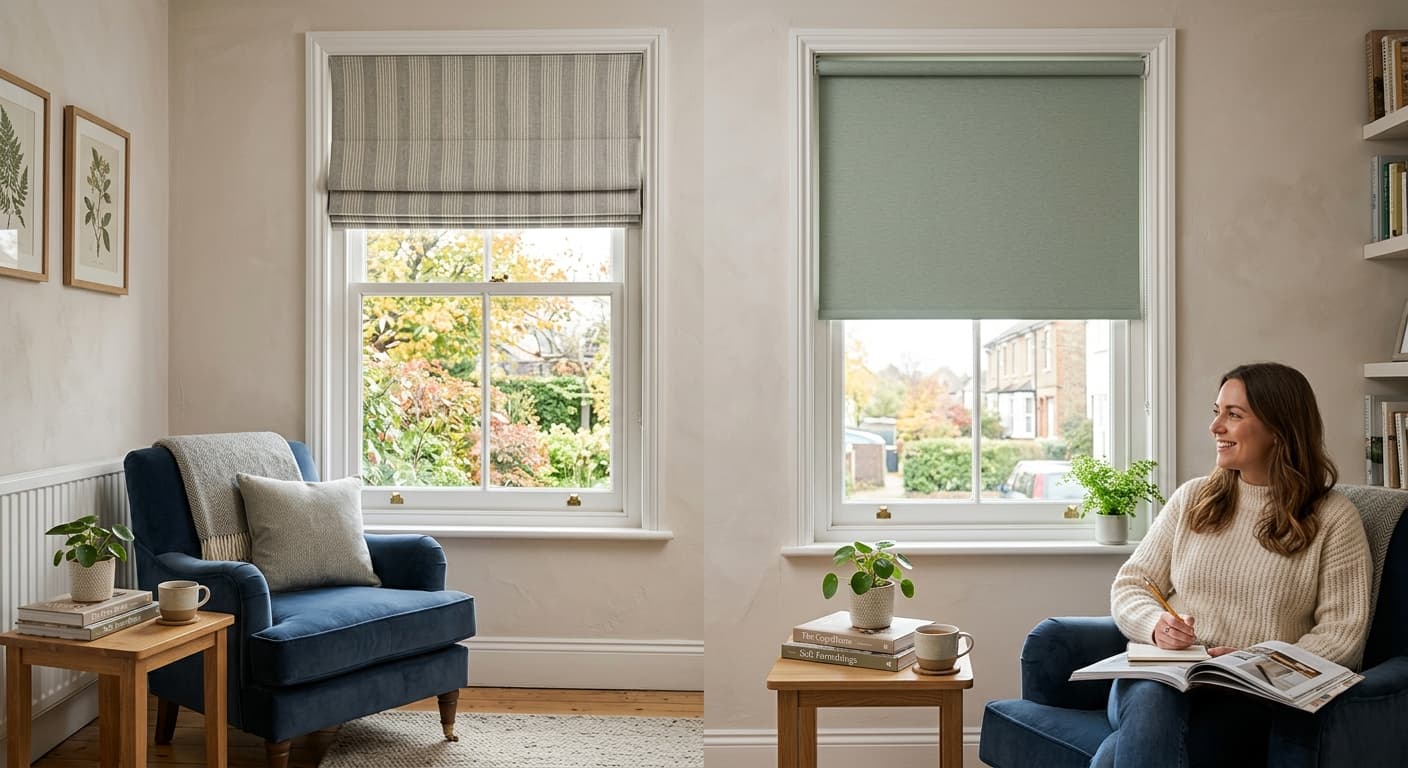
The roman blind vs roller blind comparison comes down to aesthetics, insulation, and budget. Roman blinds create soft, horizontal folds when raised, offering a more luxurious appearance that suits period properties and traditional interiors. They're constructed from fabric that gathers into pleats, providing excellent insulation due to the multiple fabric layers.
Roller blinds operate with a simple mechanism where fabric wraps around a tube. They're brilliant for contemporary spaces, smaller windows, and moisture-prone areas like kitchens and bathrooms. The sleek profile maximises natural light when raised.
For thermal performance, roman blinds win decisively. The pleated fabric creates air pockets that trap heat, reducing window heat loss by approximately 20-25% according to Energy Saving Trust research. Roller blinds offer minimal insulation unless you specify thermal-backed fabrics.
Price differences are significant. Expect to pay £30-£150 for ready-made roller blinds from retailers like Dunelm or John Lewis, whilst made to measure versions cost £60-£200. Roman blinds start at £80 for basic ready-made options, with bespoke versions ranging from £150-£300 per window depending on fabric quality and window size.
Our experience working with soft furnishings specialists in London shows installation costs add £30-£60 per blind for professional fitting, though roller blinds are easier to DIY. Roman blinds require precise tensioning to hang correctly.
How Much Do Made to Measure Curtains Cost?
The made to measure curtains vs ready made cost equation depends on window dimensions, fabric choice, lining requirements, and making fees. Ready-made curtains from high street retailers cost £25-£150 per pair for standard drops (typically 137cm, 183cm, or 229cm). Made to measure curtains typically cost £150-£400 per window.
Breaking down bespoke curtain costs:
- Fabric: £15-£80 per metre (you'll need 2-2.5 times window width for proper fullness)
- Lining: £8-£15 per metre for standard cotton sateen, £12-£20 for thermal interlining
- Making costs: £30-£60 per metre of finished curtain width
- Hardware: £25-£200 for poles, tracks, rings, and finials
For a typical 2-metre-wide window with 2.3-metre drop curtains with pencil pleat heading and thermal lining, expect to pay £250-£450 including making. Luxury fabrics from designers like Sanderson or Designers Guild push costs toward £500-£800 per window.
Regional pricing varies considerably. Specialists in Manchester and Birmingham typically charge 15-25% less than equivalent London services. According to businesses listed on HouseJester, making fees in the capital average £45-£60 per metre versus £30-£45 elsewhere.
Ready-made curtains only work if your windows match standard dimensions. We've seen countless homeowners disappointed when 'near enough' ready-made curtains look budget and ill-fitting. The gap at the sides or puddle at the bottom immediately signals compromise.
What Curtain Fabric Is Best for Insulation?
Identifying the best curtain fabrics for insulation UK homes need involves understanding fabric weight, weave density, and lining options. Heavy, tightly-woven fabrics provide superior thermal performance compared to lightweight sheers or loosely-woven linens.
Top insulating curtain fabrics include:
- Wool blends: Natural insulating properties, typically 450-600gsm (grams per square metre)
- Heavy cotton or cotton-linen unions: Dense weave, 300-450gsm
- Velvet: Pile creates air pockets, 400-500gsm
- Chenille: Textured surface traps air, 350-450gsm
Fabric weight alone doesn't determine performance. A 300gsm tight-weave cotton outperforms a 400gsm loose linen. The weave density matters enormously.
Lining choices dramatically affect insulation. Understanding how to choose curtain lining types makes the difference between curtains that merely decorate and those that genuinely reduce heating bills. Standard cotton sateen lining adds minimal thermal benefit but improves drape and protects face fabric from UV damage.
Thermal lining (aluminium-coated acrylic) reflects heat back into rooms and blocks cold air infiltration. Interlining—a thick, brushed cotton layer inserted between face fabric and lining—provides the ultimate insulation. This three-layer construction can reduce heat loss through windows by up to 25% according to Which? testing.
For rooms facing north or exposed to harsh weather, we recommend interlining. The additional £12-£20 per metre cost pays back through reduced heating bills. South-facing rooms with good double glazing manage fine with thermal lining or even standard lining if you've chosen heavy face fabric.
Building Regulations Part L requires reasonable provision to limit heat loss. Whilst curtains aren't mandated, proper window treatments contribute meaningfully to thermal efficiency, particularly in older properties with single glazing or less efficient double glazing.
Should Curtains Touch the Floor?
Curtains should either just kiss the floor (within 1cm) or break slightly with 2-5cm extra fabric pooling gently. This creates an elegant, considered appearance whilst preventing draughts at the base. Curtains hanging 2-5cm above the floor look unfinished and cheap.
The break (slight pooling) works beautifully in formal rooms like dining rooms and main bedrooms. It suits traditional interiors and luxury fabrics like velvet or silk that benefit from showing their weight and drape. Aim for 3-5cm of extra length.
The 'kiss' method—where curtains just graze the floor—suits contemporary spaces, linen fabrics, and high-traffic areas. It looks clean and intentional without appearing too formal. This requires precise measuring to within 1cm.
Never hem curtains shorter than floor level in living spaces. The only exceptions are kitchens (where floor-length poses hygiene concerns) and bathrooms (moisture issues). Even then, sill-length or just-below-sill looks better than awkward mid-height curtains.
For rooms with radiators beneath windows, curtains should still reach the floor but shouldn't drape over the radiator itself. The curtain pole needs positioning to allow fabric to fall behind or beside the radiator, not covering it. Covering radiators wastes energy and creates fire risks.
How Do I Measure for New Curtains?
Measuring for curtains requires precision. Even 2-3cm errors result in gaps, poor proportion, or curtains that don't meet in the middle. Always measure in three places across the width (left, centre, right) and use the largest measurement.
Width measurement:
- Measure the curtain pole or track, not the window
- For poles, measure the full length including finials if you want curtains to cover them when closed
- For tracks, measure the track length exactly
- Multiply by 2-2.5 for proper fullness (2× minimum for pencil pleat, 2.5× for fuller, more luxurious appearance)
Drop measurement:
- Measure from the bottom of the curtain rings (poles) or top of the track to your desired finishing point
- For floor-length, measure to the floor then add 1cm (kiss) or 3-5cm (break)
- Take measurements at three points across the window
- Use the longest measurement
Common measuring mistakes include measuring the window instead of the pole, forgetting to account for pattern repeats (add 10-20% for large patterns), and not considering how curtain heading styles affect the drop.
We strongly recommend professional measuring for made to measure curtains costing over £300. Most soft furnishings specialists offer measuring services for £30-£60, refundable against orders. This eliminates costly errors.
If measuring yourself, use a metal tape measure (fabric ones stretch), ask someone to help, and write everything down immediately. Photograph your measurements with the tape visible for reference.
What Is the Best Blackout Blind for Bedrooms?
Roller blinds with bonded blackout fabric provide the most effective light blocking for bedrooms, achieving near-total darkness when properly fitted. Blackout roller blinds use three-layer fabric construction: decorative face fabric, blackout core (usually aluminium-coated), and backing fabric.
Quality blackout roller blinds from brands like Luxaflex, Thomas Sanderson, or Bloc Blinds block 95-100% of light. Cheaper alternatives often achieve only 85-90% blocking due to thinner cores or lower-quality bonding. Budget £80-£200 per window for effective made-to-measure blackout rollers.
Roman blinds also work well for bedroom blackout when made with proper blackout lining. The pleated fabric naturally creates better light sealing at the sides compared to flat roller blinds. However, the horizontal folds allow minimal light leakage between pleats. Expect 90-95% light blocking with quality blackout roman blinds.
Fitting method determines real-world performance. Recess-fitted blinds (inside the window opening) always leak light around the edges. Face-fitted blinds (mounted on the wall overlapping the window) provide superior light blocking. For maximum darkness, specify:
- Face-mounted installation with 10-15cm overlap on each side
- Side channels (aluminium tracks that seal the blind edges)
- Cassette headrails that enclose the rolled fabric
- Coordinating blackout curtains for double-layer protection
The combination of blackout roller blinds and heavy lined curtains achieves complete darkness—essential for shift workers, young children, or anyone sensitive to early sunrise during British summer months.
Prices for premium bedroom blackout solutions range from £150 (basic made-to-measure roller blind) to £600+ (roman blind with interlining plus blackout roller blind underneath). We've found the mid-range option—quality blackout roller at £100-£150 with medium-weight curtains at £200-£300—satisfies most homeowners.
Understanding Upholstery Fabric Durability Ratings
Upholstery fabric durability ratings explained: the Martindale rub test measures how many cycles of abrasion fabric withstands before showing wear. This British Standard test (BS EN ISO 12947) predicts real-world longevity.
Martindale ratings guide:
- 10,000-15,000 rubs: Light domestic use (bedroom chairs, occasional seating)
- 15,000-25,000 rubs: General domestic use (dining chairs, home office)
- 25,000-30,000 rubs: Heavy domestic/light contract (family sofas, active households)
- 30,000-40,000+ rubs: Contract use (commercial settings, family homes with children/pets)
For family sofas seeing daily use, specify fabrics rated minimum 25,000 rubs. Performance fabrics from brands like Warwick, Panaz, or Designers Guild contract ranges often exceed 40,000 rubs whilst maintaining aesthetic appeal.
Other durability factors matter beyond Martindale ratings. Pilling resistance, colour fastness (BS EN ISO 105), and fade resistance under UV exposure all affect longevity. Quality upholstery specialists test for multiple performance criteria.
Natural fibres like linen and cotton score lower on Martindale tests but can outlast synthetics when properly maintained. Wool-blend fabrics offer excellent durability (typically 25,000-35,000 rubs) with natural stain resistance. Performance polyesters achieve 40,000+ rubs and suit high-traffic family homes.
When browsing our company directory, ask suppliers about fabric testing certificates and performance specifications. Reputable businesses provide detailed technical information.
Making Your Soft Furnishings Decision
Soft furnishings transform how rooms look, feel, and perform thermally. The decisions between roman blinds vs roller blinds, made to measure versus ready-made, and different fabric qualities all impact your daily comfort and long-term satisfaction.
Start by establishing priorities: aesthetic preferences, budget constraints, thermal requirements, and maintenance expectations. A period cottage near Edinburgh has different needs than a modern Birmingham apartment. Consider your lifestyle honestly.
For quality results, work with experienced professionals. The specialists in our directory bring expertise in measuring, fabric selection, and installation that prevents costly mistakes. Professional advice pays for itself through better fabric choices and perfect fitting.
Budget realistically for quality. Cheap curtains at £50 per pair look it and last 2-3 years. Mid-range made to measure curtains at £250-£400 per window look professional and last 10-15 years with proper care. The annual cost actually favours quality.
Browse soft furnishings businesses on HouseJester to compare specialists in your area, read verified reviews, and request quotes. Whether you're in London, Manchester, or anywhere across the UK, our directory connects you with experienced professionals who'll help you make informed decisions about your home's soft furnishings.
Sources & Further Reading
- Energy Saving Trust - Energy Efficient Windows - Government-backed guidance on reducing heat loss through windows
- Which? - How to Buy the Best Curtains and Blinds - Independent testing and buying advice
- British Blind and Shutter Association - Trade association providing consumer guidance and approved installer directory
This article was created with AI assistance and reviewed by the HouseJester editorial team for accuracy and relevance.
Written by
Sarah Mitchell
Interior Design Editor
Sarah has spent over 12 years covering UK interiors and design trends. She works closely with interior designers and soft furnishings specialists across the country to bring readers expert insights on creating beautiful, functional living spaces.
- Interior Design
- Soft Furnishings
- Paint & Wallpaper
- Lighting