
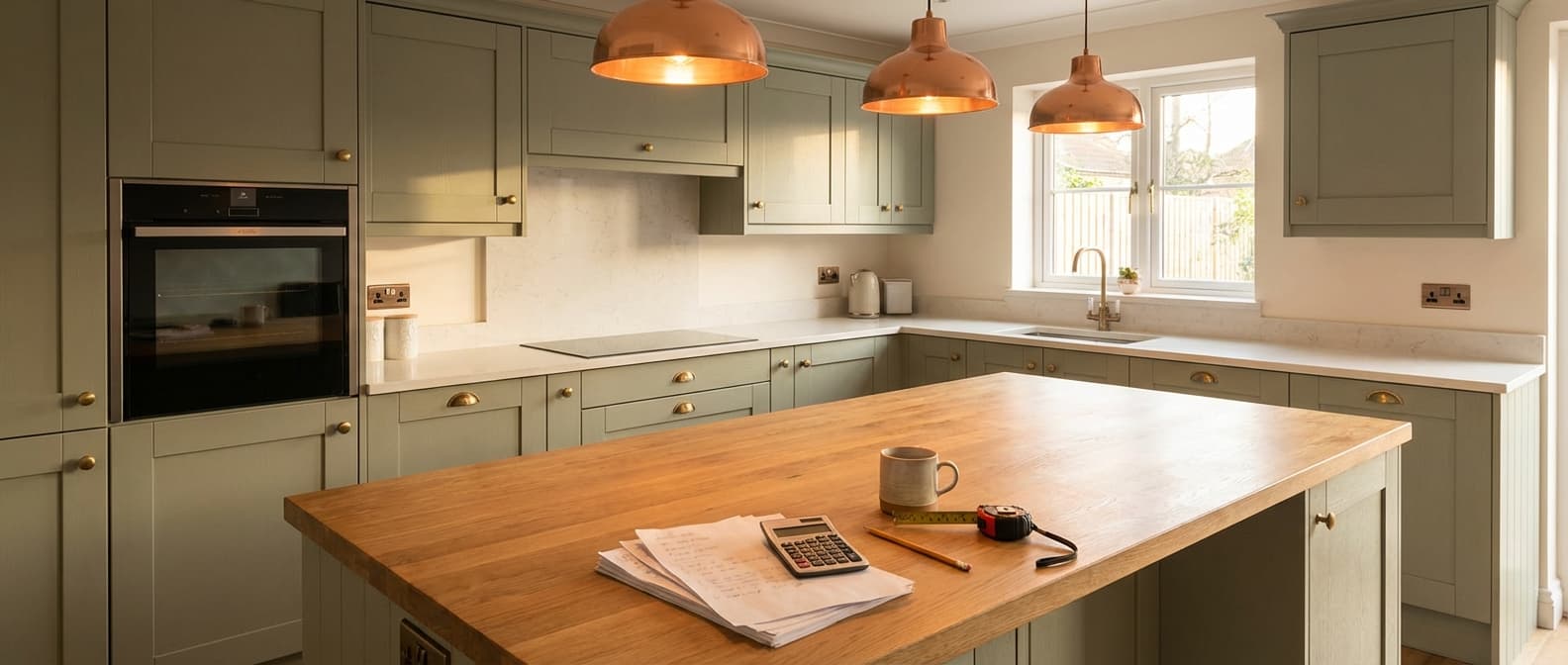
A new fitted kitchen is one of the biggest investments you will make in your home, and the range of prices can be bewildering. A budget renovation can come in under £5,000, while a premium bespoke kitchen can exceed £50,000. The final cost depends on your room size, chosen materials, appliance specification, the extent of structural work, and where in the UK you live. This guide breaks down every element so you can budget realistically and avoid surprises.
Quick Summary: Fitted Kitchen Costs at a Glance
| Tier | Total Cost (Supply & Fit) | Typical Specification |
|---|---|---|
| Budget | £5,000 – £10,000 | Flatpack or rigid carcasses, laminate worktops, basic appliances, standard taps and sinks |
| Mid-range | £10,000 – £25,000 | Painted or vinyl-wrapped doors, quartz or solid-surface worktops, branded integrated appliances, quality hardware |
| Premium | £25,000 – £50,000+ | Bespoke handmade cabinetry, natural stone or Dekton worktops, Miele/Siemens/NEFF appliances, designer lighting, bespoke features |
These figures are for a standard-sized kitchen of approximately 10-15 m² and include supply and installation. They exclude major structural work (removing walls, new floors, replastering).
Detailed Cost Breakdown by Component
Units and Cabinetry
Cabinetry typically accounts for 40-50% of the total kitchen cost. The price depends on construction type, door material, and finish.
| Type | Cost (Supply Only) | Notes |
|---|---|---|
| Flatpack (self-assembly) | £1,500 – £3,000 | Affordable, lighter construction, 15mm carcasses common |
| Rigid pre-assembled | £2,500 – £5,000 | Stronger, faster to install, 18mm carcasses standard |
| Painted MDF doors | £3,000 – £6,000 | Smooth finish, wide colour range, suits traditional and modern styles |
| Vinyl-wrapped doors | £2,000 – £4,000 | Durable, moisture-resistant, realistic woodgrain and matt options |
| Solid wood doors | £5,000 – £10,000+ | Oak, walnut, ash — natural beauty, can be refinished |
| Handleless/true handleless | £3,500 – £8,000+ | Requires precision engineering, contemporary look, 10-20% premium |
Worktops
Worktops are a high-impact, high-use surface. Choose for durability, aesthetics, and maintenance requirements.
| Material | Cost (Supply & Fit per Linear Metre) | Key Characteristics |
|---|---|---|
| Laminate | £50 – £150/m | Affordable, easy to replace, greatly improved quality, not heat-resistant |
| Solid surface (Corian) | £200 – £350/m | Seamless joints, repairable, warm to touch, good range of colours |
| Quartz (engineered stone) | £250 – £450/m | Non-porous, no sealing needed, extremely durable, huge colour range |
| Granite | £300 – £500/m | Natural beauty, unique veining, heat-resistant, needs periodic sealing |
| Marble | £350 – £600/m | Premium aesthetic, softer than granite, stains more easily, high maintenance |
| Dekton/Neolith (sintered stone) | £350 – £550/m | Extremely hard, heat and UV resistant, very low maintenance |
| Solid wood (oak, walnut) | £150 – £300/m | Warm and natural, needs oiling, not suitable near sinks without care |
Appliances
Appliance costs vary enormously by brand and specification. Below are typical ranges for a standard kitchen set (oven, hob, extractor, fridge-freezer, dishwasher).
| Level | Total Appliance Cost | Typical Brands |
|---|---|---|
| Budget | £1,000 – £2,000 | Beko, Indesit, Candy |
| Mid-range | £2,000 – £5,000 | Bosch, AEG, Samsung, Neff |
| Premium | £5,000 – £12,000+ | Miele, Siemens iQ700, Sub-Zero, Wolf |
Individual high-end appliances can significantly increase the total: a Miele built-in oven costs £1,500-£3,000 alone, while a boiling-water tap (Quooker, Grohe Blue) adds £1,000-£2,000.
Installation Labour
| Service | Typical Cost | Duration |
|---|---|---|
| Kitchen fitting (units, worktops) | £1,500 – £3,500 | 3-7 days |
| Plumbing (sink, dishwasher, taps) | £300 – £800 | 1-2 days |
| Electrics (sockets, lighting, hob connection) | £400 – £1,000 | 1-2 days |
| Tiling (splashback and/or floor) | £400 – £1,500 | 1-3 days |
| Plastering (walls and ceiling) | £300 – £800 | 1-2 days |
| Flooring | £400 – £1,500 | 1-2 days |
| Decoration (painting) | £200 – £500 | 1-2 days |
Total labour for a standard kitchen renovation: £3,500-£9,500 depending on the scope and the rates in your area.
Design Fees
| Service | Typical Cost |
|---|---|
| Free high-street design | £0 (included with purchase) |
| Independent kitchen designer | £500 – £2,000 |
| Architect (if structural changes) | £1,000 – £3,000 |
| Structural engineer (if walls removed) | £300 – £800 |
An independent designer can save you money by optimising the layout, specifying more cost-effective alternatives, and avoiding expensive mistakes.
Lighting
| Type | Typical Cost |
|---|---|
| LED downlights (6-8 units) | £200 – £500 |
| Under-cabinet LED strip | £100 – £300 |
| Pendant lights (island/dining) | £50 – £500 each |
| Electrician's labour | £200 – £500 |
Regional Price Variations
Kitchen costs vary significantly across the UK, primarily due to differences in labour rates and property values.
| Region | Labour Cost Index | Total Kitchen Cost Adjustment |
|---|---|---|
| London and South East | Highest | +20-35% above national average |
| South West | Above average | +5-15% |
| Midlands | Average | Baseline |
| North of England | Below average | -5-15% below national average |
| Scotland | Below average | -5-15% |
| Wales | Below average | -5-10% |
| Northern Ireland | Below average | -10-15% |
A kitchen costing £15,000 in the Midlands might cost £18,000-£20,000 in London and £12,500-£14,000 in the North East. Material costs are relatively consistent nationwide; it is labour and overhead costs that drive regional differences.
Hidden Costs to Budget For
Many homeowners are caught out by costs that fall outside the main kitchen quote. Budget an additional 15-20% contingency for the following:
- Structural work: Removing a load-bearing wall requires a structural engineer (£300-£800 for calculations) and steelwork installation (£1,000-£3,000 depending on the span). Building Regulations approval is required.
- Waste disposal: Removing and disposing of an old kitchen costs £200-£500 for skip hire and removal.
- Temporary kitchen: If you cannot use the kitchen for 2-4 weeks, a microwave, kettle, and portable hob are essential. Budget £50-£150 for temporary arrangements.
- Building Control: If structural changes are made, a Building Control inspection and sign-off is required (£200-£500 through your local authority or an approved inspector).
- Asbestos: Homes built before 2000 may have asbestos in floor tiles, textured coatings, or pipe insulation. Professional asbestos removal costs £500-£2,000.
- Damp or rot: Older properties may reveal damp or rotten timber once units are removed. Remediation costs vary but budget £500-£2,000 as a precaution.
- Boiler relocation: Moving a boiler to accommodate the new kitchen layout costs £500-£1,500.
- Upgraded consumer unit: Older homes may need a consumer unit (fuse board) upgrade to accommodate additional kitchen circuits (£300-£600).
How to Save Money on a New Kitchen
- Keep the existing layout: Relocating plumbing and electrics adds £1,000-£3,000 to the project. If the current layout works, refresh rather than reconfigure.
- Replace doors, not carcasses: If your existing carcasses are solid (check for 18mm thickness and firm fixing), new doors, worktops, and handles can transform the look for 40-60% less than a full replacement.
- Mix splurge and save: Invest in the elements you touch every day (worktops, taps, drawer runners) and save on less visible items (carcass material, plinths, cornices).
- Choose quartz over granite: Quartz is typically 10-20% cheaper than granite, requires no sealing, and offers a wider colour range.
- Buy appliances separately: Shop sales and cashback deals independently rather than buying through the kitchen company. Black Friday and January sales offer significant discounts on branded appliances.
- Consider ex-display kitchens: Showroom display kitchens are sold at 40-70% discounts when showrooms are refreshed. The units are typically in excellent condition.
- Get multiple quotes: Always obtain at least three itemised quotes from companies listed on HouseJester to ensure competitive pricing.
- Phase the work: If budget is tight, complete the kitchen installation first and add upgrades (lighting, tiling, appliance upgrades) over time.
Future Homes Standard: Implications for Kitchen Renovations in 2026
The Future Homes Standard, which takes full effect from 2025-2026, is primarily aimed at new-build homes but is influencing renovation choices across the UK:
- Induction over gas: New-build homes will not have gas connections. Even in existing homes, the shift towards induction hobs is accelerating. Induction requires a dedicated 32A electrical circuit — check that your consumer unit can accommodate this. Installation of a new circuit costs £150-£300.
- Energy-efficient appliances: Specifying A-rated or better appliances reduces energy consumption and aligns with the Standard's goals. An A-rated dishwasher uses 30-50% less energy than a D-rated model over its lifetime.
- Ventilation: The Standard requires improved ventilation in kitchens. Consider a higher-specification extractor or mechanical ventilation with heat recovery (MVHR) if undertaking significant renovation work.
- LED lighting: LED lighting throughout the kitchen is now standard practice. Tuneable LED strip under cabinets provides both task lighting and adjustable ambience.
- Sustainable materials: FSC-certified timber carcasses, recycled-content worktops, and low-VOC finishes contribute to healthier indoor environments and responsible sourcing.
- Water efficiency: Low-flow taps (6-8 litres per minute vs 12+ for standard taps) and efficient dishwashers reduce water consumption.
Even if your existing home is not subject to the Standard, adopting these principles future-proofs your kitchen investment, may improve your EPC rating, and can reduce long-term running costs.
Frequently Asked Questions
What is the average cost of a fitted kitchen in the UK?
The average UK kitchen renovation costs approximately £10,000-£15,000, according to industry surveys. This typically includes mid-range units with quartz worktops, branded appliances, and professional installation. However, the range is wide — from under £5,000 for a budget refresh to over £50,000 for a bespoke premium kitchen. The most important factor is setting a realistic budget based on your priorities and getting itemised quotes to compare like-for-like.
How long does a kitchen renovation take from start to finish?
From first consultation to completion, a typical mid-range kitchen renovation takes 8-16 weeks. This breaks down as: design and planning (2-4 weeks), manufacturing and lead times (4-8 weeks for made-to-order kitchens), and installation (1-3 weeks on site). Stock kitchens can be ready much faster — some high-street brands offer 2-week delivery. The installation itself typically takes 5-10 working days for a straightforward replacement, or 2-4 weeks if structural work is involved.
Should I hire an independent kitchen designer?
An independent designer (£500-£2,000) is worth considering for larger or more complex projects, particularly if structural changes are involved. They work for you rather than a specific manufacturer, so their recommendations are impartial. They can often access trade discounts that offset their fee. For a straightforward kitchen replacement with no layout changes, the in-house design service offered by most kitchen companies is usually sufficient and is included in the price.
Can I claim any grants or tax relief for a kitchen renovation?
Standard kitchen renovations do not qualify for grants or tax relief. However, if you are installing energy-efficient measures as part of the renovation (upgraded insulation, energy-efficient appliances, improved ventilation), some elements may qualify under government energy efficiency schemes. The ECO4 scheme and the Great British Insulation Scheme focus on whole-house energy efficiency but may contribute if your renovation includes insulation improvements. VAT is charged at the standard rate (20%) on kitchen renovations; reduced VAT rates do not apply to kitchen work specifically.
Will a new kitchen add value to my house?
A modern, well-designed kitchen is one of the most effective ways to add value to a property. Estate agents estimate that a new kitchen can add 5-10% to a home's value, with a typical return on investment of 60-80%. A £15,000 kitchen in a property valued at £300,000 could add £15,000-£30,000 to the sale price. The kitchen should be appropriate for the property — over-specifying a luxury kitchen in a modest home yields diminishing returns. Focus on quality rather than luxury, and choose timeless design over fashion-led trends.
Get Quotes from Trusted Kitchen Companies
Ready to start your kitchen project? Browse verified kitchen companies on HouseJester, compare portfolios and reviews, and request quotes from multiple specialists to find the right company for your budget and vision. Our directory features rated and reviewed kitchen companies across the UK, from local independent fitters to national brands.
This article was created with AI assistance and reviewed by the HouseJester editorial team for accuracy and relevance.
